Hello! Welcome to your fourth lesson in the "Training AI for Dental Vision" module.
In our previous lesson, we outlined the entire workflow of creating a dental AI model, from collecting radiographs to the iterative training process. We briefly touched on the idea of testing a model on data it has never seen before. Today, we're going to dive deep into that critical concept.
This lesson will focus on how a dataset is strategically divided to ensure the final AI model is not just accurate in a lab but also reliable and trustworthy for clinical use. You'll learn the answer to the crucial question: "How do developers know the model really works?"
This directly addresses our learning outcome for today: Explain the distinct roles of training, validation, and testing datasets in developing a reliable AI model.
The Problem with Memorization
Imagine you're preparing for a board exam. The examiners give you a set of 1,000 practice questions. You study them relentlessly until you can answer every single one perfectly. Does that mean you've mastered dentistry?
Not necessarily. You might have just memorized the answers to those specific questions. The true test of your knowledge comes when you face the actual board exam, which contains questions you've never seen before.
AI models face the exact same issue. If we train and test a model on the same data, it might just "memorize" the answers. We wouldn't know if it has genuinely learned to identify disease or if it has simply memorized the features of the images it was shown.
To solve this, developers split their data into three distinct sets, each with a very specific job.
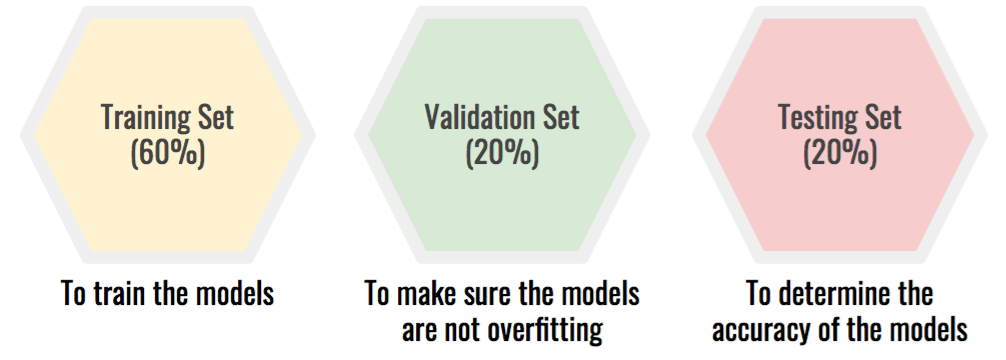
Let's break down the role of each set.
1. The Training Set: The Textbook
The training set is the largest portion of the data, typically 60-80% of the total dataset. This is the "textbook" the AI model studies. During the training process you learned about in the last lesson, the model repeatedly cycles through these images, making predictions, comparing them to the expert labels (the ground truth), and adjusting its internal parameters to reduce errors.
- Purpose: To allow the model to learn the patterns, features, and relationships in the data.
- Analogy: The set of practice questions and answers you study from.
Performance on the training set tells us if the model is capable of learning. But high performance here doesn't guarantee success in the real world, due to the risk of memorization, also known as overfitting.
2. The Validation Set: The Mock Exam
After the model has studied the training set, how do developers refine it? They can't use the final exam questions to guide them—that would be cheating. Instead, they use a validation set (or "dev set"), which is about 10-20% of the data.
This video provides an excellent analogy to understand why this separate set is so crucial.
Validation data: How it works and why you need it - Machine Learning Basics Explained
The video 'Validation data: How it works and why you need it' from Galaxy Inferno Codes uses a simple analogy of a teacher preparing students for a competition to explain the roles of the three datasets. It's perfect for understanding the 'why' behind this process.
Watch from the beginning to 03:16. Pay close attention to the distinction between the questions the students study (training), the new questions the teacher uses to pick the best student (validation), and the final competition (testing).
As the video explains, the validation set has two main purposes:
-
To Prevent Overfitting: An overfit model is one that has learned the training data too well, including its noise and random quirks. It performs brilliantly on the training data but fails on new, unseen data. It's like the student who memorized the practice questions but didn't understand the underlying concepts. By checking the model's performance on the validation set during training, developers can see if the model is starting to overfit and can stop the training or make adjustments.
-
To Tune the Model: AI developers often try several different model architectures or settings (e.g., how complex should the neural network be?). They train each version on the training set and then see which one performs best on the validation set. The validation set acts as a neutral judge to help them select the best-performing model to move forward with. This is often called "hyperparameter tuning."
The overall workflow looks like an iterative loop:

3. The Test Set: The Final Board Exam
Once the developer has used the validation set to select and finalize their best model, it's time for the final judgment. The test set, the remaining 10-20% of the data, is brought out.
Crucially, the test set has been locked away and completely untouched throughout the entire development process. The model has never seen these images before.
Validation data: How it works and why you need it - Machine Learning Basics Explained
Let's continue with the 'Validation data' video to understand the sanctity of the test set.
Watch from 03:16 to the end (05:37). Focus on why the test set is the 'true final performance' and the concept of 'data leakage'—why you can't adjust your model based on test results.
As you just saw, the test set serves one, and only one, purpose:
- Purpose: To provide a final, unbiased estimate of how the model will perform on new, real-world data.
The performance metrics (which we'll cover in the next module) calculated on this test set are the numbers that matter most to you as a clinician. They are the results reported in scientific papers and submitted to regulatory bodies like the FDA. If a model performs well on the test set, we can be much more confident that it has truly learned to generalize and will be useful in practice.
A Real-World Dental Example
This might seem abstract, so let's look at how this is done in a published dental AI study. The following paper developed an AI to assess periodontal disease from panoramic radiographs.
Development and validation of artificial intelligence models for ...
This research article, 'Development and validation of artificial intelligence models for automated staging and grading of periodontitis,' provides a perfect, real-world example of these concepts in action.
First, read the 'Dataset splitting' subsection under 'AI model development.' It's a short paragraph that gives the exact numbers. Then, read the first two paragraphs of the 'Discussion' section. Notice how the authors emphasize the importance of their independent test set and even critique another study for not using one.
From that paper, you can see the concrete application of these principles:
- The Split: The researchers used 500 radiographs and split them: 375 for training (75%), 75 for validation (15%), and 50 for testing (10%).
- The Result: They report that the model's performance was excellent, but they note a slight, expected drop in performance when moving from the validation set to the independent test set.
- The Justification: Most importantly, they highlight that their evaluation on an independent test set provides stronger evidence of the model's ability to generalize to new patients compared to studies that only report validation results. They correctly point out that relying only on validation data can lead to an overestimation of performance.
This is a critical insight for you as a future consumer of AI research. When you read a paper, one of the first things you should look for is whether the authors evaluated their model on a truly independent test set.
Conclusion
Understanding the distinction between training, validation, and testing data is fundamental to critically appraising any AI tool. It's the core methodology that separates a fragile lab experiment from a robust clinical tool.
Key Takeaways:
- Training Set: The 'textbook' used by the model to learn.
- Validation Set: The 'mock exam' used by developers to tune the model, compare different versions, and prevent overfitting.
- Test Set: The 'final board exam'—unseen data used only once to get an unbiased measure of the final model's real-world performance.
- The three-way split is the standard for developing reliable AI. The performance on the test set is the most credible and important result for a clinician.
In our next lesson, we'll move from how a model is built and tested to what it tells you. We will learn to interpret the common output formats of a dental AI model, such as probability scores, bounding boxes, and segmentation masks.