Hello! Welcome to the final lesson in our module on AI in advanced diagnostics.
In our last session, we explored the exciting potential of AI for oral cancer screening using clinical photographs, seeing how it can make detection more accessible and objective. We touched on the idea that AI is a powerful assistant, but not a perfect one.
Today, we'll take a closer look at the other side of the coin. The goal of this lesson is to discuss the current challenges and limitations of AI in soft tissue and pathology assessment. While AI's promise is significant, its path into routine clinical practice is filled with hurdles. Understanding these limitations is just as important as knowing the benefits, as it will equip you to be a critical and informed user of this technology.
We will group these challenges into three main areas:
- Data-Related Challenges: Issues stemming from the data used to train AI.
- Technical and Algorithmic Limitations: Inherent weaknesses in how current AI models work.
- Clinical, Ethical, and Regulatory Hurdles: The real-world barriers to implementation.
1. The Data Problem: "Garbage In, Garbage Out"
The performance of any AI model is fundamentally tied to the data it was trained on. In medicine, and especially in a specialized field like oral pathology, getting the right data is a massive challenge.
Let's begin by reading an excellent summary of these challenges from a recent review paper.
Current AI Applications and Challenges in Oral Pathology - PMC
The paper 'Current AI Applications and Challenges in Oral Pathology' provides a focused overview of the hurdles in this specific field. We'll read the section dedicated to these challenges.
Please read Section 4, titled 'Challenges of AI in Oral Pathology'. This section covers data quality, generalization, legal/ethical issues, and more. Focus on understanding the core ideas behind each subsection.
The reading you just completed highlights several critical issues. Let's break down the two most significant data-related problems: data scarcity and data bias.
A. Data Scarcity and Quality
As the paper mentions, AI models require large, high-quality, and accurately labeled datasets to learn effectively. This presents a few problems in oral pathology:
- Rarity of Disease: While we want AI to be good at detecting rare and aggressive cancers, there are, by definition, fewer examples of these cases to train the model on compared to common benign conditions.
- Variability: Images can look different due to variations in tissue staining, slide preparation, or the camera and lighting used for clinical photos. An AI trained on perfectly prepared slides from one lab may perform poorly on slides from another.
- The Annotation Bottleneck: Every image in the training set must be meticulously labeled by expert pathologists (e.g., outlining a tumor, classifying a lesion). This is an incredibly time-consuming and expensive process, creating a major bottleneck in developing new models.
B. Data Bias and Generalizability
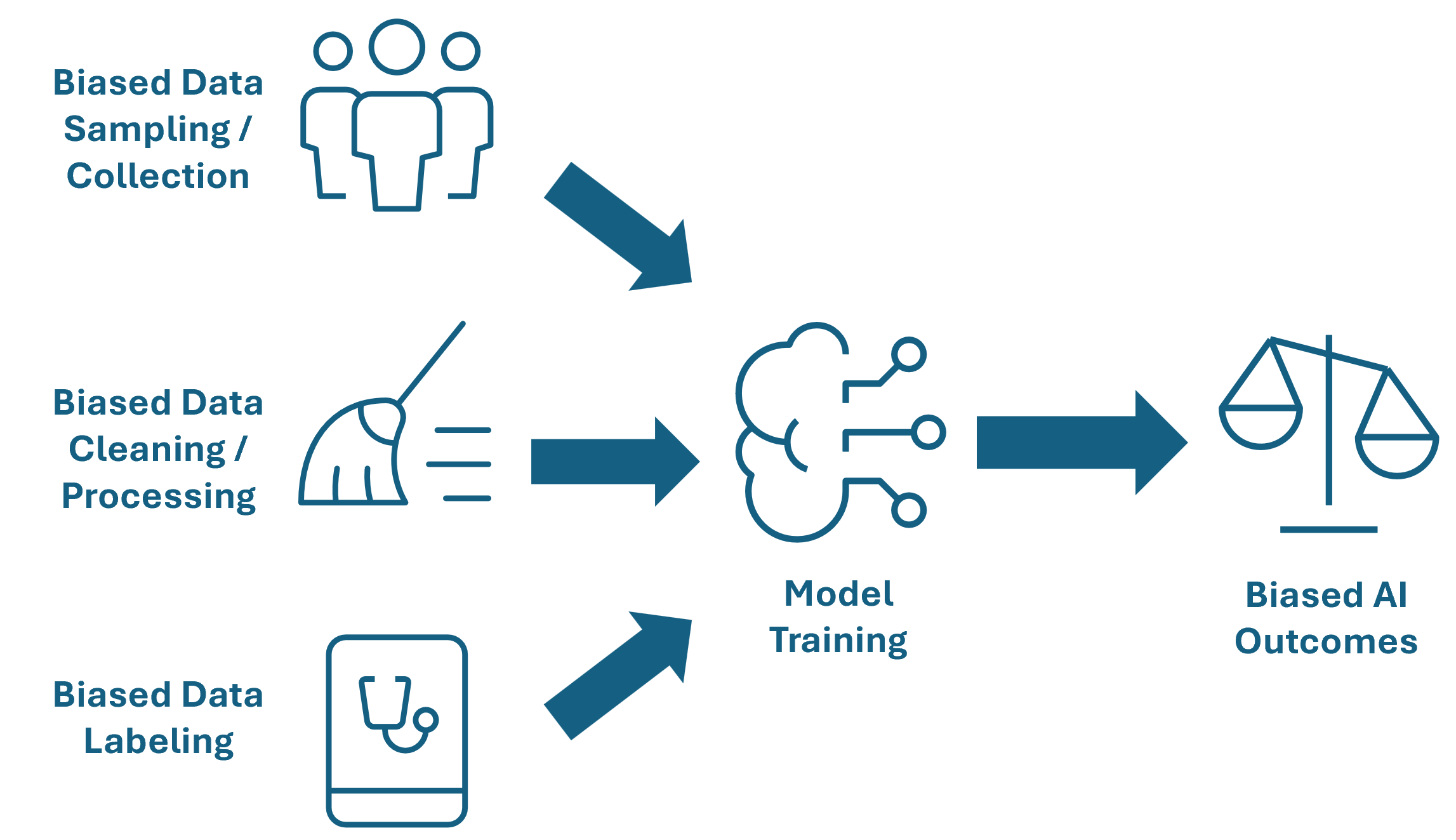
This is perhaps the most critical limitation. An AI model will only be as unbiased as the data it learns from.
This flowchart clearly illustrates how bias can be introduced at every step of the data preparation pipeline, ultimately leading to skewed AI results.
To see a powerful real-world analogy for this, let's watch a short segment from a TEDx talk.
Artificial intelligence in healthcare: opportunities and challenges | Navid Toosi Saidy | TEDxQUT
In this clip from his TEDx talk 'Artificial intelligence in healthcare', Navid Toosi Saidy uses a very clear example from dermatology to explain the danger of biased training data.
Watch the section from 05:59 to 06:54. The speaker discusses how a skin cancer detection app trained predominantly on one demographic might fail on others. This is directly analogous to the challenges in oral pathology.
The skin cancer example perfectly illustrates the problem of generalizability. An AI model for detecting oral lesions trained primarily on data from a single country or demographic might have dangerously low accuracy when used on patients from different ethnic backgrounds, who may present with different clinical manifestations. This lack of generalizability means that a model that performs well in a lab study may not be reliable in your diverse clinical practice.
2. Technical and Algorithmic Limitations
Beyond the data itself, there are limitations in the very nature of today's AI algorithms.
A. The "Black Box" Problem
As we've discussed, many deep learning models operate as "black boxes." They give you an answer, but they don't explain their reasoning. In the previous lesson, we saw how Explainable AI (XAI) with heatmaps tries to solve this. However, for many systems, this level of transparency is still limited. For a clinician making a life-altering diagnosis, trusting a recommendation without understanding the "why" is a major barrier to adoption.
B. Difficulty with Ambiguity and Uncertainty
Clinicians are trained to handle uncertainty. You can say, "This looks suspicious, but I'm not 100% sure. Let's get a biopsy and a second opinion." Most AI models can't do this.
Let's return to the same TEDx talk to hear this point explained.
Artificial intelligence in healthcare: opportunities and challenges | Navid Toosi Saidy | TEDxQUT
The speaker goes on to highlight another critical technical gap in current AI models.
Please watch the clip from 06:54 to 07:34. Focus on the concept that AI models currently lack the ability to say 'I don't know' or express when their confidence is low due to skewed data.
This is a profound limitation. An AI might provide a high-confidence prediction of "benign" for a rare lesion simply because it has never seen anything like it before and is matching it to the closest (but incorrect) examples in its training data. The inability to express uncertainty is a significant safety concern.
C. Weakness with Fine-Grained Features
AI models, particularly in oral pathology, can sometimes struggle with tasks that require identifying very subtle, fine-grained features. For example, a study might report high accuracy in distinguishing between healthy tissue and advanced cancer, but the same model might have very low sensitivity for detecting high-grade dysplasia—the critical precursor lesion where intervention matters most. This is because the visual cues for early-stage disease are much more subtle and complex.
3. Clinical, Ethical, and Regulatory Hurdles
Finally, even a technically perfect, unbiased AI faces significant challenges to being used in a real clinic.

Let's break these down:
- Regulation & Ethics: As the TEDx talk LINK also pointed out (03:32 - 05:15), regulatory bodies like the FDA traditionally approve medical devices that are static. But the whole point of AI is to learn and adapt. This has led to a "locked algorithm" problem, where an AI model is not allowed to be updated with new data after it's approved, preventing it from getting smarter and potentially causing it to become outdated.
- Liability: As the paper "Artificial Intelligence in Dentistry: A Narrative Review" discusses, if an AI contributes to a misdiagnosis, who is responsible? Is it the clinician who used the tool, the hospital that bought it, or the company that developed it? This legal gray area makes many institutions hesitant to adopt AI for high-stakes decisions.
- Cost & Accessibility: Implementing a digital pathology workflow and purchasing AI software licenses can be prohibitively expensive, especially for smaller clinics.
- Paradigm Shift: Integrating AI requires a change in how pathologists and dentists work. It involves building trust in a new kind of tool and adapting clinical workflows, a transition that often meets with resistance.
Conclusion
Today, we've taken a crucial, critical look at the road ahead for AI in oral pathology. While the potential we saw in the last lesson is real, the challenges are equally significant.
Key Takeaways:
- Data is the Foundation and the Bottleneck: AI is critically dependent on large, diverse, high-quality, and expertly-labeled datasets, which are difficult to create in oral pathology.
- Bias is a Major Risk: Models trained on non-representative data can perform poorly on different patient populations, creating serious risks for health equity.
- Technical Gaps Remain: The "black box" nature of some models, and their inability to express uncertainty, limits clinical trust and safety.
- Real-World Hurdles are High: Legal, regulatory, financial, and workflow challenges must be solved before AI can be widely and responsibly integrated into clinical practice.
Understanding these limitations does not mean dismissing AI. Instead, it positions you as a future clinician who can ask the right questions, critically evaluate new tools, and advocate for the development of AI that is not only powerful but also safe, fair, and transparent.
Preview of the Next Module
We have now completed our module on AI in advanced diagnostics. We've seen its power in suggesting differential diagnoses and screening for cancer, but also its significant limitations.
In our next module, we will shift gears from diagnostics to AI-Assisted Treatment Planning. We'll begin by exploring a very successful and widely adopted application of AI: the automation of cephalometric landmark identification for orthodontics. This will provide a fascinating contrast, showcasing an area where AI's role is less about high-stakes diagnosis and more about improving efficiency and consistency in a routine clinical task.