Hello! Welcome back.
In our last lesson, we explored how to use open-ended and closed-ended questions to act as the "gas pedal" and "steering wheel" of a conversation, giving you control over its flow and direction. You learned the Funnel Technique for moving from broad exploration to specific understanding.
Today, we'll build on that foundation to manage the depth of your conversations. Your goal is to build deeper bonds, and that requires moving beyond surface-level exchanges. This lesson focuses on exactly that. Our learning outcome is to transition from small talk to meaningful conversation using depth-building questions.
We'll explore why small talk can feel draining (especially for introverts), and how to skillfully pivot towards more rewarding, substantive topics that spark genuine connection.
From Small Talk to "Big Talk"
Most conversations follow a natural progression. We start with pleasantries, move into small talk, and, if the conditions are right, we can transition into more meaningful "big talk."
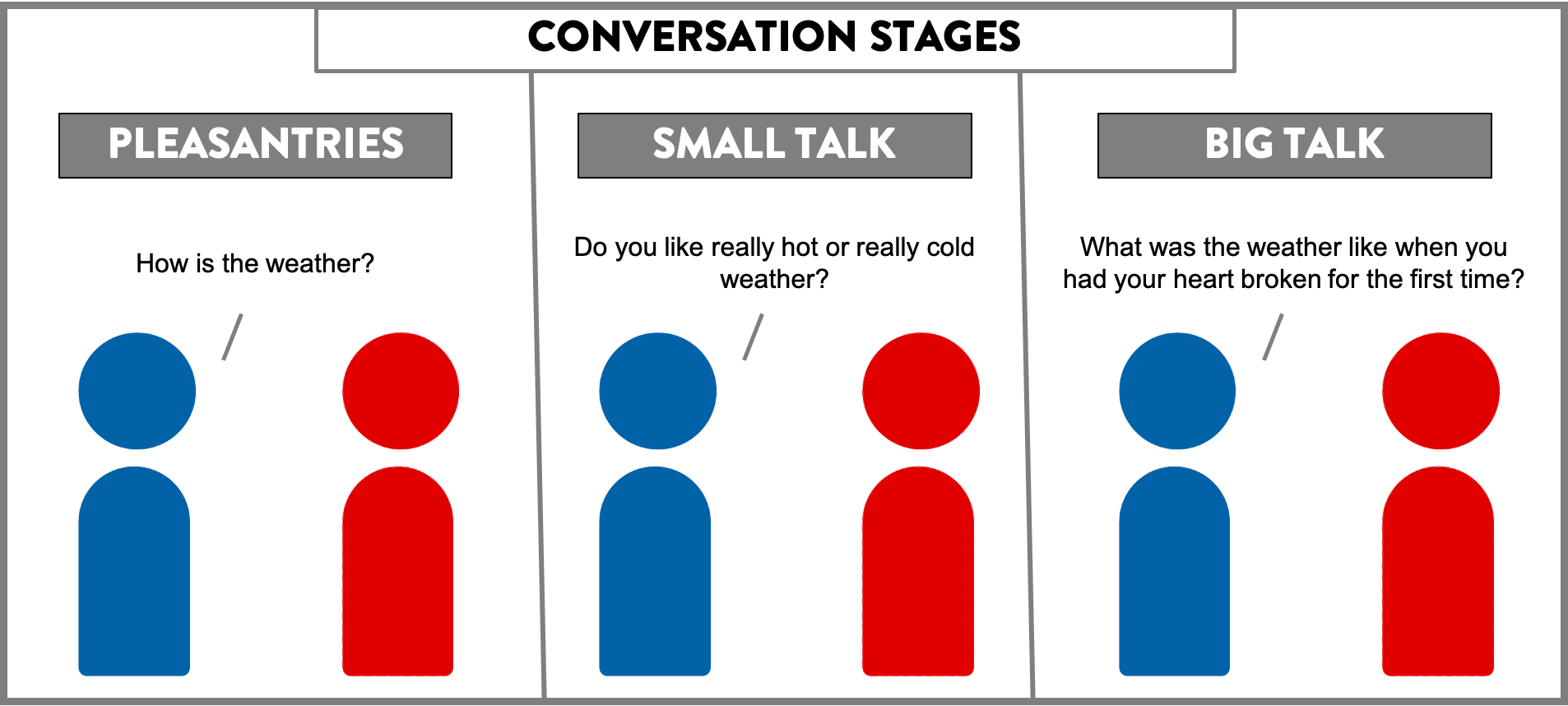
Small talk isn't useless. As we've discussed, it's a vital social lubricant that builds initial comfort and rapport. The article "How to have more meaningful conversations" reinforces this idea.
How to have more meaningful conversations
Let's start by framing the role of small talk correctly. Please read a brief section from the Psyche article, 'How to have more meaningful conversations,' which describes it as a necessary first step.
Please read the section titled 'Recognise small talk as a necessary first step'. Notice the analogy of small talk being the 'inactive ingredient' that holds the medicine together.
The key is not to get stuck in small talk. The goal is to use it as a launchpad. To do that, we first need to understand what we're aiming for.
The Anatomy of a Deeper Conversation
Why do some conversations feel engaging while others fall flat? It often comes down to the type of conversation we're having. A fact-based discussion about the weather feels very different from an emotional one about a personal challenge.
Journalist Charles Duhigg explains that most discussions contain three potential layers: the practical ("what is this about?"), the emotional ("how do we feel?"), and the social ("who are we to each other?"). Meaningful connection happens when both people are engaging on the same layer, often the emotional or social one.
The science behind dramatically better conversations | Charles Duhigg | TEDxManchester
In this TEDx talk, Charles Duhigg breaks down the different types of conversations happening simultaneously within any discussion. This framework is key to understanding why simply exchanging facts often fails to create a bond.
Watch from 02:12 to 03:29. Focus on the distinction between practical, emotional, and social conversations. Think about a recent conversation you had and try to identify which of these layers were present.
Transitioning to a deeper conversation, therefore, means inviting the other person to shift from the practical layer to the emotional or social layer. The tool for this invitation is the depth-building question.
The What and How of Depth-Building Questions
A depth-building question—or "deep question"—invites a person to share their experiences, feelings, beliefs, or values. It shifts the focus from the facts of their life to their relationship with those facts.
Let's watch Duhigg introduce this concept.
The science behind dramatically better conversations | Charles Duhigg | TEDxManchester
Continuing with the same TEDx talk, Charles Duhigg now explains what a 'deep question' is and provides some excellent examples.
Watch from 04:01 to 05:05. Note the key distinction he makes: 'Instead of asking about the facts of someone's life, we should ask them how they feel about their life.'
This is the central principle. You take a standard small-talk topic and reframe your question to target emotion, motivation, or experience.
Clinical psychologist Dr. Thomas Smithyman provides a fantastic guide on exactly how to make this transformation.
Master The Art Of Conversation (Using Psychology)
This video offers highly practical, before-and-after examples for converting common, boring small-talk questions into engaging, depth-building ones.
Watch from 01:32 to 05:01. Pay close attention to the specific rephrasing of questions about where someone is from, what they do, and where they live. The goal is to get them telling a story or revealing a motivation.
Let's consolidate these ideas into a repeatable formula:
- "Where are you from?" → "What was it like growing up there?" (Invites storytelling and memory)
- "What do you do?" → "How did you get into that line of work?" or "What's the most rewarding part of your job?" (Explores motivation and values)
- "Have you seen [Movie]?" → "What did you think of [Movie]?" (Shifts from a closed yes/no to an open opinion)
Another powerful category of depth-building questions focuses on positive emotions and anticipation. These are low-pressure and often make people feel good.
5 Ways for Introverts to Turn Small Talk Into 'Deep' Talk
The article '5 Ways for Introverts to Turn Small Talk Into 'Deep' Talk' offers some great examples of questions designed to 'spark joy.'
Read point #3, 'Ask questions that spark joy, like “What is something you’re looking forward to doing?”' This is a great technique for building positive energy in a conversation.
Examples like "What are you excited about this week?" or "What's the best thing that happened to you today?" are excellent for lifting the conversational mood and opening the door to more personal topics.
Test your understanding!
You're talking to an acquaintance at a party. They mention, "I'm thinking of learning how to play the guitar."
Instead of a simple "Oh, cool" or "What kind of guitar?", formulate a depth-building question that targets one of the following:
- Their motivation.
- Their emotional vision for the future.
- A past experience related to it.
Show answer
Here are some possible answers:
- Motivation: "That's fantastic. What's making you want to pick it up now?"
- Emotional Vision: "I love that. What kind of music do you dream of being able to play?"
- Past Experience: "Have you always wanted to play? What’s your earliest memory connected to guitar music?"
Notice how all of these invite a much richer response than a factual question.
Reading the Road: Cues, Pacing, and Reciprocity
Asking a great question is only half the battle. A charismatic communicator is also attuned to the response and the overall dynamic of the conversation.
1. Look for the "Light Up"
How do you know when you've hit a topic worth exploring? Look for signs of emotional engagement. The person may lean in, their facial expression may become more animated, or they might start speaking faster and more freely. Dr. Smithyman calls this the moment they "light up."
Master The Art Of Conversation (Using Psychology)
Let's return to Dr. Smithyman's video to learn about identifying the right moments to go deeper. This is crucial for improving your ability to read audience responses.
Watch the segment from 05:01 to 09:24. Focus on the concept of looking for when someone 'lights up' and the advice to 'dig deeper' when you see that cue. This is a direct, practical way to read non-verbal signals.
When you see this sign, it's a green light to ask curious follow-up questions: "That sounds fascinating, tell me more about that," or "What was that experience like?"
2. Avoid the Interrogation: The Importance of Sharing
A conversation is a two-way street. If you only ask questions, even great ones, it can start to feel like an interview or an interrogation. To build a true connection, you must also be willing to share. This is known as the principle of reciprocity and self-disclosure.
How to have more meaningful conversations
The Psyche article explains this dynamic of 'mutual, escalating self-disclosure' beautifully.
Read the section titled 'Be willing to share something about yourself'. The analogy of peeling an onion is a powerful way to think about gradually building intimacy.
This doesn't mean you have to reveal your deepest secrets. It can be as simple as sharing a related, brief personal anecdote.
- Them: "...and that's what was so rewarding about finally finishing the project."
- You: "I know that feeling. It reminds me of a smaller-scale project I worked on last year, and the sense of relief at the end was immense. So, what's next for you now that it's done?"
This shows you're not just a passive listener but an active, relatable participant. Since thinking of stories on the spot can be stressful, it helps to be prepared.
5 Ways for Introverts to Turn Small Talk Into 'Deep' Talk
The 'Introvert Dear' article has a great tip for managing the pressure of sharing in the moment.
Read point #4, 'Have three good stories ready...' This is an excellent strategy for reducing in-the-moment anxiety and ensuring you can contribute to the conversation's depth.
Conclusion
You now have a powerful set of tools to guide conversations from the shallow end to the deep end. By moving beyond facts and asking about feelings, experiences, and motivations, you invite genuine connection and create the more meaningful interactions you're seeking.
Key Takeaways:
- Small talk is a necessary bridge. Use it to establish rapport before attempting to go deeper.
- Transition to depth by asking about experiences, not just events. Shift from "what" to "what was it like," "how did it feel," and "why did you choose that?"
- Look for the "light up." When someone shows emotional engagement with a topic, that's your signal to ask follow-up questions and explore it further.
- Practice reciprocity. A deep conversation is a dance, not an interrogation. Balance your questions with your own brief, relevant self-disclosures to build mutual trust.
Preview of the Next Lesson:
In this lesson, we focused on formulating the right questions to build depth. In our next lesson, we'll learn how to identify and use conversational hooks in others' responses to extend dialogue. You'll learn to spot the natural entry points in what someone says, making the transition to your depth-building questions feel even more seamless and organic.