Hello! Welcome back to our module on "Conversation Mechanics."
In our last lesson, we focused on the IFR method (Introduce, Find common ground, Relate) to build initial rapport. A key part of that process, especially for finding common ground, was asking deeper, more open questions. We saw how a question like "What was it like growing up there?" is far more effective than "Where are you from?"
Today, we're going to expand on that idea and give you precise control over the dynamics of a conversation. Our learning outcome is to strategically use open-ended vs. closed-ended questions to manage conversational flow.
Think of these two question types as the gas pedal and the steering wheel of a conversation. One pushes it forward and opens it up, while the other guides it, confirms direction, and allows you to make precise turns. Mastering both is essential for becoming a more agile and charismatic communicator, which aligns directly with your goals.
The Two Essential Tools: Open vs. Closed Questions
At the most fundamental level, questions can be sorted into two categories based on the type of answer they are designed to elicit.
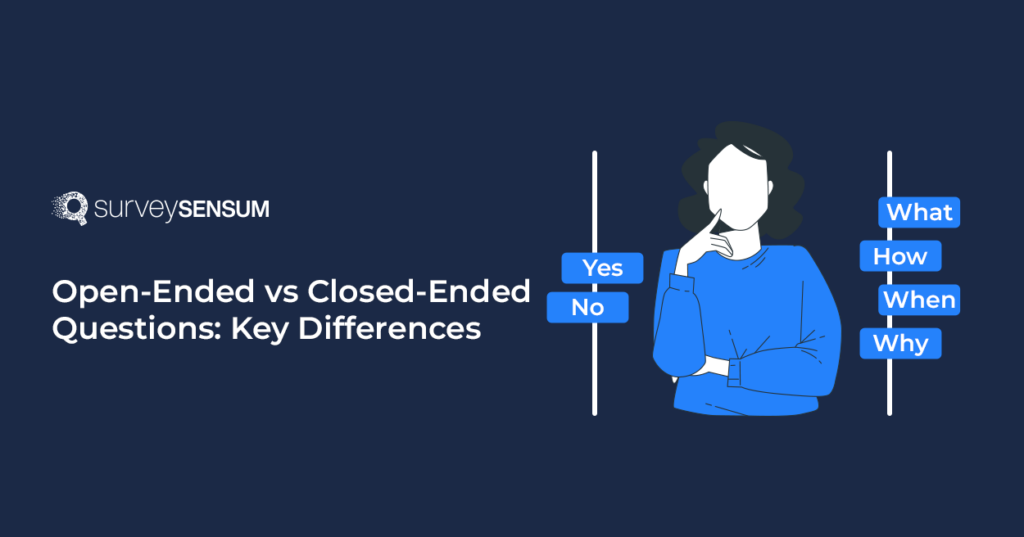
Let's get a formal definition.
How to Ask Open vs Closed Questions. 5 Best Tips & ...
The article 'How to Ask Open vs Closed Questions' from Symonds Research provides excellent, clear definitions for both question types.
Please read the first part of the article, from the beginning down to the end of the section 'Examples of Open vs Closed Questions'. Focus on the core difference: one invites elaboration, the other seeks a limited response.
To summarize and build on that:
-
Closed-Ended Questions are questions that can be answered with a "yes," "no," or another short, factual response. They are used to confirm information, make decisions, or narrow down options.
- They often start with words like: Did, Are, Will, Have, Can, Is.
- Example: "Did you enjoy the movie?"
-
Open-Ended Questions are questions that require a more descriptive, thoughtful answer. They are used to encourage sharing, explore feelings and opinions, and gather more information.
- They often start with words like: What, How, Why, When, Where, Describe...
- Example: "What did you enjoy most about the movie?"
Watch this short video clip for a great real-world explanation of this distinction.
Never Struggle with Small Talk Again | Easy Tips for Better Conversations
In his video 'Never Struggle with Small Talk Again', Jefferson Fisher gives a very practical demonstration of how to turn a conversation-stopping closed question into a conversation-starting open one.
Please watch from 01:31 to 02:49. Pay close attention to his examples of rephrasing questions to begin with 'what,' 'how,' or 'when.'
One quick but important tip: avoid "stacking" questions, which is asking multiple questions at once (e.g., "What did you think of the event, and did you talk to the host?"). People will almost always answer only the last question, so ask one at a time to maintain control.
The Strategic Purpose: Gas Pedal vs. Steering Wheel
Knowing the definition is one thing; knowing when to use each is where the strategy comes in. The choice between an open and closed question depends entirely on your goal for that moment in the conversation.

Here’s a simple breakdown of when to use each:
Use Open-Ended Questions to (The Gas Pedal):
- Start a conversation and build rapport: "What brings you to this event?"
- Explore someone's thoughts and feelings: "How do you feel about that?"
- Encourage them to tell a story: "What was the most challenging part of that project?"
- Gather more detail and expand a topic: "Tell me more about your trip to Japan."
Use Closed-Ended Questions to (The Steering Wheel & Brakes):
- Confirm your understanding: "So, you're saying the deadline is Friday?"
- Get a specific piece of information: "Are you free at 3 PM?"
- Direct a conversation or get a decision: "Should we focus on topic A or topic B?"
- Gracefully end a topic or conversation: "Was there anything else you needed help with?"
As the "Call Centre Helper" article astutely notes: "Open questions give information; closed questions give confirmation. You need closed questions as well because closed questions give direction."
Application: A Framework for Managing Flow
Now let's put it all together. How do you combine these questions to skillfully manage a conversation? One of the most effective models for this is the Funnel Technique.
This technique involves starting with broad, open questions to gather general information and then gradually narrowing the focus with more specific or closed questions. This prevents conversations from feeling like an interrogation and allows you to explore topics systematically.
6 Effective Questioning Techniques for Customer Service
The article '6 Effective Questioning Techniques' explains this 'Funnel Questions' model very clearly.
Please read section 3, 'Funnel Questions'. Focus on the three steps: starting with open questions, using probing questions to delve deeper, and using closed questions to confirm.
Let's translate this from a customer service context to a social one. Imagine you're talking to someone who just got back from a trip.
-
Start Broad (Open Question):
- You: "I hear you just got back from Italy! How was it?"
- This is a wide-open question that allows them to start wherever they want.
-
Probe and Explore (More Open Questions):
- Them: "It was amazing! The food was incredible, especially in Tuscany."
- You: "What was your favorite meal you had there?" or "Tell me more about your time in Tuscany."
- These follow-up open questions dive into a specific part of their initial answer, showing you're listening and are curious.
-
Narrow and Confirm (Closed Question):
- Them: "The best was a homemade pasta dish at a small family-run place in Florence. I think I could eat it every day."
- You: "So it sounds like Florence was the highlight of your trip?"
- This closed question confirms your understanding and summarizes that part of the topic. From here, you could pivot to a new topic or ask another open question about Florence.
This structure gives you a powerful way to guide conversations with purpose, moving from exploration to understanding. It provides a mental map, reducing the in-the-moment anxiety of "what do I say next?"
Test your understanding!
A colleague mentions they are training for a marathon. Your goal is to understand their motivation and how they are handling the challenge.
- What is a good open-ended question to start the conversation and explore the topic broadly?
- They respond, "It's tough, but I'm determined. The long runs on weekends are killers." What is a good probing, open-ended question to learn more about their experience?
- After they describe the difficulty, what is a closed-ended question you could use to confirm your understanding of their feeling or to show support?
Show answer
Here's one possible sequence using the funnel technique:
-
Initial Open Question: "Wow, a marathon! What made you decide to take on such a huge challenge?" (This explores their 'why' and motivation).
-
Probing Open Question: "That makes sense. How do you manage to stay motivated during those long, difficult weekend runs?" (This delves into the specific challenge they mentioned).
-
Confirming Closed Question: "It sounds incredibly demanding. Are you still finding it rewarding despite the difficulty?" (This confirms the emotional core of their experience and shows you've been listening).
Conclusion
Mastering the strategic use of questions transforms you from a passive participant into an active director of your conversations. It gives you the tools to manage social energy, guide interactions toward your goals, and make others feel heard and understood.
Key Takeaways:
- Open-ended questions (What, How, Why) are your gas pedal. Use them to expand the conversation, gather information, and encourage sharing.
- Closed-ended questions (Did, Are, Will) are your steering wheel and brakes. Use them to confirm, clarify, make decisions, and direct the flow.
- The Funnel Technique provides a powerful framework: start broad with open questions, probe deeper with more open questions, and then confirm understanding with closed questions.
- The key to strategic use is balance. Too many open questions can lead to a rambling, unfocused chat. Too many closed questions can feel like an interrogation and shut down the conversation.
Preview of the Next Lesson:
You now have the fundamental tools to manage the flow and direction of a conversation. In our next lesson, we will focus on applying these tools to manage the depth. We will learn how to transition from small talk to meaningful conversation using depth-building questions, a crucial skill for forming the deeper bonds you're looking to create.