Hello! Welcome back to your training in advanced communication skills.
In our last lesson, we focused on identifying and using individual "conversational hooks" to extend a dialogue. You learned to latch onto a single keyword or idea to ask a deeper question or make an insightful observation. This is an essential skill for staying engaged in the moment.
Today, we will elevate that skill to a new level. Instead of just catching one thread, you'll learn to see all the threads a person offers and weave them together like a master conversationalist. The learning outcome for this lesson is to use the 'thread' technique to manage and return to multiple conversational topics.
This technique is a powerful antidote to the feeling of "running out of things to say." For you, as someone who finds socializing can be draining, this is also a crucial energy management tool. By having a mental map of available topics, you reduce the cognitive load of constantly searching for the next thing to say, allowing you to relax and engage more authentically.
Part 1: What is Conversational Threading?
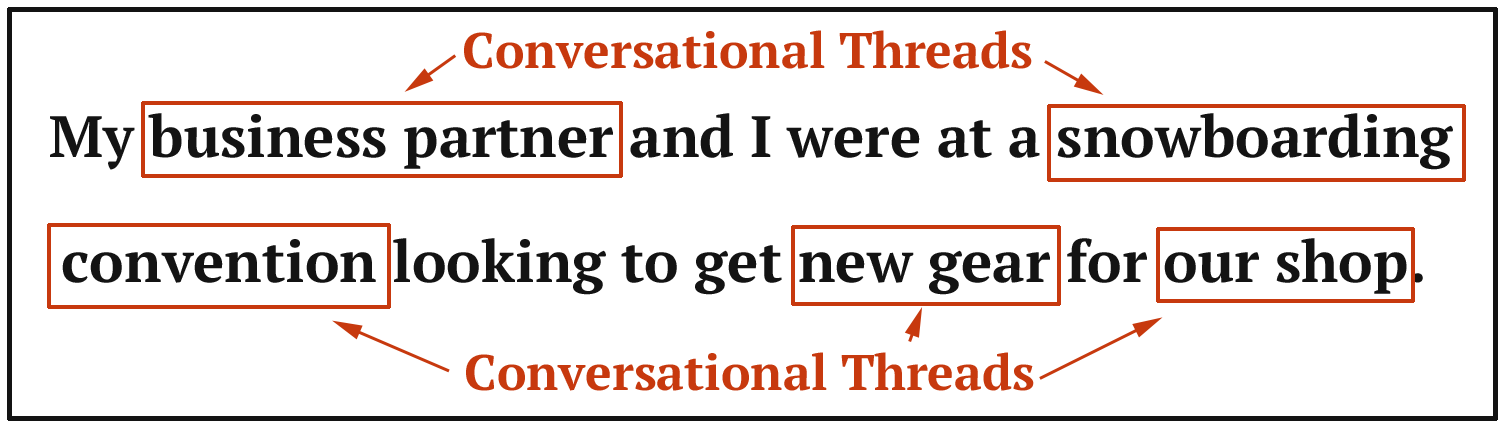
Conversational threading is the practice of identifying multiple potential topics (threads) within what someone says. Instead of seeing a single statement, you'll learn to see a cluster of opportunities for conversation.
When you only focus on one topic until it's exhausted, conversations can feel linear and sometimes stall abruptly. Threading gives you a safety net and makes the dialogue more dynamic and interesting.
Let's start with a foundational explanation of this concept.
How to (Mostly) Never Run Out of Things To Say
The video 'How to (Mostly) Never Run Out of Things To Say' from the Jamie Social channel introduces conversation threading as a form of 'conversation insurance.' It clearly explains how to break down a single sentence into multiple potential paths.
Please watch the segment from 06:20 to 08:22. Pay attention to how the speaker deconstructs the sentence about hiking in Colorado into five distinct threads. This is the core skill of identifying your options.
This idea of mentally "noting" or holding onto threads is key. You don't have to act on every thread immediately. Think of them as conversational bookmarks you can return to later.
The following image provides a simple, clear visual of what these threads look like within a sentence.
To reinforce this, let's watch one more short explanation that emphasizes how to use these threads to avoid conversational dead ends.
How To Keep A Conversation Going FOREVER | 3 Techniques For A Better Social Life
This video from Cole Hastings offers another perspective on 'conversational threading.' He describes it as keeping mental bullet points that you can bring up when the current topic starts to fade.
Watch from 02:22 to 04:22. The key takeaway here is the proactive nature of this technique: you're consciously identifying topics to 'bank' for later use, ensuring the conversation flows smoothly.
Part 2: A Mental Model for Managing Threads
Identifying threads is the first step. The next is organizing them in your mind. Given your background in applied economics, you might appreciate having a clear mental model or framework for this process. One of the most effective is the "Spokes Method."
How To Make Conversation - 5 Tips That Will Help You ...
The article 'How To Make Conversation' on BecomeMoreCompelling.com explains this powerful mental model. It will help you visualize and structure your conversational options.
Please read section #3, 'How To Make Conversation The Easy Way,' which introduces the 'Spokes Method.' Focus on the bicycle wheel analogy: the main topic is the hub, and the related threads you identify are the spokes.
The beauty of the Spokes Method is that it keeps you anchored.
- The Hub: The central theme of the conversation.
- The Spokes: The related topics (threads) branching off from it.
You can follow one spoke for a while (e.g., talk about the challenges of being a chef), and if that conversation runs its course, you can return to the hub (cooking) and pick another spoke (e.g., plating techniques). This provides structure and prevents the conversation from drifting aimlessly.
Part 3: The Art of Switching and Returning
Beginner conversationalists often cling to one topic until it is completely exhausted. An expert, however, skillfully navigates between different threads, which makes the conversation feel more exciting and less predictable. This is called multi-threading.
Let's look at an article that distinguishes between beginner and expert conversationalists. This will frame multi-threading as an advanced skill you are now developing.
Please read section #7, 'Use Multi-Threading.' Notice the description of how an expert moves from topic A to B, back to A, then to C. This is the dynamic flow we're aiming for.
The most skillful part of threading isn't just switching topics, but returning to a thread that was mentioned earlier. This action is incredibly powerful because it proves you were not just hearing, but actively listening and thinking about what the person said.
The same article explains this under a different name, "conversational hooks."
Let's continue with the same article, 'How To Be More Talkative,' to learn the technique for returning to a previously dropped thread.
Now, read section #8, 'Use Hooks.' The example about 'Brutus' the dog is perfect. It shows how remembering a detail from twenty minutes prior and bringing it back up demonstrates genuine care and attention.
To circle back to a previous thread, you can use simple transitional phrases:
- "You mentioned earlier that you were working on a new website. I was curious, what's the project about?"
- "Going back to what you said about your trip to Colorado, what was the weather actually like?"
- "Something you said a few minutes ago just stuck with me..."
This technique turns your memory into a powerful tool for connection.
Test your understanding!
Imagine you're talking to a colleague, and they say:
"This has been a crazy week. I had to finish a huge report for the finance department, my daughter had her first piano recital on Wednesday, and on top of that, we're planning a trip to Japan for next spring."
Your task:
- Identify at least three conversational threads from their statement.
- Imagine you first ask about the piano recital and talk about it for a minute.
- Now, write a sentence you could use to gracefully pivot back to one of the other threads you identified.
Show answer
1. Potential Threads:
- The "crazy week" (a chance to commiserate)
- The huge report for finance (work-related)
- The daughter's first piano recital (family/personal milestone)
- Planning a trip to Japan (travel/dreams)
2. First Follow-Up (Example): "Oh, a first piano recital, that's a huge moment! How did it go? Was she nervous?"
3. Pivoting Back: After they answer, you could pivot back by saying:
- (To the Japan thread): "That's so wonderful she had a great experience. And wow, amidst all that, you're planning a trip to Japan? That's amazing! I've always wanted to go. What part are you most excited to see?"
- (To the report thread): "I'm glad the recital went well. It sounds like you can finally breathe a sigh of relief. You mentioned a huge report for finance—I hope that went smoothly as well."
Notice how the transition acknowledges their last comment before gently guiding the conversation back to a previously "bookmarked" topic.
Conclusion
Today you've moved from simply reacting in a conversation to being able to navigate it strategically. By learning to manage multiple threads, you've acquired a technique that ensures you'll rarely feel stuck or anxious about what to say next.
Key Takeaways:
- Conversational threading is the skill of identifying multiple topics within a person's statements.
- Use a mental model like the Spokes Method (hub and spokes) to organize topics and maintain a central theme.
- Expert conversationalists practice multi-threading, moving between topics to keep the dialogue fresh and engaging.
- The most powerful move is returning to a dropped thread, which demonstrates deep listening and builds strong rapport.
This skill reduces the mental effort required to sustain a conversation, freeing up your energy to focus on connecting with the other person, which is your ultimate goal.
Preview of the Next Lesson:
Now that you have the tools to keep a conversation flowing for as long as you wish, it's equally important to know how to end it well. In our next lesson, we will focus on how to execute a graceful exit from a conversation using transitional phrases, ensuring you always leave a positive final impression.