Hello! Welcome to the final lesson of our first module, "Foundations of Strategic Communication."
In our last lesson, we focused on decoding the messages you receive from others, learning to distinguish between the explicit content and the implicit relational subtext. You learned how to use frameworks like the Four-Sides Model to "listen" with different ears and understand what's truly being communicated beneath the surface.
Today, we bring that analytical lens inward. This lesson's outcome is to identify your own default communication style and its potential impact on others. This is a crucial capstone for our foundational module. By understanding your own patterns, you can begin to see how you contribute to the context, frame conversations, and create subtext—concepts we've explored throughout this module.
Understanding your default style is essential for achieving your goals. It will help you manage your social energy by recognizing why certain interactions are draining, build deeper bonds by learning when to flex your style to connect better, and become more charismatic by consciously choosing how you present yourself rather than operating on autopilot.
1. Identifying Your Approach: The Four Core Styles
Let's begin with a self-assessment to get a baseline reading of your communication tendencies. The most widely recognized framework categorizes communication into four styles: Passive, Aggressive, Passive-Aggressive, and Assertive.
Quiz: What Your Communication Style Says About You (self-test)
This short video from Psych2Go is a quiz designed to help you discover your dominant communication style in different scenarios. It's a lighthearted but insightful way to start our self-reflection.
Please watch the full video (around 8 minutes). As you watch, keep track of your answers (A, B, C, or D) to the 10 questions. The results at the end will give you a preliminary idea of your style.
Now that you have your result from the quiz, let's add more formal definitions to these styles. The following video provides a more structured breakdown of Passive, Aggressive, Passive-Aggressive, and Assertive behaviors.
Assertiveness - What are Passive, Aggressive & Assertive Behavior?
This video from Management Courses - Mike Clayton explains the underlying psychology of each of the four styles, focusing on the balance between respect for yourself and respect for others.
Watch from 00:15 to 07:24. As you watch the descriptions of each style, reflect on which one aligns most with your quiz result. Pay close attention to the summary at the end (starting at 05:40) that connects each style to self-respect and respect for others.
Here is a summary of what you just watched:
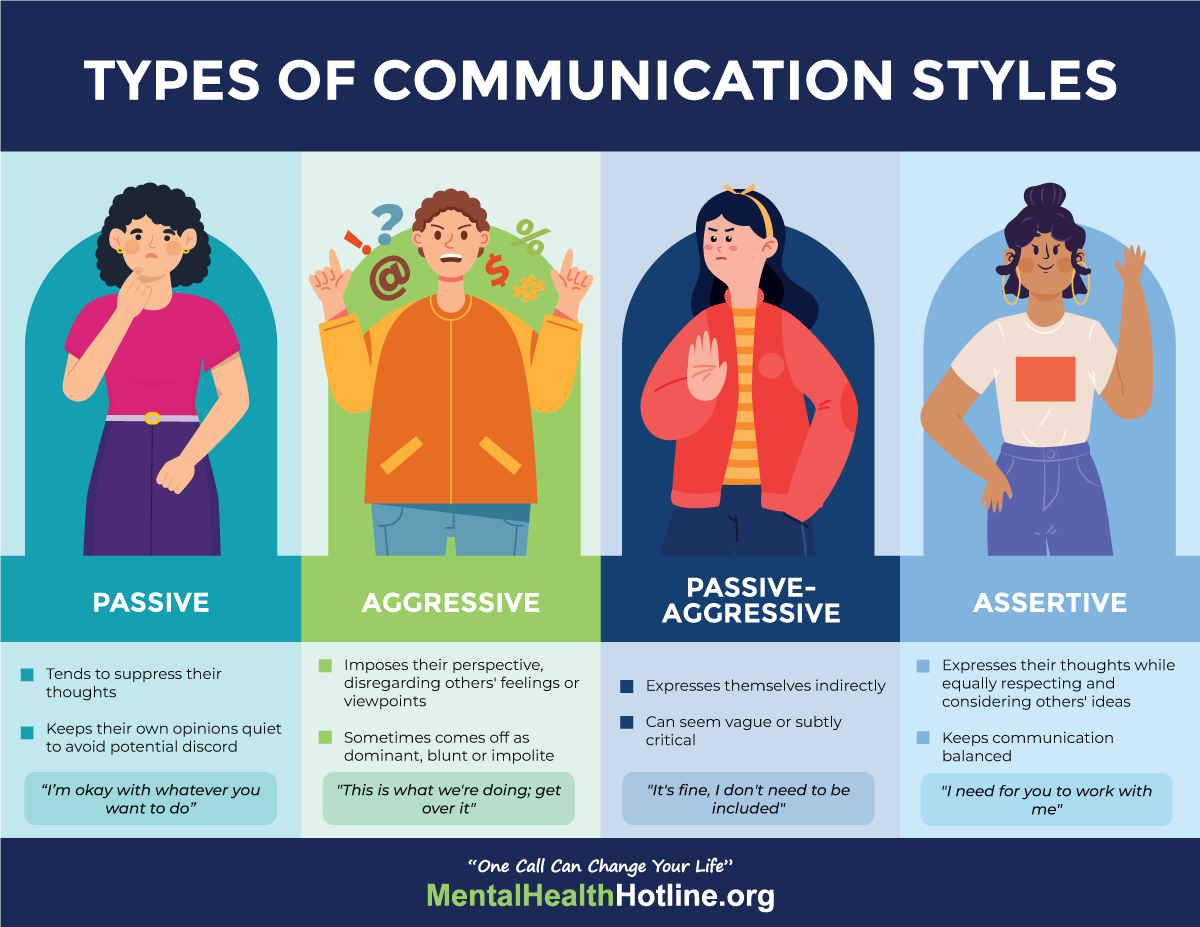
As the video explained, these styles can be understood through the lens of respect:
- Aggressive: High self-respect, low respect for others.
- Passive: Low self-respect, high respect for others.
- Passive-Aggressive: Low respect for self and others.
- Assertive: High respect for self and others.
The assertive style is generally the most effective for building healthy, deep relationships and for clear, confident communication in settings like debates. It allows you to state your needs and opinions clearly without devaluing the person you're speaking with.
2. A More Nuanced Look: How You Process Information
The previous model is excellent for understanding how you navigate needs and conflict. However, there's another layer to communication style: how you process and present information. This second model may appeal to your background in economics, as it focuses on whether you lead with data, feelings, action, or ideas.
The following resource provides a self-assessment for a different set of styles: Thinker, Feeler, Sensor, and Intuitor.
Communication Style Self-Assessment
We will now use a self-assessment from the Ohio Human Services Training System to identify your primary style of processing and delivering information. This will add another dimension to your self-understanding.
Please download the PDF and complete the self-assessment on the first page. For each of the 17 lines, circle the one word that is most descriptive of you. Then, tally your scores for each of the four columns.
Your highest scores indicate your primary and secondary styles. Now that you have your results, let's explore what they mean and, crucially, how they might impact others.
Communication Style Self-Assessment
Now, let's analyze your results. This document provides a rich description of the positives, negatives, and behaviors under stress for each style.
Please read the sections titled 'Characteristics of the Four Styles of Communication' and the detailed breakdowns for each of the four styles that follow. Focus on the 'Positives,' 'Negatives,' and 'how primary [styles] function under stress.' This will help you see how your default style can be perceived by others in different situations.
Test your understanding!
Imagine a "Thinker" communicator and a "Feeler" communicator are discussing a project delay. The Thinker says, "We are three days behind schedule. We need to re-allocate 15% of our resources from Task B to Task A to meet the deadline."
How might a Feeler perceive this message, and what might be their primary concern?
Show answer
A Feeler is likely to perceive the Thinker's message as cold, impersonal, and possibly critical. While the Thinker is focusing on the objective problem and a logical solution (the matter side), the Feeler's primary concern might be the team's morale. They might worry about how the team members being re-allocated will feel, or they might interpret the directness as a lack of trust in the team's ability. The Feeler might respond with, "I'm worried the team is already feeling burned out. How can we support them through this change?" This highlights a potential clash between a data-driven approach and a people-driven one.
3. Putting It All Together: Your Unique Communication Profile
You now have results from two different models. You are not just "Assertive" or just a "Thinker." Your style is a combination of these layers. For example, you might be an Assertive Thinker or a Passive Feeler. These profiles have very different impacts.
- An Assertive Thinker might be perceived as direct, logical, and efficient, but could also be seen as unemotional or overly blunt if they don't consciously add warmth.
- A Passive Feeler might be seen as supportive, kind, and a great team player, but could struggle to have their own ideas heard and may build resentment over time.
It's also crucial to remember that our styles are not static. This is a key insight for anyone who finds social interaction taxing.
Exploring 6 Communication Styles
This article by Shani Goodson explores how our communication styles are not fixed but can change depending on the situation. This helps explain why you might communicate one way with friends and another in a formal debate.
Please read the introduction of this article. Focus on the concepts of 'primary and secondary communication styles' and, most importantly, the idea that 'context matters a lot'.
The key takeaway is that you have a default style, but you are not trapped by it. The goal of this course is to build your flexibility—your ability to consciously adapt your style to the context, your audience, and your goals. This is the essence of strategic communication.
4. Reflection: Your Style in Action
Let's connect this new self-awareness to your own experiences. Think about a recent conversation that you found difficult or draining. This could be from your public speaking organization, an impromptu speech, or a social gathering.
Consider the following questions:
- Which of your identified communication styles (e.g., Passive, Thinker) was most active during that interaction?
- Looking at the "Negatives" or "how this style functions under stress" from the PDF resource, can you see how your communication might have been perceived by the other person?
- How did your default style contribute to the conversation feeling difficult or draining? (e.g., "As a 'Passive' style, I spent all my energy agreeing with others to avoid conflict, which was exhausting," or "As a 'Thinker,' I tried to solve their emotional problem with logic, and it created a disconnect.")
- Knowing what you know now, what is one small thing you could have done differently to adapt your style? (e.g., "I could have used an 'I-statement' to assert my own need," or "I could have asked a question about their feelings instead of offering a solution.")
This reflection isn't about criticism; it's about analysis. By deconstructing your own behavior, you gain the power to consciously reconstruct it in the future.
Conclusion
This lesson concludes our first module on the foundations of strategic communication. We've journeyed from analyzing external factors like context and audience to, finally, analyzing yourself.
Key Takeaways:
- You have a default communication style, which can be understood through models like Passive/Aggressive/Assertive and Thinker/Feeler/Sensor/Intuitor.
- Each style has inherent strengths and potential weaknesses, and its effectiveness is highly dependent on the context.
- The Assertive style, which balances high respect for self and others, is a powerful foundation for building strong relationships and communicating clearly.
- Self-awareness is the first step toward adaptability. By understanding your own patterns, you can begin to consciously choose how you communicate to better achieve your goals and manage your social energy.
You are now equipped with a foundational understanding of communication strategy. You know how to set goals, adapt to your audience, frame your message, listen for subtext, and now, you understand your own starting point.
This prepares us perfectly for our next module, "Emotional Intelligence and Social Awareness." Having built this strategic foundation, we will now dive into the real-time skills of reading the people in front of you. Our very next lesson will focus on a critical skill you've expressed interest in: recognizing basic and complex emotions in others through facial expressions and micro-expressions.