Hello! Welcome back to our module on Emotional Intelligence and Social Awareness.
In our last lesson, we built the foundational map of Emotional Intelligence, defining its four key components: Self-Awareness, Self-Management, Social Awareness, and Relationship Management. You now have the "why" and "what" of EI. Today, we begin the "how."
This lesson is our first deep dive into the Social Awareness domain. It directly targets one of the key challenges you've mentioned: difficulty reading non-verbal cues. Our learning outcome is to recognize basic and complex emotions in others through facial expressions and micro-expressions. Mastering this skill is like learning to read the emotional data that flows in every conversation. For your goals in debate, persuasion, and building connections, this data is invaluable. It allows you to gauge your impact and adapt your strategy in real-time, making social interactions less of a guessing game and therefore more manageable.
1. The Face as an Emotional Readout
The human face is one of the richest sources of information about a person's internal state. Before we get into specific emotions, it's useful to have a simple, high-level framework for initial assessment. A former FBI agent, Joe Navarro, suggests a powerful binary: comfort versus discomfort.
Former FBI Agent Explains How to Read Facial Expressions | WIRED
In this video from WIRED, an expert in non-verbal communication explains the foundational principle of reading faces. This will give us a simple, effective starting point.
Watch from 00:56 to 02:44. Focus on the distinction he makes between the facial signs of psychological 'comfort' and 'discomfort'.
As Navarro explains, the core idea is:
- Comfort: Associated with relaxation. Facial muscles are relaxed, you might see genuine smiles, and the chin is often out.
- Discomfort: Associated with tension. This can manifest as a furrowed brow, squinting eyes, a pursing of the lips, or a tucked chin.
Think of this as your first filter. Before trying to identify a specific emotion like anger or sadness, simply ask yourself: "Does this person's face signal comfort or discomfort?" This initial reading provides immediate context for the interaction.
2. Macro vs. Micro: The Speed of Emotion
Facial expressions come in two main varieties, distinguished by their duration and controllability.
- Macro-expressions: These are the typical expressions we are all familiar with. They last between 0.5 and 4 seconds and are usually easy to see. A broad smile or an obvious frown are macro-expressions. They can be consciously controlled.
- Micro-expressions: These are involuntary, extremely brief facial expressions, lasting less than half a second. They flash across the face and reveal a person's true, concealed emotion.
Because micro-expressions are generated by the limbic system—the brain's emotional center—before your conscious, rational brain (the neocortex) can intervene, they are highly reliable indicators of genuine feeling.
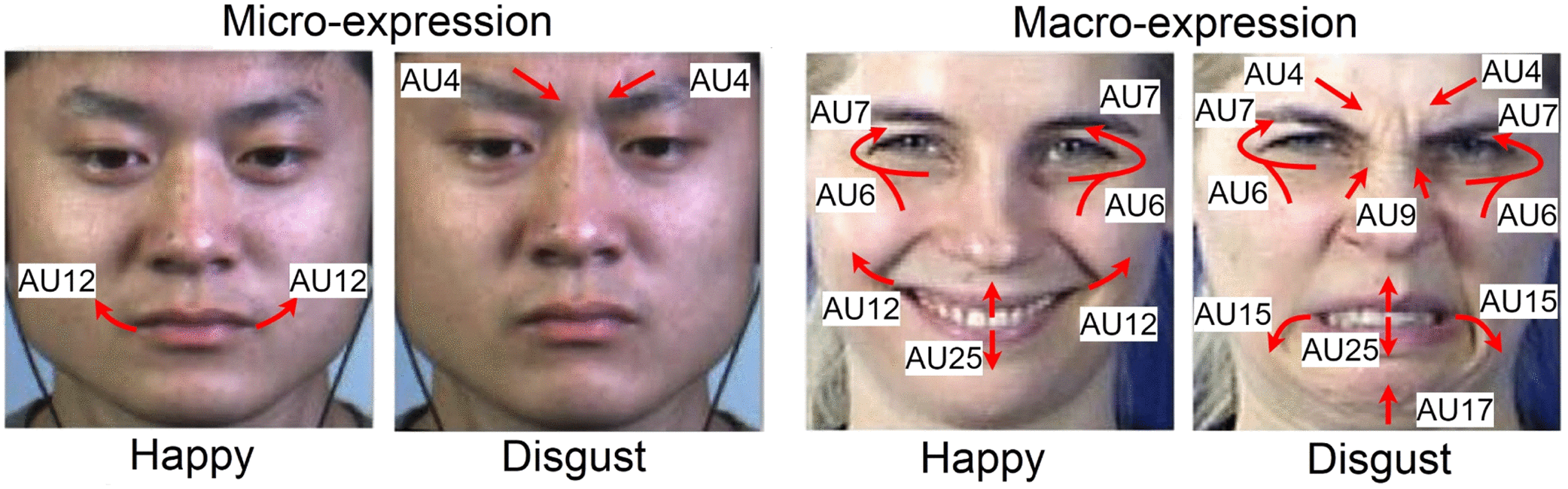
To develop your ability to read people, you need to train your eye to catch these fleeting but honest signals.
3. The 7 Universal Basic Emotions
Groundbreaking research by Dr. Paul Ekman identified seven emotions that have universal facial expressions across all human cultures—even in tribes completely isolated from the modern world. Learning the specific facial "recipes" for these seven emotions is the foundation of facial expression analysis.
The seven universal emotions are: Anger, Disgust, Fear, Happiness, Sadness, Surprise, and Contempt.
The Definitive Guide to Reading Facial Microexpressions
The article 'The Definitive Guide to Reading Facial Microexpressions' from Science of People provides an excellent, detailed breakdown of each of the seven universal emotions, complete with descriptions and visual aids.
First, read the introduction under the heading 'How to Read Microexpressions' to solidify your understanding of their universality. Then, read the section 'The 7 Microexpressions,' focusing on the descriptions and key facial cues for each of the seven emotions. Pay close attention to the animated GIFs, as they provide dynamic examples.
To summarize the key cues you've just read about, here is a helpful visual guide.
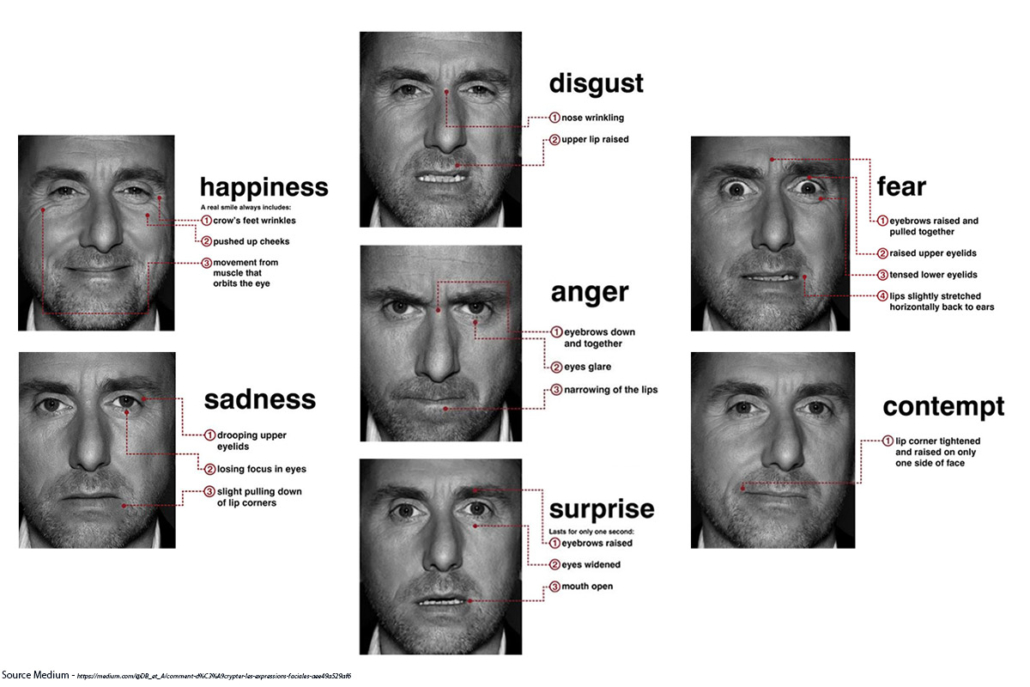
A crucial point from the reading is the Duchenne smile (genuine happiness) versus a social or polite smile. The key differentiator is the engagement of the orbicularis oculi muscle, which creates "crow's feet" wrinkles at the corners of the eyes. Spotting this is a reliable way to distinguish genuine joy from mere politeness.
Test your understanding!
Imagine you are in a debate. You make a point, and for a split second, you see your opponent's lip corner on one side pull up and out into a smirk before their face returns to a neutral expression. Based on the 7 universal emotions, what are you likely observing?
Show answer
You are likely observing a micro-expression of contempt. Contempt is the only one of the seven universal emotions that is asymmetrical, characterized by one side of the mouth rising in a smirk. It signals a feeling of moral superiority or disdain. Recognizing this cue could tell you that your opponent dismisses your argument, which is valuable strategic information.
4. Recognizing Complex and Mixed Emotions
While the seven basic emotions are our building blocks, real-world emotional expressions are often more complex. People can feel multiple emotions at once, or display more nuanced social emotions.
Blended Expressions
Often, you won't see a "pure" expression of anger or disgust. Instead, you'll see a blend.
- The Snarl: As mentioned in the Science of People article (LINK), a snarl is a clear example of a blended expression, combining the raised upper lip of disgust with the lowered brow and tension of anger.
- Mixed Micro-expressions: People can show a rapid sequence of different emotions, or even combine parts of different expressions at the same time.
This next video provides fantastic, slow-motion analysis of these complex, blended micro-expressions.
FULL MICRO EXPRESSIONS Analysis in 4K LIE TO ME Style - Micro Expressions Training as in Lie To Me
Let's watch some examples from 'FULL MICRO EXPRESSIONS Analysis in 4K LIE TO ME Style'. This will train your eye to spot multiple emotions happening in quick succession or simultaneously.
Watch two specific analyses: the first from 00:46 to 02:15, which breaks down a blend of happiness and disgust. Then, watch from 06:47 to 08:41, which shows a rapid sequence of anger, disgust, and contempt.
Social Emotions
Some emotions, like embarrassment, are inherently social and have their own unique cluster of facial and body language cues.
The article 'Embarrassment' from Psychology Today describes the specific, universal signals for this complex social emotion.
Read the second and third paragraphs of the article. Focus on the list of signals for embarrassment, such as the downward gaze and face touching.
Unlike the seven basic emotions, which are often direct reactions, embarrassment is a self-conscious emotion related to breaking a social standard. Its expression is more about hiding and appeasement, involving cues like gaze aversion, covering the face, and inhibited smiles.
Conclusion
Today, we've moved from the theory of emotional intelligence to the practical skill of emotional observation. You've learned how to decode the data that is constantly being broadcasted from the human face.
Key Takeaways:
- You can start reading a room with a simple filter: comfort vs. discomfort.
- The face displays both controllable macro-expressions and involuntary, honest micro-expressions.
- There are 7 universal basic emotions (Anger, Disgust, Fear, Happiness, Sadness, Surprise, Contempt) with distinct and reliable facial cues.
- Real-world emotions are often complex, appearing as blends, rapid sequences, or nuanced social emotions like embarrassment.
This skill is not about judging people, but about understanding them. By learning to see these emotional cues, you gain a more accurate understanding of your audience, allowing you to be more empathetic, persuasive, and connected.
In our next lesson, we will broaden our focus beyond the face. We will continue building your Social Awareness toolkit by learning to interpret common body language signals, including posture, gestures, and proxemics. This will give you an even more complete picture of the non-verbal conversation happening beneath the surface of the words.