Hello! Welcome to the fifth lesson in our "Foundations of Strategic Communication" module.
In our last lesson, you learned about framing—the art of consciously presenting your message to set a specific tone and guide a conversation. We focused on how you, as the speaker, can shape perception.
Today, we're flipping the coin. We will move from being the sender to being the receiver, focusing on how to deconstruct the messages you hear. This brings us to this lesson's outcome: to distinguish between the explicit content and the relational subtext of a message.
Every communication is layered. On the surface, there are words and facts. But underneath, there's a whole other conversation happening—one about emotions, status, intentions, and the relationship between the people involved. Learning to "hear" this hidden layer is a crucial step toward becoming a more charismatic and insightful communicator. It will help you build the deeper bonds you're seeking by responding to unspoken needs, sharpen your debate skills by identifying the real argument behind the words, and even manage your social energy by preventing misunderstandings that arise from focusing only on the surface-level content.
1. The Two Channels: Content and Relationship
At its core, every message you receive is running on two parallel channels. Think of it as the difference between what is said and how it is said.
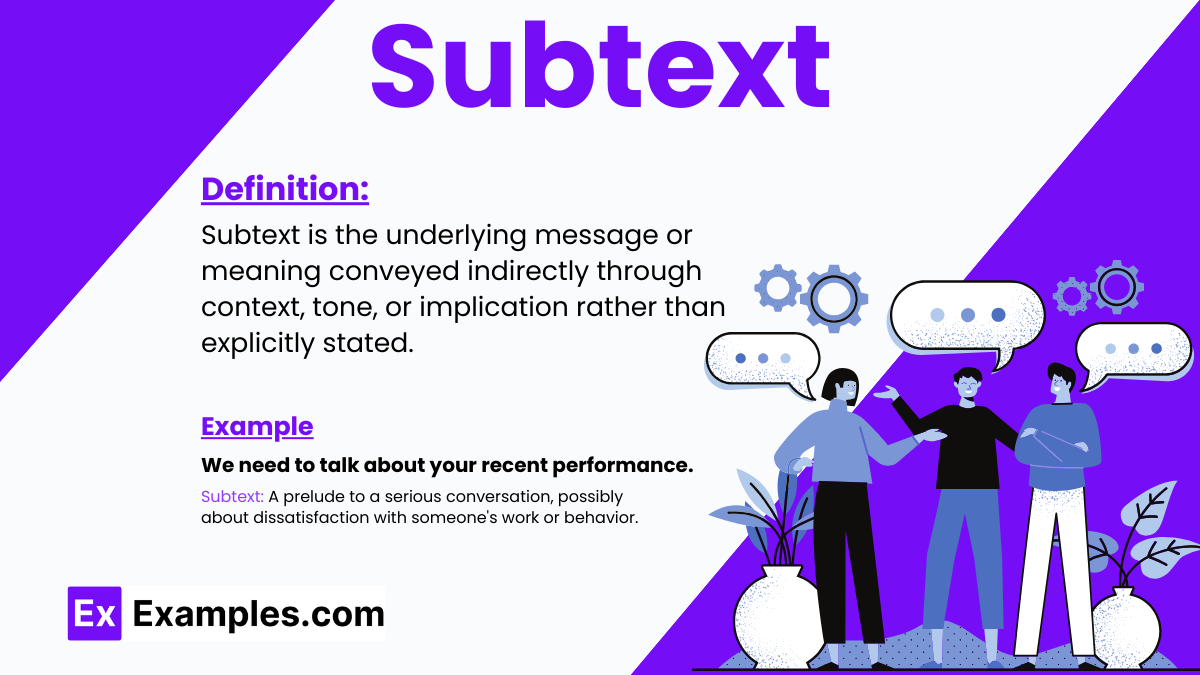
This idea was formally captured by communication theorist Paul Watzlawick and his colleagues. They proposed that all communication has two aspects:
- The Content Level: This is the explicit part of the message—the raw data, the facts, the literal meaning of the words. It's the "what" of the conversation.
- The Relationship Level (or Subtext): This is the implicit part of the message. It comments on the content and provides information on how it should be interpreted. It also says something about the relationship between the speakers. This is the "how" and "why."

To see this distinction in action, let's watch a short video explaining Watzlawick's theory.
The 5 Axioms of Communication by Watzlawick, Beavin and Jackson
This video from the channel Soft Skills English provides a clear breakdown of Watzlawick's second axiom of communication, which is the foundation of our topic today.
Please watch the section explaining the second axiom (04:32 - 07:58). Focus on how the simple example, 'You have beautiful eyes!', is almost meaningless on the content level but carries significant weight on the relationship level.
The key takeaway is that the relationship level classifies the content. It tells you whether the words "You're late" are a simple statement of fact, a criticism of your character, an expression of worry, or a joke.
So, how is this relational information conveyed? Watzlawick makes another useful distinction.
The 5 Axioms of Communication by Watzlawick, Beavin and Jackson
The same video explains Watzlawick's fourth axiom, which describes the two types of communication we use to send these different messages.
Now, watch the segment on the fourth axiom (09:57 - 14:06). Pay close attention to the difference between 'digital' communication (words, best for content) and 'analogical' communication (tone, gestures, expression, best for relationships).
This is directly relevant to your goal of better reading non-verbal cues. The words ("digital" communication) carry the content, but the tone, pace, volume, facial expressions, and gestures ("analogical" communication) carry the much richer relational subtext.
2. A Deeper Dive: The Four-Sides Model
Building on Watzlawick's work, German psychologist Friedemann Schulz von Thun developed a more detailed framework called the "Four-Sides Model." It breaks down the "subtext" layer into three distinct components, giving you a more powerful analytical tool.
To add more nuance to your understanding, we'll explore Schulz von Thun's Four-Sides Model. This reading explains the four 'ears' with which we can listen to any message.
Please read the initial sections of the article, covering the 'Four-Sides Model' and its examples. Focus on understanding the four levels: Matter, Relationship, Appeal, and Self-Revealing. Pay close attention to the 'It's green' example to see how one simple phrase can be interpreted in four very different ways.
To summarize, any single message can be heard from four perspectives:
- The Matter/Factual Side: What is the factual information? (This is the same as Watzlawick's Content.)
- The Self-Revealing Side: What does this message say about the person speaking? (Their values, emotions, personality.)
- The Relationship Side: What does the speaker think of me, and how do they see our relationship?
- The Appeal Side: What does the speaker want me to do, think, or feel?
When there's a misunderstanding, it's often because the sender is emphasizing one side of the message while the receiver is listening with a different "ear." For example, the sender might just be stating a fact (Matter), but the receiver hears a criticism (Relationship).
Test your understanding!
Imagine you're in a public speaking competition, and after your speech, a judge says, "That was a very passionate delivery."
Analyze this statement using the Four-Sides Model. What could be the message on each of the four levels?
Show answer
- Matter/Factual Level: The delivery was characterized by strong emotion.
- Self-Revealing Level: "I value emotional expression in speeches," or "I was taken aback by the intensity."
- Relationship Level: This could be a compliment, indicating the judge sees you as a compelling speaker. However, depending on tone, it could also imply a lack of logical structure: "You're all passion and no substance," defining the relationship as one of a critical expert to an unpolished novice.
- Appeal Level: "Continue to use this strength," or conversely, "You need to balance that passion with more facts and structure next time."
3. From Theory to Practice: Matching the Conversation
Knowing these models is the first step. The next is learning what to do with this knowledge in a live conversation. When you sense a disconnect, it’s often because you and your conversation partner are having two different types of conversations simultaneously.
Author Charles Duhigg offers a simple, practical framework for this.
The science behind dramatically better conversations | Charles Duhigg | TEDxManchester
This TEDx talk by Charles Duhigg provides a brilliant framework for identifying and aligning with the hidden conversation happening beneath the surface.
Watch this opening clip (02:04 - 03:29). Notice the three 'buckets' of conversation—practical, emotional, and social—and the importance of the 'matching principle.'
Duhigg's framework maps nicely onto what we've learned:
- Practical Conversation aligns with the Matter/Content Level.
- Emotional & Social Conversations align with the Relational/Subtext Level.
The "matching principle" is the key takeaway: effective communication requires recognizing what kind of conversation is really happening and aligning with it. If someone is trying to have an emotional conversation (venting about their bad day) and you respond with a practical one (offering solutions), a disconnect is inevitable.
So, how do you uncover the hidden emotional or social conversation? Duhigg suggests a powerful tool: deep questions.
The science behind dramatically better conversations | Charles Duhigg | TEDxManchester
Let's see how this works in practice. Duhigg's story about a cancer surgeon is a profound demonstration of using a deep question to move beyond content and connect with subtext.
Watch the remainder of this clip (04:01 - 09:44 and the summary at 11:29 - 11:52). Observe how asking 'What does this diagnosis mean to you?' transformed the interaction from a practical discussion of medical options to an emotional one about fear, family, and legacy.
This is a strategy you can immediately apply. When a conversation feels stuck, or you sense there's more going on beneath the surface, resist the urge to respond only to the literal words. Instead, ask a question that invites the other person to share their feelings, values, or experiences.
- Instead of asking about the facts of their life ("Where did you grow up?"), ask about the feeling of their life ("What was it like growing up there?").
- This simple shift from content to subtext is what allows for vulnerability, fosters trust, and turns a mundane exchange into an opportunity for a deeper bond.
Conclusion
Today we've moved from broadcasting messages to decoding them. You've learned that every communication is a complex interplay between what is said and what is meant. Being an adept communicator means being sensitive to both.
Key Takeaways:
- Every message contains both explicit content (the facts) and implicit relational subtext (the meaning).
- Subtext is primarily carried through analogical communication: your tone, body language, and the context of the situation.
- Models like Schulz von Thun's Four Sides (Matter, Self-Revealing, Relationship, Appeal) give you a powerful lens to analyze the unspoken layers of a message.
- Breakdowns in communication often happen when people fail to match the type of conversation they are having (e.g., practical vs. emotional).
- You can skillfully uncover and connect with the subtext by asking deep questions that probe for feelings, values, and experiences, not just facts.
This lesson serves as a perfect bridge to our next module, "Emotional Intelligence and Social Awareness." We've established that relational and emotional data exists in every conversation. Our next lessons will equip you with the specific skills to perceive and interpret that data with greater precision, starting with how to recognize emotions through facial expressions and micro-expressions.