Hello! Welcome to the fourth lesson in our "Foundations of Strategic Communication" module.
In our last lesson, we focused on audience adaptation—tailoring the substance of your message to the person you're speaking with. You learned to consider their values, beliefs, and perspective to make your message more resonant and acceptable.
Today, we take the next logical step. Once you've decided on the right substance, how do you present it? This brings us to our learning outcome: to use framing techniques to establish the desired tone and direction of a conversation.
Framing is the art of presentation. It’s about how you package your ideas to make them more understandable, appealing, and influential. For you, this is a crucial skill. It will help you guide conversations toward more meaningful topics, respond convincingly in high-stakes situations like debates or Q&As, and manage the social energy of an interaction by setting a productive tone from the outset.
1. What is Framing?
Think of a frame around a painting. The frame doesn't change the painting itself, but it directs your attention, affects how you interpret the art, and defines its boundaries. In communication, a frame does the same thing for an idea. It's not what you say, but how you present it.
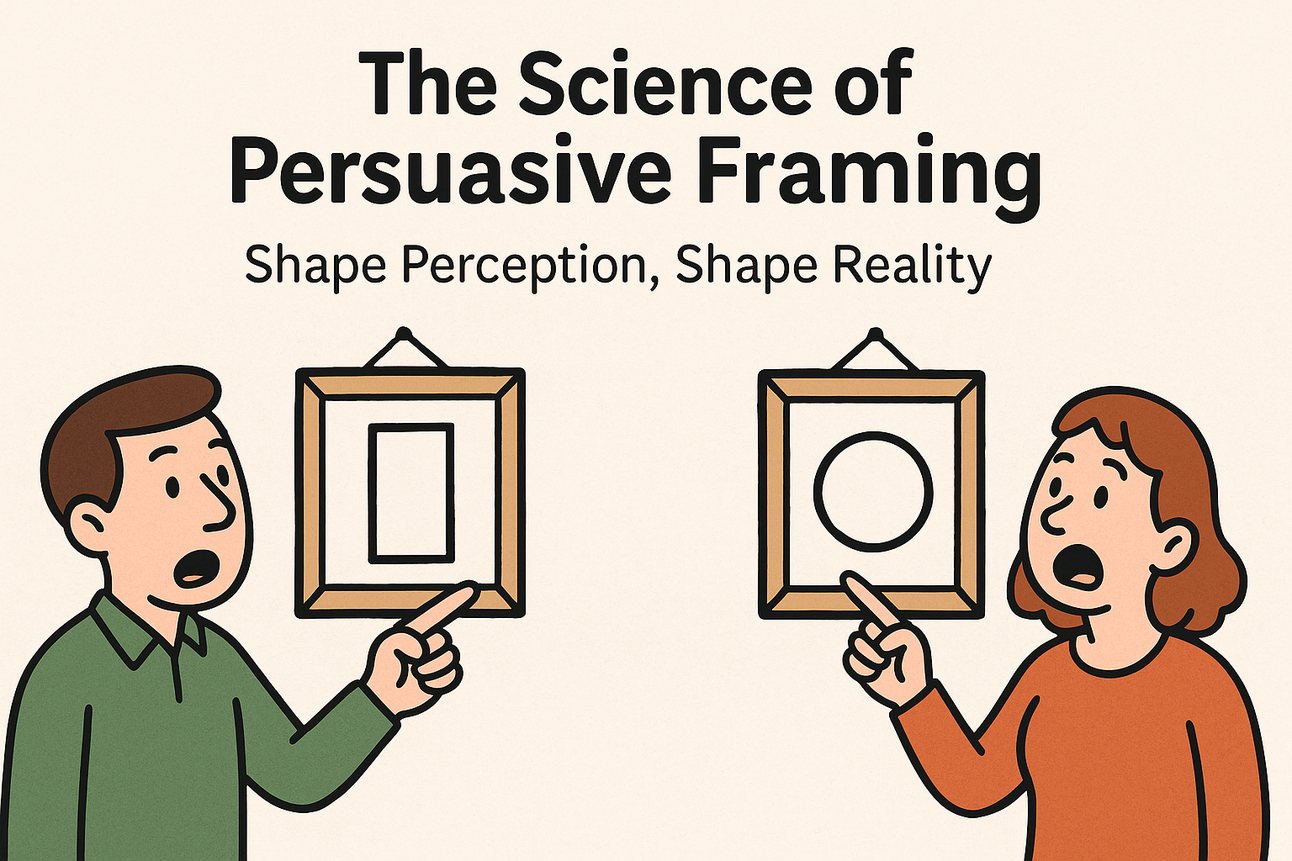
To get a clearer sense of this, let's watch a short video that introduces the concept and its power.
How THE FRAMING EFFECT influences YOUR DECISION MAKING - (Psychology mental model)
This video from AI Alfie provides an excellent introduction to the framing effect, using simple visual analogies to explain how the presentation of information influences our decisions and emotions.
Please watch the first two segments of the video (00:00 - 02:15). Pay attention to the picture frame analogy and the examples of association (fonts) and comparison (circles).
As the video explains, framing draws attention to certain aspects of a message while downplaying others. It’s a natural part of communication that we all do, often unconsciously. The goal of this lesson is to learn to do it consciously and strategically.
2. The Mechanics of Framing: Core Techniques
There are several established techniques for framing information. Understanding these will give you a versatile toolkit for almost any conversational situation. Your background in applied economics will be useful here, as some of these concepts originate in behavioral economics.
A. Loss vs. Gain Framing
This is one of the most powerful frames, rooted in the Nobel Prize-winning work of Daniel Kahneman and Amos Tversky on "Prospect Theory." The core idea is that people are more motivated to avoid a loss than to achieve an equivalent gain.
- A Gain Frame emphasizes what will be gained by taking an action (e.g., "This plan will save 200 lives").
- A Loss Frame emphasizes what will be lost by not taking an action (e.g., "Without this plan, 400 people will die").
Let's see this in action.
How THE FRAMING EFFECT influences YOUR DECISION MAKING - (Psychology mental model)
The next segment of the same video explains loss aversion and how framing options as gains versus losses dramatically changes decision-making.
Watch the segment on Daniel Kahneman's research (04:36 - 07:23). Notice how the exact same outcome, presented differently in the vaccination scenario, leads to opposite choices.
Application: When you want to persuade someone to change (e.g., adopt a new strategy), framing the current situation as a "surefire loss" if they don't change is often more effective than framing your proposal as a "probable gain."
B. Positive vs. Negative Attribute Framing (Frame Inversion)
This is a simpler but highly effective technique where you highlight the positive or negative attributes of the exact same information.
- Example: "This yogurt is 80% fat-free" (positive frame) vs. "This yogurt has 20% fat" (negative frame).
Both statements are true, but the "fat-free" frame encourages a more favorable perception. You can apply this to qualities, statistics, or characteristics in any conversation.
C. Contextual Framing (Changing the Reference Point)
The perceived value or meaning of something changes drastically depending on what you compare it to. By changing the context, you change the frame.
How THE FRAMING EFFECT influences YOUR DECISION MAKING - (Psychology mental model)
The video provides two excellent examples of this: the cost of a Starbucks coffee and the market positioning of Red Bull.
Watch the segment discussing frame inversion and reframing the reference point (02:15 - 04:36). Focus on how changing the comparison (coffee vs. office space, Red Bull as soft drink vs. functional drink) alters the perception of value.
Application: When presenting an idea, you can frame it as more affordable, innovative, or efficient simply by choosing a favorable point of comparison.
Test your understanding!
A team member is complaining about a new software tool, saying, "Learning this new system is going to take up so much of our time." You want to reframe this to create a more positive and motivated tone.
How could you apply Loss vs. Gain, Positive Attribute, and Contextual framing to respond?
Show answer
Here are some possible responses:
- Loss Frame: "I hear you. But if we don't learn this, we risk getting stuck with the old, inefficient system while other teams pull ahead." (Focuses on the loss of competitiveness).
- Positive Attribute Frame: "True, there's a learning curve. But think about the features that will automate our weekly reports. We'll be saving hours in the long run." (Focuses on the positive outcome, not the initial cost).
- Contextual Frame: "It might seem like a lot, but remember the nightmare of the last software rollout? This one has a built-in training module and support, so it's actually much more user-friendly by comparison." (Compares it to a worse alternative).
3. Frame Control in Conversation
Beyond framing information, you can frame an entire conversation. This is known as frame control. It's the ability to define the terms of the discussion, establish the emotional tone, and guide the interaction toward a desired outcome. This is a hallmark of charismatic communicators.
The following video uses examples of Bruce Lee to demonstrate how a master communicator controls the frame of a conversation, often by subtly rejecting the frame offered by a questioner and substituting his own.
How To Take Control Of Any Conversation Without Trying
The channel Charisma on Command breaks down 'frame control' by analyzing interviews with Bruce Lee. This is a masterclass in steering a conversation away from the superficial and toward the philosophical.
Watch the three examples featuring Bruce Lee (00:33 - 06:12). For each one, identify: What was the original frame of the question? How did Bruce Lee reject that frame and assert a new one?
Here’s a breakdown of the key takeaways from those examples:
- Elevating the Frame: The interviewer asks a factual question: "Why do movie stars want to learn martial arts?" (Frame: practical reasons). Bruce Lee rejects this and elevates it to a philosophical discussion about self-knowledge and expression (Frame: deep purpose). This moves the conversation from transactional to meaningful.
- Rejecting a Dichotomy: The interviewer asks, "Who was the best student?" (Frame: a competitive ranking). Lee rejects this binary and introduces a multi-faceted frame where "best" can mean different things (best fighter vs. deepest understanding). This is a sophisticated debate tactic to avoid being trapped by an oversimplified question.
- Asserting a Higher-Level Identity: The interviewer asks, "Are you Chinese or North American?" (Frame: national identity). Lee rejects this and asserts a universal frame: "I think of myself as a human being." This allows him to share his core philosophy.
In all cases, he doesn't dodge the question like a politician. He answers it, but on his own terms, by providing a deeper, more insightful frame. This is a powerful way to take control and make a conversation more memorable.
4. Internal Framing: Managing Your Own Mindset
Finally, framing is not just an external tool for influencing others; it's also a vital internal tool for managing your own state. This is called cognitive reframing. You mentioned that socializing can be taxing; cognitive reframing is a direct strategy for managing that mental and emotional energy.
It involves identifying your own negative or unhelpful thought patterns and consciously replacing them with more constructive ones.
Ultimate Guide to Cognitive Reframing in Communication
This guide from Personos AI provides a clear and practical overview of cognitive reframing. It explains the psychology behind it and offers actionable strategies.
Please read the sections 'Core Principles of Cognitive Reframing' and 'Practical Strategies for Cognitive Reframing in Communication.' Focus on identifying common 'cognitive distortions' (like mind reading or catastrophizing) and the practical reframing techniques (like perspective-taking and separating behavior from intent).
The key insight is that our interpretation of an event—the frame we put around it—causes our emotional reaction, not the event itself. If you go into a conversation thinking, "This is going to be draining and awkward," you've already framed it as a negative experience.
By practicing cognitive reframing, you can learn to see challenges differently:
- Instead of thinking, "They are judging my every word" (mind reading), you can reframe it as, "They are listening intently because they are interested."
- Instead of seeing a difficult question as a threat, you can reframe it as an opportunity to clarify your position, just as we saw in the previous lesson with the 'Imaginary Gifts' exercise.
- Instead of interpreting a brief email as rude (behavior vs. intent), you can reframe it as a sign of efficiency.
This internal work is fundamental. It reduces anxiety, builds resilience, and frees up the cognitive resources you need to be present and charismatic in your conversations.
Conclusion
Today, you've learned that framing is a multi-layered skill. It operates on the level of information, conversation, and your own internal mindset. By mastering it, you gain a significant degree of control over how your message is received, how a conversation unfolds, and how you experience social interactions.
Key Takeaways:
- Framing Shapes Reality: The context you put around information is as important as the information itself.
- A Toolkit of Frames: You can strategically use techniques like Loss/Gain, Positive/Negative attributes, and changing the reference point to make your ideas more persuasive.
- Control the Conversational Frame: You don't have to accept the frame given to you. By elevating the topic or rejecting false dichotomies, you can lead the conversation.
- Reframe for Resilience: Cognitive reframing is a powerful internal technique to manage social energy, reduce anxiety, and approach interactions with a more constructive mindset.
In our next lesson, we will delve deeper into the other side of this equation. Now that you know how to build frames, you'll learn to deconstruct them by learning to distinguish between the explicit content and the relational subtext of a message. This will sharpen your listening skills and make you more attuned to the unspoken dynamics in any conversation.