Hello! Welcome back to our module on "Quick Thinking and Impromptu Speaking."
In our last lesson, we explored the Past-Present-Future (PPF) framework, a powerful chronological tool for organizing your thoughts. It's excellent for telling a story or explaining the evolution of an idea. But what happens when a topic doesn’t fit neatly into a timeline?
This is where today’s lesson comes in. We will focus on how to structure on-the-spot answers using a simple three-point list. This technique, often called the "Rule of Three," is one of the most versatile and memorable structures in communication. It allows you to organize your ideas logically or thematically, providing a clear, concise, and persuasive response. For you, this is another crucial "energy management" tool—it's a pre-built mental framework that reduces the cognitive load of structuring an answer from scratch, freeing you to focus on your message.
1. The Power of Three: Why It Works
Why is the number three so effective in communication? It's rooted in how our brains process information. Three is the smallest number of elements required to create a pattern, and humans are fundamentally pattern-seeking creatures. A list of three feels complete, rhythmic, and is easier to remember than a list of two, four, or five.
To understand the enduring power of this principle, let's explore its history and application.
Master Speech Structure with "The Rule of Three"
The article 'Master Speech Structure with "The Rule of Three"' from Project Charisma provides a great introduction to this concept, explaining its psychological basis and showing how it has been used in famous speeches and slogans.
Please read the first two sections, 'Why Speech Structure Matters' and 'The Rule of Three Creates Memorable Soundbites.' Take note of why a three-part structure is so memorable and the famous examples provided.
As you can see, from Julius Caesar's "Veni, Vidi, Vici" to modern marketing, the Rule of Three is a fundamental tool for creating messages that stick.
2. Thinking in Frameworks
The three-point list is a type of mental model or framework. Adopting "framework thinking" is a discipline that can dramatically improve your ability to think fast. Instead of getting lost in details, you use a pre-defined structure to organize your thoughts and identify the key levers of a topic.
Given your background in applied economics, you are likely already familiar with this way of thinking. For example, the formula for profit, Profit = Revenue - Cost, is a simple framework. If asked how to increase profit, you instantly know you can focus on two main areas: increasing revenue or decreasing costs. This is the essence of framework thinking.
Let's watch a video that explains this concept and its power.
How to Think Fast Before You Speak: Framework Thinking
In this video, 'How to Think Fast Before You Speak,' Vicky Zhao explains the concept of framework thinking. The examples she uses from the business world should resonate with your economics background.
Please watch from 01:00 to 04:38. Pay close attention to how she defines frameworks and uses the examples of revenue and profit to demonstrate how they help organize complex ideas into simple, actionable components. Then, watch from 05:18 to 07:20 to see how she applies the ethos-pathos-logos framework, which is another example of a three-part structure.
The key idea is to build a mental library of frameworks. The three-point list, in its various forms, is one of the most useful you can have.
3. Practical Frameworks Using the Rule of Three
Now let's move from the general concept to specific, actionable three-point frameworks you can use immediately in impromptu situations.
A. The Basic Three-Point List
The most straightforward application is to break any topic down into three key points. This idea is championed by many great communicators, including the actor and science communicator Alan Alda.
3 Ways to Express Your Thoughts So That Everyone Will Understand You | Alan Alda | Big Think
In this short clip from Big Think, Alan Alda explains his 'three rules of three.' His first rule is the very essence of what we're learning today.
Please watch from 02:19 to 03:09. Notice his reasoning: if you can't remember more than three things and your audience can't either, why say more?
This principle can be applied to many different scenarios, as shown in the image below.
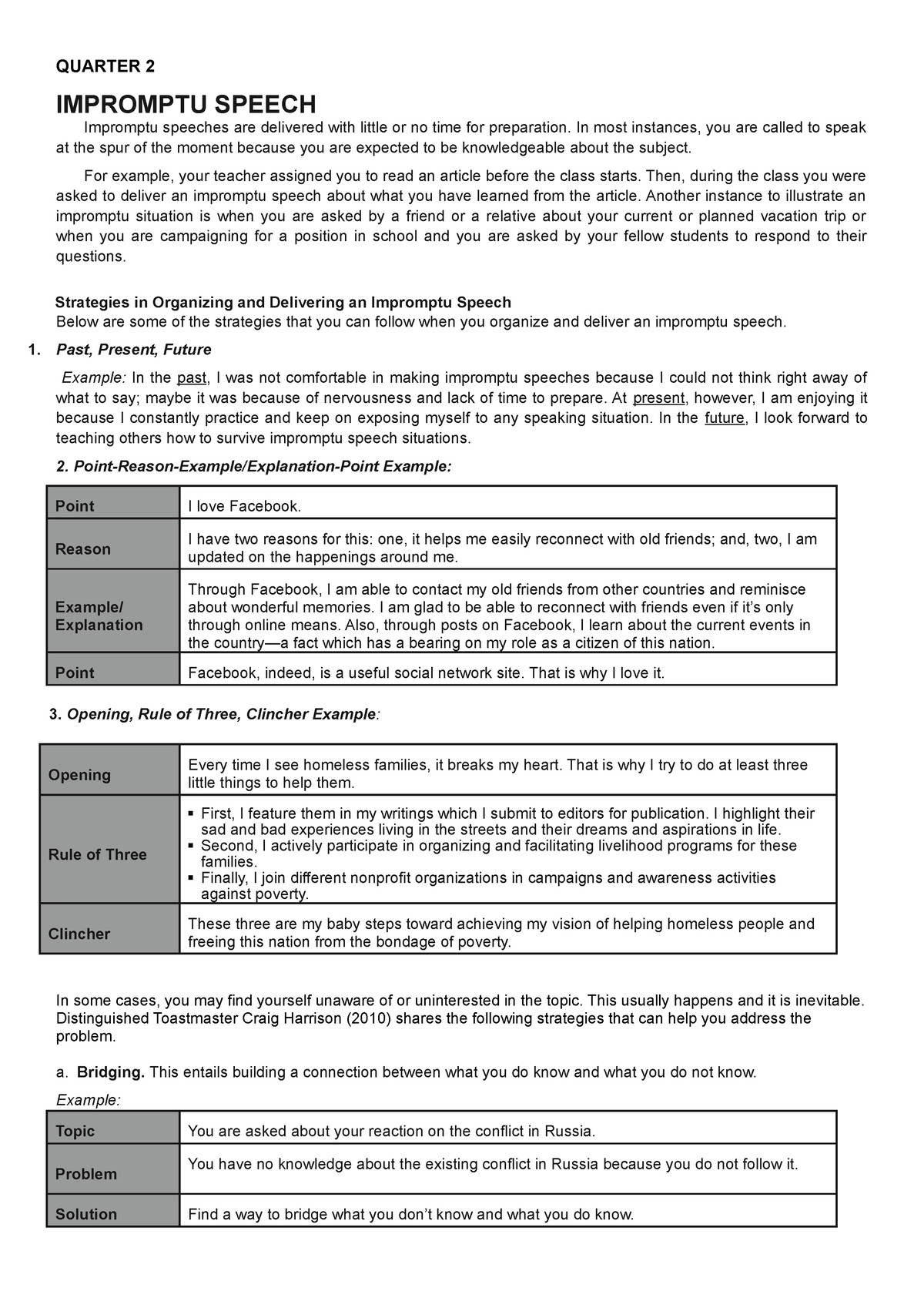
As the image and the Project Charisma article suggest, you can structure your response around:
- Three reasons for an argument.
- Three lessons learned from an experience.
- Three case studies or examples.
B. Advanced Three-Point Frameworks
Beyond a simple list, you can use more specialized three-point frameworks that are tailored to specific types of questions.
How to Talk to People and Explain Anything at Ease
The article 'How to Talk to People and Explain Anything at Ease' from Lifehack.org presents several excellent spontaneous speaking structures. We'll focus on three of the most useful three-part frameworks.
Please read the following three sections: Section 1: 'What? So What? Now What?' Section 3: 'Problem/Opportunity – Solution – Benefit' Section 4: 'ADD (Answer – Detail – Describe)' Think about when you might use each of these frameworks.
Let's quickly summarize these powerful models:
-
What? So What? Now What?
- What? State the fact, event, or idea.
- So What? Explain its importance or implications.
- Now What? Propose a next step or call to action.
- Best for: Explaining a situation, analyzing an event, or reflecting on a piece of information.
-
Problem – Solution – Benefit
- Problem: Identify a challenge or an opportunity.
- Solution: Propose a way to address it.
- Benefit: Explain the positive outcome of your solution.
- Best for: Persuading someone, pitching an idea, or answering "what should we do about X?" questions. This framework is particularly effective in professional and academic settings.
-
Answer – Detail – Describe Value (ADD)
- A: Answer the question directly and concisely.
- D: Detail your answer with an example, story, or data.
- D: Describe the value or relevance of your answer to the listener.
- Best for: Q&A sessions, interviews, or when you need to give a direct answer and then elaborate.
Test your understanding!
Imagine you are at a networking event for economics students and a professor asks you, "What's your take on carbon pricing as a tool to combat climate change?"
Outline a brief, on-the-spot answer using the Problem – Solution – Benefit framework. Just write one sentence for each of the three parts.
Show answer
Here is one possible way to structure the response:
- Problem: "The core economic problem with climate change is the negative externality of carbon emissions, where the full social cost isn't reflected in the market price of goods and services."
- Solution: "Carbon pricing addresses this directly by creating a financial incentive for businesses and consumers to reduce their carbon footprint, either through a tax or a cap-and-trade system."
- Benefit: "Ultimately, this not only helps us meet climate goals but also drives innovation in clean technology and creates new markets for sustainable solutions, fostering long-term economic resilience."
This structure allows you to give a comprehensive, well-reasoned answer that showcases your understanding of economic principles in a clear and persuasive way.
Conclusion
Today, we've added a fundamental and highly flexible tool to your impromptu speaking arsenal. The three-point list, or the Rule of Three, is more than just a speaking trick; it's a powerful framework for organizing your thoughts under pressure, ensuring your message is clear, memorable, and impactful. By mastering different variations of this rule, you can confidently respond to a wide range of questions and topics.
Key Takeaways:
- The Rule of Three is effective because it creates a memorable pattern that feels complete to the human brain.
- Thinking in frameworks (like the three-point list) reduces cognitive load and allows for quick, structured responses.
- You can use a simple list of three reasons, examples, or lessons.
- For more specific situations, you can use frameworks like Problem-Solution-Benefit, What?-So What?-Now What?, or Answer-Detail-Describe Value.
Preview of the Next Lesson:
So far, we've focused on frameworks for structuring your own ideas (PPF and the Rule of Three). But great conversation isn't just about delivering well-structured monologues; it's about dynamic interaction. In our next lesson, we will shift focus to a more collaborative technique by learning to use the 'Yes, and...' improvisational principle to build upon others' ideas constructively. This will help you move from simply responding to co-creating the conversation.