Hello! Welcome back to our module on "Quick Thinking and Impromptu Speaking."
In our last lesson, we focused on frameworks like the "Rule of Three" that help you structure your own thoughts into a clear, concise monologue. This is an essential skill for delivering a well-organized answer. However, most conversations aren't a series of monologues; they are a dynamic, interactive dance.
Today, we'll shift our focus from structuring your own ideas to co-creating ideas with others. You will learn to use the 'Yes, and...' improvisational principle to build upon others' ideas constructively. This technique, born from improvisational theater, is a powerful tool for making conversations more creative, collaborative, and engaging. For you, this is another "energy management" strategy: by building on what's already there, you reduce the pressure to generate entirely new topics, making interactions feel less like a performance and more like a partnership.
1. What is 'Yes, and...'? The Core Principle
At its heart, 'Yes, and...' is a simple two-step process:
- Yes: You accept the reality or premise of what the other person has said. This signals agreement and validation.
- And: You add a new piece of information, building upon their contribution. This moves the conversation forward.
This principle is the cornerstone of improvisational comedy, where actors must create scenes together on the spot.
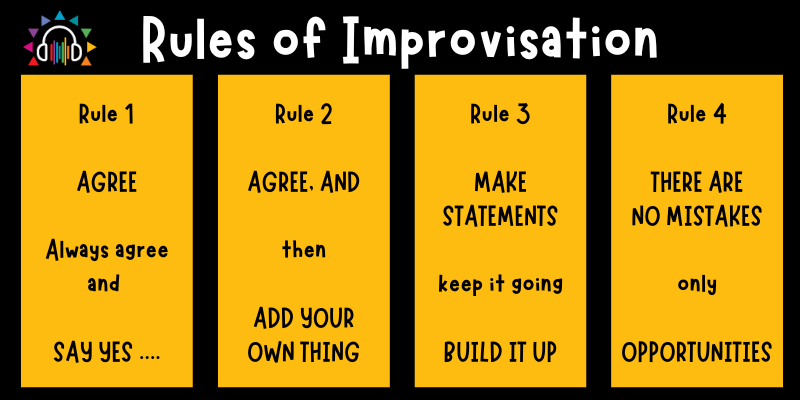
To get a clear understanding of this concept in a real-life context, let's watch a short segment from a TEDx talk.
YES, AND: THE POWER OF IMPROV IN EVERYDAY LIFE | REBECCA WAHLS | TEDxCMU
In her TEDx talk, 'YES, AND: THE POWER OF IMPROV IN EVERYDAY LIFE,' Rebecca Wahls provides a fantastic introduction to this principle. She explains why it's such a valuable rule for everyday interactions.
Watch from 01:26 to 03:01. Pay close attention to her definition of 'Yes, and...' as a 'bridge between points in a conversation' and why she argues it's more applicable to daily life than other improv rules like 'never say no.'
2. Why Does 'Yes, and...' Work? The Social Framework
The power of 'Yes, and...' goes beyond a simple conversational trick. It taps into a deep-seated social dynamic. Your background in economics involves understanding how frameworks and models explain human behavior; similarly, sociology offers frameworks for social interaction.
Sociologist Erving Goffman described social life using a "dramaturgical" model, suggesting we are all actors on a stage. In any interaction, we present a "line"—a pattern of behavior that expresses our view of the situation and ourselves. When you use 'Yes, and...', you are essentially endorsing the other person's line. You are accepting the version of reality they are presenting, which is a fundamentally generous and welcoming act.
Unlock Amazing Conversations: The 'Yes, And' Secret
This video from the 'How Communication Works' channel does an excellent job of explaining the social and psychological weight of 'Yes, and...'. It connects the principle directly to Goffman's theories, giving you a solid theoretical foundation for why it builds rapport.
Please watch from 02:20 to 06:28. The first minute offers a quick recap of the principle, but the core of this segment is the explanation of how 'saying yes' to someone's 'line of action' makes them feel accepted and encourages conversational adventure.
By accepting their premise, you lower their defenses and invite them to be more open and creative. The conversation stops being a series of competing agendas and becomes a shared exploration.
3. 'Yes, and...' in Action: Constructive Dialogue
The true test of this principle is in its application, especially when you don't fully agree with an idea. 'Yes, and...' is often misunderstood as "Yes, I agree with everything you said." In reality, it's about finding something to agree with—the premise, the intention, or a part of the idea—and then building from there.
This contrasts sharply with the common responses:
- "No, but...": This is a direct negation. It shuts down the other person's idea and replaces it with your own, creating an adversarial dynamic.
- "Yes, but...": This is a disguised "No." It seems agreeable at first but ultimately dismisses the original idea. The "but" invalidates everything that came before it.
Let's see a practical demonstration of how 'Yes, and...' allows for constructive disagreement.
YES, AND: THE POWER OF IMPROV IN EVERYDAY LIFE | REBECCA WAHLS | TEDxCMU
Returning to Rebecca Wahls' TEDx talk, she provides a brilliant example of using 'Yes, and...' in a group project scenario. This perfectly illustrates how to guide a conversation toward your own idea without shutting down your partner.
Watch from 03:01 to 05:55. Notice how the 'Yes, and...' response identifies a useful part of the original proposal (the historical period) before adding a new element. Contrast this with the dead-end created by the 'No, but...' response.
This technique is incredibly useful in academic and professional settings. Here are some practical phrases you can adapt.
How to Master Improv Techniques in Tough Workplace Conversations
For some concrete, ready-to-use phrases, let's look at the article 'How to Master Improv Techniques in Tough Workplace Conversations.' It offers specific scripts for applying this principle in discussions and disagreements.
Please read the sections 'The Power of Yes, And' and 'Turning Disagreements into Dialogues.' The phrase 'Yes, I see the potential benefits of that approach, and I wonder if we could also consider…' is a perfect template for your toolkit.
Test your understanding!
Imagine you are in a study group for your economics class. A group member suggests, "To analyze the effect of interest rates on investment, we should gather 50 years of data from 20 different countries. It will be very comprehensive." You feel this is too ambitious for the deadline.
Formulate both a "Yes, but..." response and a "Yes, and..." response.
Show answer
-
"Yes, but..." response: "Yes, that would be comprehensive, but we'll never finish that in time. We should just focus on the US for the last 20 years." (This dismisses their ambition and creates a slight conflict).
-
"Yes, and..." response: "Yes, a multi-country analysis would give us incredibly robust findings! That’s a great long-term goal. And to make sure we can deliver a strong initial presentation by the deadline, what if we start with a deep dive into the US data for the last 20 years and propose the multi-country analysis as the next phase of the project?" (This validates their ambition, affirms the value of their idea, and then constructively adds a practical constraint to move forward).
4. The Necessary Caveat: When Not to 'Yes, and...'
'Yes, and...' is a powerful tool for collaboration and creativity, but it is not a rule for life. You are not obligated to agree with or build upon ideas that are harmful, unethical, or violate your personal boundaries. In improv, the principle works because all participants share a goal: create a good scene. In life, agendas can differ.
It's crucial to distinguish between a collaborative offer and a statement that needs to be directly challenged.
Is the "Yes, And" Improv Rule a Rule for Life?
To ensure we have a balanced perspective, the article 'Is the "Yes, And" Improv Rule a Rule for Life?' provides a vital discussion on the limitations of this principle.
Please read the section titled 'Major Caveat about the "Yes, And" Improv Rule.' The author makes it clear that 'No' is still a powerful and necessary tool for maintaining boundaries and shutting down things that need to be shut down.
The key is to use your judgment. Use 'Yes, and...' to build creative ideas, solve problems collaboratively, and explore flights of fancy. Use a firm 'No' or a direct challenge when dealing with racism, sexism, misinformation, or anything that compromises your values.
Conclusion
Today we've moved from the structured world of individual responses to the dynamic world of collaborative conversation. The 'Yes, and...' principle is more than a technique; it's a mindset that prioritizes collaboration over confrontation. By accepting and building on others' ideas, you not only make conversations more creative and enjoyable but also make your conversation partners feel valued and heard.
Key Takeaways:
- 'Yes, and...' is an improv principle where you first accept a premise ('Yes') and then add to it ('and').
- It works by socially validating the other person, framing the interaction as a collaborative partnership rather than a competition.
- It's a highly effective tool for brainstorming, creative problem-solving, and having constructive disagreements without being adversarial.
- It is not a rule for blind agreement. Maintaining your personal boundaries and values is paramount, and sometimes a direct 'No' is the right response.
Preview of the Next Lesson:
So far in this module, we've learned frameworks for structuring your own ideas (PREP, Rule of Three) and a principle for building on others' ideas ('Yes, and...'). In our final lesson for this module, we will combine these skills to tackle one of the most challenging impromptu situations you mentioned: the 'hot-seat' question. We'll learn how to handle 'hot-seat' questions by acknowledging the premise, delivering a concise answer, and redirecting, giving you maximum composure and control in high-pressure moments.