Hello! Welcome to the next lesson in our "Quick Thinking and Impromptu Speaking" module.
In our last session, we focused on techniques like tactical pauses and paraphrasing to create essential thinking time when you're put on the spot. Now, the question is: what do you do with that time? How do you organize your thoughts quickly and coherently?
This lesson directly addresses that question by teaching you how to apply the 'past-present-future' framework to quickly organize thoughts on a topic. This framework is one of the most reliable and versatile mental models for impromptu speaking. It’s incredibly effective because it’s simple to recall under pressure and provides a natural, narrative structure for your response. For you, this is a perfect "energy management" tool—it reduces the cognitive load of inventing a structure from scratch, allowing you to focus on the content of what you want to say.
1. Understanding the Past-Present-Future (PPF) Framework
At its core, the PPF framework is a simple chronological storytelling device. When faced with a topic, you structure your response by breaking it down into three parts:
- Past: Where did this topic come from? What is the background or historical context?
- Present: What is the current situation? What is happening right now?
- Future: Where is this topic heading? What are the potential outcomes or next steps?
This structure transforms a potentially jumbled set of ideas into a clear, logical, and engaging mini-narrative.
To start, let's watch a brief clip that introduces this concept within the context of impromptu speaking strategies.
Toastmasters 101 Impromptu Speaking Course
This clip from the 'Toastmasters 101 Impromptu Speaking Course' on the ToastmasterTalks channel quickly introduces the Past-Present-Future strategy and provides a simple example.
Please watch from 07:06 to 08:20. Notice how the speaker positions PPF as one of three core strategies and then demonstrates it with the topic of television.
As you can see, this framework provides an instant and easy-to-follow path for your thoughts, preventing you from rambling and helping you build a coherent point.
2. Seeing the Framework in Action
The true power of the PPF framework lies in its versatility. It can be applied to almost any topic, from personal experiences to complex societal issues. Let's look at some detailed examples.
Impromptu speech outline: 7 structural patterns with examples
The article 'Impromptu speech outline: 7 structural patterns with examples' from Write-out-Loud.com provides excellent illustrations of the PPF framework. It will show you how the same structure can be applied to both a personal, anecdotal topic and a more factual one.
Please read section 2, titled 'Past, Present, Future.' Focus on the two examples provided: one about getting children to eat vegetables, and the other about popular children's toys. Observe how the framework organizes the speaker's thoughts in both cases.
The first example ("vegetables") uses personal narrative to make its point, while the second ("toys") uses historical facts. Both are effective because the chronological structure makes the information easy for an audience to digest.
Now, let's look at another common scenario where this framework is useful: giving a quick personal or professional update.
How to Brilliantly Articulate Your Thoughts - StoryLab
The article 'How to Brilliantly Articulate Your Thoughts' from StoryLab offers a very practical example of using the PPF framework in a common conversational setting.
Read section 3, titled 'Past, Present, Future.' Pay close attention to the example provided in response to the question, 'How’s your new role going?'.
This example is perfect for everyday conversation. Instead of a simple "It's fine," the PPF structure allows you to give a more thoughtful and engaging answer that shows progress and ambition.
3. Visualizing and Adapting the Framework
While "Past-Present-Future" is the standard order, the framework is flexible. Sometimes, it can be more effective to start with the present situation, especially in a professional context like a job interview or a project update. This variation is often called "Present-Past-Future."
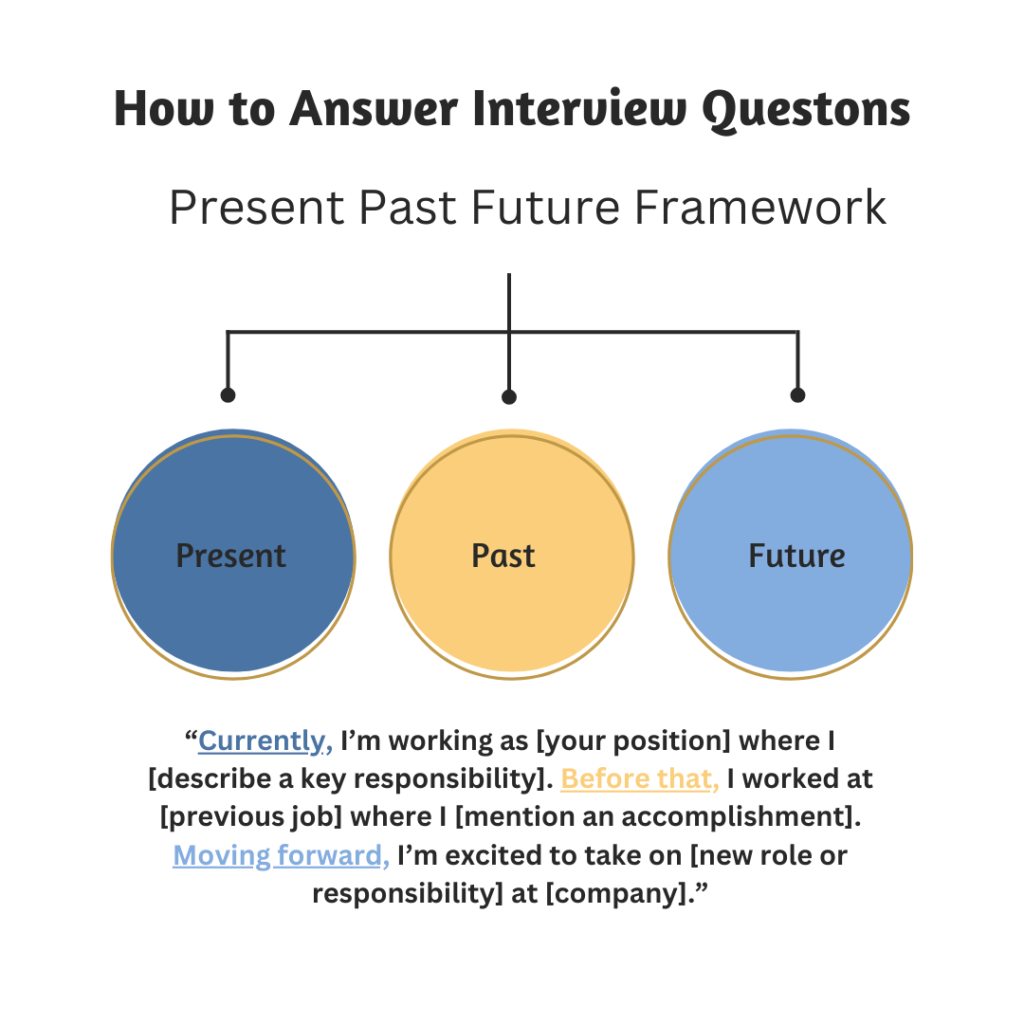
Here's how to decide which order to use:
- Past-Present-Future: Best for explaining the evolution of a topic or telling a story. It builds context first, leading the listener on a journey. Use this for broader, more open-ended questions.
- Present-Past-Future: Best for giving a status update or answering a direct question about the current situation. It gives the core answer upfront and then uses the past and future to add depth and perspective.
The choice depends on the question and your goal. Do you need to build context first, or do you need to be direct?
Test your understanding!
You are in a discussion about economic policy, drawing on your Applied Economics background. Someone asks you, "What do you think about the trend of remote work?"
Outline a quick response using the Past-Present-Future framework. Just list one key idea for each of the three parts.
Show answer
Here's one possible way to structure the response:
- Past: "Historically, work was tied to a physical location, like a factory or an office. For decades, the daily commute was a non-negotiable part of most professional jobs."
- Present: "Today, accelerated by the pandemic, technology has decoupled work from location for many knowledge workers. We're currently in a massive societal experiment, with companies adopting fully remote, hybrid, or full return-to-office models, and we're seeing real-time effects on productivity, city economies, and employee well-being."
- Future: "Looking ahead, I believe we won't see a single dominant model. Instead, the future of work will likely be a fragmented landscape. We might see a greater emphasis on contractual, project-based work over traditional employment, and economic geography could shift as people are no longer tethered to expensive urban centers."
This structure allows you to provide a comprehensive and thoughtful answer that draws on historical context, current events, and future trends—all organized by a simple, memorable framework.
Conclusion
You now have a new, powerful tool in your impromptu speaking toolkit. The Past-Present-Future framework provides a simple, low-effort, high-impact structure that can bring clarity and confidence to your on-the-spot responses. It leverages the natural human affinity for narrative and reduces your cognitive load, allowing you to construct a coherent argument even under pressure.
Key Takeaways:
- The Past-Present-Future framework is a simple chronological structure for organizing thoughts on any topic.
- It works by establishing context (Past), describing the current situation (Present), and speculating on what's next (Future).
- This creates a natural narrative flow that is easy for listeners to follow and makes your response more engaging.
- The framework is flexible and can be adapted to a Present-Past-Future order for more direct answers, such as in project updates or interviews.
Preview of the Next Lesson:
The PPF framework is chronological. But what if a topic doesn't lend itself to a timeline? In our next lesson, we will learn another simple but powerful method: how to structure on-the-spot answers using a simple three-point list. This will give you a complementary tool for organizing your thoughts logically and thematically.