Hello! Welcome back to our module on Structured Argumentation and Debate.
In our last lesson, we explored the Point-Counterpoint-Synthesis framework, a powerful way to rise above simple binary arguments and create a more sophisticated, well-rounded position. A key step in that process, particularly in moving from counterpoint to synthesis, is acknowledging the valid points made by the other side. Today, we'll master that specific skill.
Your learning outcome for this lesson is to concede minor points strategically to strengthen your core position.
This might sound counterintuitive. Why would you admit your opponent is right about something? As we'll see, making a strategic concession is one of the most powerful moves you can make. It demonstrates confidence, builds your credibility, and allows you to control the focus of the conversation.
For your goals, this is a triple win:
- Debate Skill: It makes you appear reasonable and in command of the topic, forcing the debate onto the ground where you are strongest.
- Deeper Bonds: It lowers the other person's defensiveness and shows that you are listening to understand, not just to rebut. This transforms an adversarial exchange into a more collaborative one.
- Energy Management: As you know, arguing can be draining. Fighting over every single detail is exhausting. Strategic concession allows you to conserve your mental energy for the arguments that truly matter.
1. The Power of Concession: Building Credibility
First, let's reframe what a concession is. It's not an admission of defeat. It's a tool for establishing your own credibility and creating common ground, which you can then use as a foundation to build your more important points. By conceding a minor point, you signal that you are a thoughtful, reasonable person who has considered the issue from all sides.
There is no better example of this than Frederick Douglass's famous 1852 speech, "What, to the American slave, is your 4th of July?". Before delivering a searing critique of American hypocrisy, he spent the first third of his speech praising the nation's founders. To understand why this was so effective, let's look at an analysis of his strategy.
Understanding Arguments: On Counterarguments ...
The article 'Understanding Arguments: On Counterarguments, Concessions and Rebuttals' from Elite Prep provides a brilliant breakdown of why concessions are so persuasive, using a powerful historical example.
Please read from the section that begins with 'As a case in point, consider one of the “strongest” rhetorical excerpts...' down to the line '...To this end, they establish their authors’ credibility as truth-seekers.' Focus on how Douglass's extensive praise of the Founding Fathers (his concession) made his later criticism even more powerful.
As the article argues, concessions establish you as a "reasonable, thoughtful, and educated" individual. When you grant that an opposing view has some merit, you're not weakening your argument; you're strengthening your position as a credible speaker. You show that you're not afraid of the other side's arguments because your core position is strong enough to withstand them.
2. The Art of the Triage: When to Concede
The key word in our learning outcome is "strategically." You can't concede every point, and you certainly can't concede your central claim. So, how do you decide which points to concede and which to fight?
This is a form of intellectual triage. In your study of economics, you understand the concept of opportunity cost. Every minute you spend defending a weak or tangential point is a minute you can't spend advancing your strongest argument. A master debater wisely "spends" their time and energy where it will yield the highest return.
Bo Seo, a former Harvard debate coach, offers a simple yet profound framework for making this decision.
Train for any argument with Harvard’s former debate coach | Bo Seo
In this video from Big Think, Bo Seo explains that wisdom in debate isn't about answering every argument, but knowing which ones to answer. His insights provide a clear test for when a concession is the right move.
Please watch from the beginning of the clip (02:11) to (03:13), and then from (05:59) to (07:36). Pay close attention to the two questions he suggests asking to decide whether to challenge a point.
As Bo Seo explains, before you challenge a point, you should ask yourself two questions:
- Is this disagreement necessary to resolve in order to make progress?
- Even if it's not necessary, will challenging it help us make progress on the overall dispute?
If the answer to both questions is "no," then that point is a prime candidate for a strategic concession. You can grant the point and move on, saving your energy for the core of the disagreement.
Let's say you're debating a new public transportation project. Your main argument is that it's too expensive. Your opponent argues that the new buses will have more comfortable seats than the old ones.
- Is it necessary to disagree about the seats to debate the cost? No.
- Will arguing about seat comfort help you make progress on your financial argument? No.
This is a perfect point to concede. "You're right, the new seats will definitely be more comfortable. But let's focus on whether we can afford them..."
3. The Anatomy of a Concession: How to Do It Gracefully
Once you've identified a point to concede, there's a technique to doing it effectively. A well-executed concession follows a simple three-step process: Acknowledge, Minimize, and Redirect.
Let's explore the basic principles of this technique.
6.5 Time allocation and strategic concessions
This study guide from Fiveable, while designed for formal debate, provides a clear outline of the techniques for making concessions. We'll use its structure as a guide.
Please review the section titled 'Techniques for effective concessions.' You don't need to read the whole page, just focus on the three bullet points in that section: 'Acknowledging valid points,' 'Minimizing damage to case,' and 'Redirecting focus to strengths.'
Here's how those three steps work in practice:
-
Acknowledge: State clearly and generously that you agree with the specific point. Don't hedge. This is where you build credibility.
- "That's a very fair point."
- "I agree with you completely on that."
- "You're right to point out that..."
-
Minimize (or Reframe): Subtly frame the conceded point as less important than your core argument. You're not dismissing it, but you are contextualizing it as a secondary concern.
- "...and while that's an important consideration..."
- "...but that's a matter of implementation, not principle."
- "...however, that addresses a symptom, not the root cause."
-
Redirect (or Pivot): Smoothly transition back to your main argument. This is where you regain control of the narrative.
- "...the more critical issue we need to solve is..."
- "...what we really need to focus on is..."
- "...so let's turn to the fundamental question of..."
Combining them looks like this:
"(Acknowledge) You're right, the administrative costs of this proposal are higher than the current system. (Minimize) But when we're talking about a multi-billion dollar project, that difference is a rounding error. (Redirect) The fundamental question we must answer is whether the long-term economic benefits justify the initial investment."
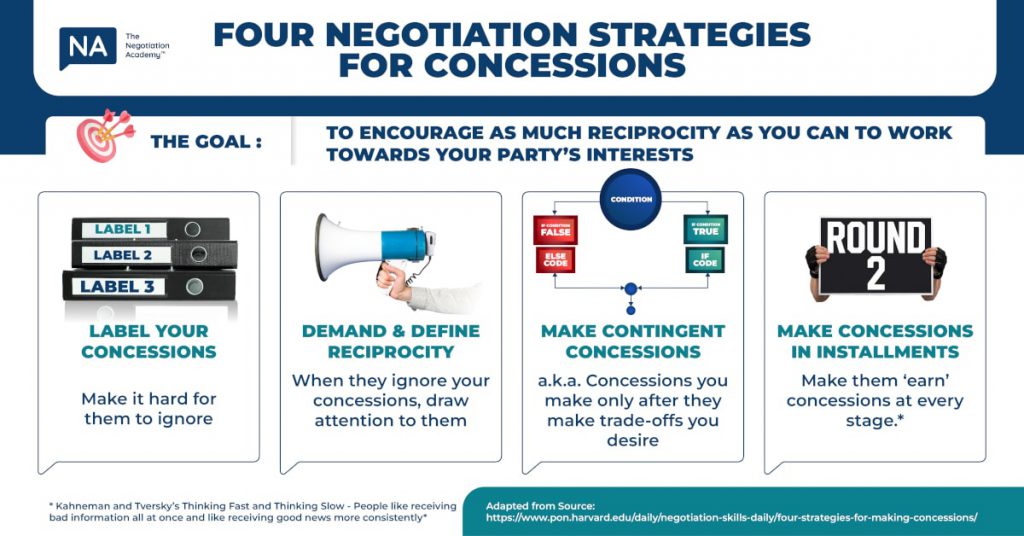
This infographic, while focused on negotiation, provides a great visual summary of the proactive mindset behind strategic concessions.
Test your understanding!
You are arguing that your city should invest in bike lanes (your core argument is about environmental benefits and long-term health). Your opponent argues that removing a lane of traffic for bikes will make traffic jams worse for cars in the short term.
How would you use the Acknowledge-Minimize-Redirect framework to concede this point strategically?
Show answer
Here's one possible way:
- (Acknowledge): "You're absolutely right. In the first few months, as drivers adjust, there will likely be an increase in traffic congestion along that route. That's a valid concern."
- (Minimize): "However, research from other cities shows this is a temporary effect. The real question isn't about short-term inconvenience, but about long-term vision."
- (Redirect): "And the long-term vision has to be about reducing the total number of cars on the road, which is the only sustainable way to solve traffic. By providing a safe alternative, these bike lanes are a crucial first step towards that goal, leading to cleaner air and a healthier population."
Conclusion
Today, we've added a sophisticated and powerful tool to your argumentation toolkit. Strategic concession is a hallmark of a confident and persuasive communicator. It allows you to build credibility, manage the flow of a debate, and focus the discussion on the territory where you are strongest.
Key Takeaways:
- Concession is strength: Granting a minor point shows you are confident, reasonable, and have a strong command of your core argument.
- Be strategic: Use Bo Seo's two questions to decide if a point is worth fighting over. If not, concede it. This is a crucial tactic for managing your social energy.
- Follow the framework: Use the Acknowledge-Minimize-Redirect method to make your concession gracefully and pivot back to your main points.
Preview of the Next Lesson:
Once you've used concession to focus the debate on your core claim, you need to back it up. Our next lesson, "Support arguments with credible evidence, such as statistics, expert opinion, or analogies," will equip you with the tools to do just that, ensuring your key points are not just asserted, but proven.