Hello! Welcome back to our module on Structured Argumentation and Debate.
In our last lesson, you learned the powerful technique of 'steel-manning'—articulating the strongest, most compelling version of an opposing argument. This skill is about engaging with ideas in good faith and is a hallmark of a truly confident and intellectually honest communicator.
Today, we will put that skill into a formal structure. We're moving beyond simply responding to a counter-argument and learning how to use the tension between opposing views to create something new and more powerful.
Your learning outcome for this lesson is to use the point-counterpoint-synthesis approach to structure a debate.
This framework, also known as Thesis-Antithesis-Synthesis, is a cornerstone of effective argumentation and a secret weapon for charismatic communication. For your debate goals, it provides a sophisticated structure that goes beyond a simple "for" and "against." For building deeper connections, it shows you are interested in finding the best possible outcome, not just in winning. This collaborative approach can also make intellectual disagreements feel less like a draining battle and more like a shared journey toward understanding—a key element of managing your social energy.
1. The Dialectic: A Framework for Resolving Conflict
At its core, the point-counterpoint-synthesis model is a form of dialectic: a structured process for resolving contradictory viewpoints through reasoned discussion. Instead of two ideas clashing until one wins, they merge to form a third, more refined idea.
To get a clear understanding of this framework, let's look at an article that breaks it down.
Persuasive Writing In Three Steps: Thesis, Antithesis, ...
The article 'Persuasive Writing In Three Steps: Thesis, Antithesis, Synthesis' by Ryan Law explains this powerful structure, which is directly applicable to debate.
Please read from the beginning of the article down to the end of the section 'Creates a sense of inevitability.' Focus on understanding the role of each of the three steps and why this structure is so persuasive.
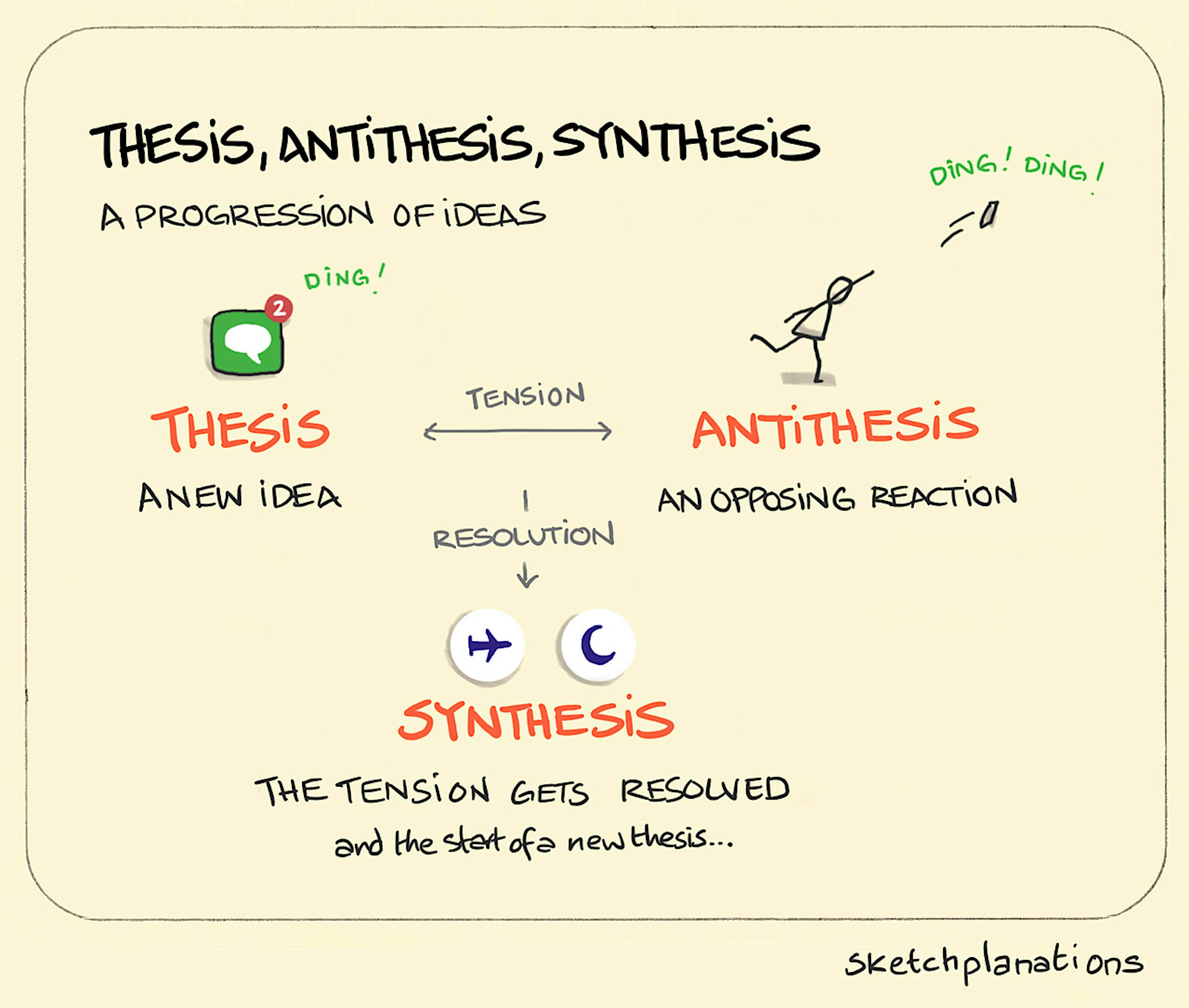
As the article explains, the three stages are:
- Thesis (Point): This is the initial argument, the status quo, or the proposition being put forward.
- Antithesis (Counterpoint): This is the counter-argument. To be effective, this shouldn't be a weak objection; it should be the strongest possible opposition. This is where your steel-manning skill from the last lesson becomes critical.
- Synthesis: This is the resolution. It's a new viewpoint that reconciles the valid points of both the thesis and the antithesis. It's not just a compromise; it's a more sophisticated, higher-level understanding that resolves the initial conflict.
This progression creates a compelling journey for your audience, moving from a simple idea, through a challenge, to a satisfying and well-reasoned conclusion.
2. Structuring an Argument with Point-Counterpoint-Synthesis
This framework isn't just a theoretical concept; it's a practical tool for structuring persuasive content. An argument built this way demonstrates that you have thoroughly considered the issue from multiple angles.
Let's return to the same article to see a concrete example of this structure in action.
Persuasive Writing In Three Steps: Thesis, Antithesis, ...
Let's continue with the article from Animalz to see how this framework is applied to a full-length argument.
Now, read the section titled 'Structuring Entire Articles with TAS.' Pay close attention to how the author breaks down the example article ('The Hive is the New Network') into its thesis, antithesis, and synthesis components.
Notice the key insight from the example: the bulk of the argument is dedicated to the synthesis. The thesis (the old way) and antithesis (the problems with the old way) are relatively straightforward to state. The real intellectual work lies in developing a new position that solves the problems of the thesis without succumbing to other flaws. This is what makes an argument robust and convincing.
3. A Formal Model for Debate: The "Complex Middle"
How does this translate into a live debate? While a traditional two-sided debate pits a point directly against a counterpoint, a more advanced format explicitly carves out a role for synthesis.
The "Three-Sided Debate" model does exactly this. It features a "for" team (Thesis), an "against" team (Antithesis), and a "complex middle" team whose job is to create the Synthesis. Let's explore the instructions for this third team, as they provide an excellent guide for what you should be aiming for when you create a synthesis.
A Three-Sided Pedagogical Model for Classroom Debate
The paper 'A Three-Sided Pedagogical Model for Classroom Debate' by Ijaz and Sergeant details a debate format that institutionalizes the synthesis role. We'll focus on the specific instructions given to the synthesis team.
Please read the section 'The Model' and the 'Debate Assignment Sheet' in the Appendix. Pay special attention to the instructions for the 'complex middle' teams in both sections. These instructions are a brilliant recipe for creating a strong synthesis.
As you saw, the 'complex middle' or synthesis team is explicitly tasked with:
- Pointing out inconsistencies or problems on both sides.
- Looking for common ground (e.g., shared values or goals) as well as irreconcilable differences.
- Suggesting a conciliatory stance that shows how the two viewpoints might productively co-exist or compromise.
This is the essence of moving a debate from a zero-sum game to a constructive dialogue.
Test your understanding!
Imagine you're in a debate. One side argues for complete free speech online, with no moderation (Thesis). The other side argues for heavy moderation to eliminate all harmful content (Antithesis). What kind of questions would you ask, or what areas would you explore, to start building a Synthesis?
Show answer
To build a synthesis, you would move beyond the binary and explore the nuances. You might ask:
- What do both sides agree on? (e.g., a desire for a healthy online environment, a dislike for censorship by authoritarian governments).
- Can we define "harmful content" in a way that is objective and not open to abuse?
- Are there different types of content that require different rules (e.g., illegal content vs. merely offensive content)?
- Could a solution involve user-controlled tools (like advanced filters) rather than top-down censorship?
- What is the role of platform design in promoting or discouraging toxic behavior?
Exploring these questions moves the conversation from "all or nothing" to "how and under what conditions."
4. Practice: Building a Synthesis
Let's apply this to the topic from our last lesson. Your background in Applied Economics will be very useful here.
Scenario: You are moderating a debate on climate policy.
- Point (Thesis): "We must implement a carbon tax immediately. It is the most economically efficient, market-based mechanism to price carbon, reduce emissions, and incentivize a transition to clean energy."
- Counterpoint (Antithesis): You have already steel-manned this position. The strongest counter-argument is: "A carbon tax is a regressive policy that disproportionately harms low-income households. It also puts our domestic industries at a competitive disadvantage against foreign companies without such a tax, leading to job losses and 'carbon leakage' where emissions are just offshored."
Your task is to act as the "complex middle." Propose a Synthesis that acknowledges the truth in both positions and offers a more sophisticated path forward. What would a policy look like that captures the efficiency of the tax but mitigates its negative consequences?
Take 5-10 minutes to formulate your synthesis.
Show a possible synthesis
Here is one example of a strong synthesis. Yours might differ, but it should aim for a similar reconciliation of the opposing views.
"Both sides have identified critical truths. The 'pro' side is correct that pricing carbon is essential for an efficient market transition. The 'anti' side is correct that we must protect vulnerable households and our economic competitiveness.
Therefore, a more robust solution—a synthesis—is not just a simple carbon tax, but a 'Carbon Fee and Dividend' policy.
Under this model, a fee is collected on carbon emissions at the source. However, 100% of the net revenue is returned directly to citizens on an equal, per-capita basis. This addresses the regressive impact, as most low- and middle-income families would receive more in dividends than they pay in increased costs, making the policy progressive.
To address economic competitiveness and carbon leakage, we would implement a 'Border Carbon Adjustment.' This is essentially a tariff on goods imported from countries that don't price carbon, leveling the playing field for our domestic industries.
This synthesis captures the market efficiency of the thesis while directly solving the equity and competitiveness problems raised by the antithesis, creating a policy that is both environmentally effective and socially just."
Conclusion
Today, you've learned to use one of the most powerful structures in argumentation. The point-counterpoint-synthesis framework allows you to control a debate by rising above the binary conflict and demonstrating a more comprehensive understanding of the issue.
Key Takeaways:
- The Point-Counterpoint-Synthesis (or Thesis-Antithesis-Synthesis) model is a dialectical method for resolving arguments.
- It involves stating an initial Point (Thesis), engaging with the strongest Counterpoint (Antithesis), and creating a new, superior position—the Synthesis.
- An effective synthesis doesn't just split the difference; it integrates the valid insights from both sides to form a more complete and resilient solution.
- This structure transforms a debate from an adversarial fight into a collaborative search for a better answer.
Preview of the Next Lesson:
Building a powerful synthesis often requires you to acknowledge that the other side has valid points. Our next lesson, "Concede minor points strategically to strengthen your core position," will delve into this crucial skill. You'll learn how making smart concessions can actually make your overall argument more credible and persuasive, a key tactic in moving from counterpoint to a successful synthesis.