Hello! Welcome back to your module on "Structured Argumentation and Debate."
In our last lesson, we broke down arguments into their core components using the Toulmin model. We saw how a good argument isn't just about making a claim, but about supporting it with grounds and connecting them with a warrant. We also touched on the importance of the rebuttal—acknowledging counter-arguments.
Today, we're going to elevate that concept. Instead of simply acknowledging an opposing view, you'll learn how to engage with it in the most intellectually rigorous way possible. This is a technique used by sharp thinkers, skilled debaters, and effective leaders to foster genuine understanding and build incredibly resilient arguments.
Your learning outcome for this lesson is to practice 'steel-manning' by articulating the strongest possible version of an opposing argument.
This skill is central to your goals. For debate, it allows you to preemptively dismantle the best version of your opponent's case, not just a flimsy one. For building deeper connections, it's a powerful display of respect and intellectual integrity, showing you're more interested in truth than in simply "winning." For an introvert, this can transform a draining adversarial conflict into a more energizing, collaborative search for insight, which is a key part of managing your social energy.
1. From Straw Man to Steel Man
In a previous lesson, you learned to identify the straw man fallacy—the dishonest tactic of misrepresenting an opponent's argument to make it easier to attack. The "steel man" is the exact opposite. It's an act of intellectual good faith.
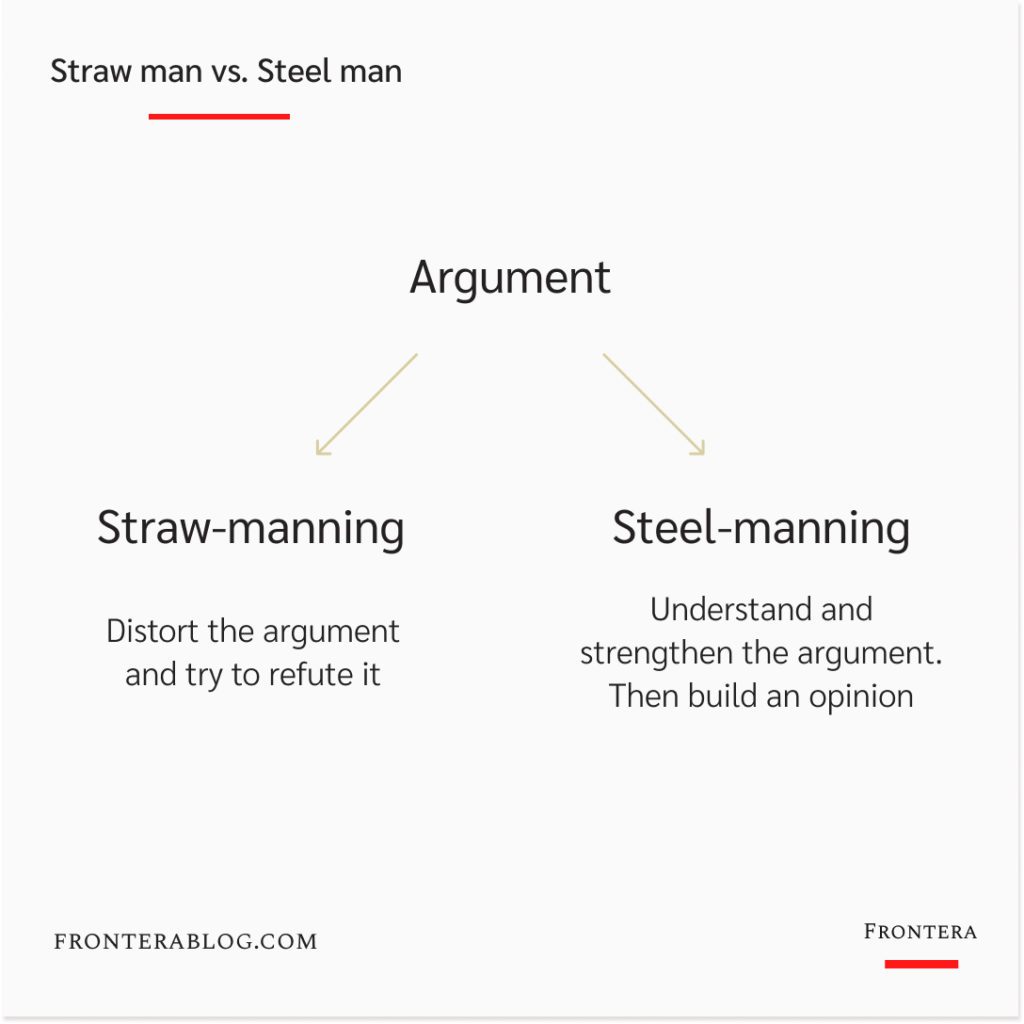
To steel-man an argument, you must first understand it, then actively try to improve it. You reformulate your opponent's position in its most persuasive, rational, and compelling form before you present your own counter-arguments.
Let's watch a short video that explains this distinction clearly.
Steel Man Argument - Explained
The video 'Steel Man Argument - Explained' from Philosophy Vibe offers a concise introduction to the concept and provides some simple, clear examples.
Watch from 00:56 to 03:10. Pay close attention to how the speaker doesn't just repeat the opponent's argument, but actively rephrases and adds information to make it stronger.
2. Why Bother Strengthening Your Opponent's Argument?
At first, steel-manning might seem counterintuitive. Why would you help someone you disagree with? The benefits are both strategic and relational. It's a hallmark of a truly confident and charismatic communicator.
To explore these benefits, let's turn to a reading.
The article 'Steel Manning Arguments' from MindInsight provides a great breakdown of the advantages of this technique.
Please read the section titled 'Benefits of Steel Manning'. As you read, think about how each benefit—like building stronger arguments and better relationships—aligns with your personal goals for this course.
As the article highlights, steel-manning achieves several things:
- It forces you to understand. You cannot strengthen what you do not comprehend. This process challenges your own biases and might even reveal valid points you'd overlooked.
- It strengthens your own position. By testing your ideas against the best possible version of the opposition, you identify and fortify the weak spots in your own logic.
- It builds trust and reduces hostility. People feel heard and respected when you engage with their actual ideas. This de-escalates conflict and makes the other person more receptive to hearing your perspective. It moves the conversation from a battle to a collaboration.
3. How to Steel-man: A Step-by-Step Guide
Steel-manning is a deliberate process. The "MindInsight" article we just looked at outlines a clear method. Let's walk through it.
- Listen Carefully: Set aside your own rebuttal and focus entirely on understanding what the other person is saying, both explicitly and implicitly. Ask clarifying questions.
- Find Their Best Evidence: Look for the strongest reasons that support their position, even if they didn't present them well. Ask yourself, "What's the best case someone could make for this?"
- Strengthen Their Reasoning: Add logical connections, context, or supporting arguments that make their case more compelling. Fill in any gaps.
- State It Back & Confirm: This is the most critical step. Present the strengthened version back to them for confirmation. The goal is for them to say, "Yes, that's exactly right," or even, "Thanks, I wish I'd put it that way."
- Then Respond: Only after they have confirmed your understanding should you present your counter-arguments, addressing their strongest points.
Here is an excellent practical guide that illustrates this process using a dialogue.
The article 'Steelmanning' by Luke Johnson and Anthony Magnabosco provides a clear, step-by-step example of this process in a real conversation.
Read the section 'How to Practice and Apply Steelmanning'. Pay close attention to the dialogue between Sujin and Eric, and notice how Eric follows the steps to understand, reconstruct, enhance, and present Sujin's argument before stating his own position.
4. Steel-manning in Action: A High-Stakes Debate
Now, let's see what this looks like in a real-world, high-level intellectual debate. This video features a discussion between neuroscientist Sam Harris and psychologist Jordan Peterson, two thinkers with deeply contrasting views on religion and ethics.
How To Steel Man An Opposing Argument (feat. Sam Harris and Jordan Peterson)
In this clip from 'How To Steel Man An Opposing Argument,' you'll see both speakers make a genuine effort to articulate the other's worldview fairly and accurately. This is a masterclass in the technique.
Watch the following segments carefully: 03:16 - 06:19: Listen to Sam Harris steel-man Jordan Peterson's argument about the value of religious narratives. 06:19 - 07:15: Note Peterson's reaction. Does he feel understood? This is the confirmation step. 07:15 - 12:07: Now listen as Peterson returns the favor, steel-manning Harris's position on grounding morality in science. 12:07 - 12:44: Observe Harris's response, which confirms Peterson's successful steel-man. This example showcases the power of steel-manning to create understanding even in the face of profound disagreement.
The key takeaway here is the reciprocity and the explicit confirmation. Both speakers check with each other, ensuring they are arguing against the real argument, not a phantom. This is what transforms a debate from a shouting match into a productive exploration of ideas.
5. Practice Your Skills
Now it's your turn. Given your background in Applied Economics, let's use a relevant topic.
Scenario: You are in a discussion about environmental policy. Your conversation partner makes the following argument:
"A carbon tax is a terrible idea. It's just another tax grab that will hurt poor families and kill jobs in the energy sector. We can't afford to sacrifice our economy for the environment."
This is a fairly weak, emotionally-driven argument. Your task is to steel-man it. Articulate the strongest, most charitable, and most economically sound version of the case against a carbon tax. Don't respond to it yet—just build the best possible version of the opposing argument.
Test your understanding!
Take 5-10 minutes to write down your steel-manned version of the argument against a carbon tax. Try to use more precise language and incorporate valid economic concerns.
Show answer
Here is one possible steel-manned version. Yours might be different, but it should aim for a similar level of rigor and fairness.
"Let me make sure I understand your position, because there are some very serious concerns here. If I'm hearing you correctly, the main worry is about the regressive nature of a carbon tax, where the burden would fall disproportionately on lower-income households, as they spend a larger percentage of their income on essentials like heating and transportation.
Furthermore, there's a significant concern about economic competitiveness. If we implement a carbon tax unilaterally, our domestic energy-intensive industries could be at a disadvantage compared to international competitors in countries without such a tax, potentially leading to job losses and 'carbon leakage,' where emissions are simply offshored rather than reduced.
Finally, there's the issue of implementation effectiveness. Without a well-designed policy for how the tax revenue is used—whether it's rebated to citizens to offset the regressive impact (as in a 'carbon fee and dividend' model) or invested in green technology—it could function as a simple punitive tax that slows economic growth without guaranteeing significant environmental benefits. Is that a fair and accurate summary of the core concerns?"
Notice how this version replaces emotional language ("terrible idea," "tax grab") with specific economic concepts ("regressive nature," "economic competitiveness," "carbon leakage"). It acknowledges the validity of the underlying concerns while framing them in a way that allows for a productive, evidence-based discussion.
Conclusion
Today you've learned a technique that separates good debaters from great ones. Steel-manning is not about concession; it is about strategic and respectful engagement. It demonstrates that you are confident enough in your own position to face the strongest version of your opponent's.
Key Takeaways:
- Steel-manning is the practice of articulating the best possible version of an opposing argument before you critique it.
- It is the direct opposite of the straw man fallacy.
- The core steps are: Listen, Strengthen, State it Back & Confirm, and only then, Respond.
- The benefits are threefold: you build a stronger argument, a deeper understanding of the issue, and a better relationship with your conversation partner.
Preview of the Next Lesson:
Mastering the steel man is a prerequisite for what comes next. In our next lesson, we will learn how to "Use the point-counterpoint-synthesis approach to structure a debate." Steel-manning is the perfect tool for accurately representing the 'counterpoint,' which is essential for being able to move beyond simple disagreement and toward a more nuanced and powerful 'synthesis' of ideas.