Hello! Welcome back to our ninth module, "Structured Argumentation and Debate."
In our last lesson, we focused on the art of strategic concession. You learned how to gracefully acknowledge a minor point from your opponent in order to build your own credibility and pivot the conversation back to your core argument. This move is about controlling the battlefield of the debate.
Today, we focus on what to do once you've established that ground: how to win the battle. Having redirected the argument to your strongest claim, you now need to prove it.
Your learning outcome for this lesson is to support arguments with credible evidence, such as statistics, expert opinion, or analogies.
Mastering this skill is fundamental to achieving your goals. For debate, solid evidence transforms your opinion into a fortified position. In terms of charisma and building deeper bonds, presenting well-reasoned, evidence-backed arguments shows that you are a thoughtful, knowledgeable person, making your contributions to any conversation more valuable and respected. As you've noted that socializing can be draining, having a toolkit of evidence allows you to argue with efficiency and impact, conserving your mental energy.
1. The Foundation of a Logical Argument: Logos
In the previous lesson, we touched on how concession builds your Ethos, or credibility as a speaker. Today, we focus on Logos, the appeal to logic and reason. A logical argument isn't just a claim; it's a claim supported by proof. This proof is your evidence.
The resource below offers a concise overview of these concepts. For now, we'll focus on its definition of Logos.
11.4 Persuasive Strategies – Communication in the Real ...
The article 'Persuasive Strategies' provides a clear introduction to Aristotle's foundational concepts of persuasion. We will use this to ground our understanding of logical appeals.
Please read the two paragraphs under the heading 'Ethos, Logos, and Pathos' that define 'Competence' and 'Trustworthiness,' followed by the paragraph defining 'Logos.' Focus on how presenting 'credible information as supporting material' is central to a logical appeal.
As the text states, speakers employ Logos by presenting credible, verifiable, and specific supporting material. Your arguments become persuasive not just because you say them, but because they are backed by something solid and external. Your background in applied economics has already given you extensive practice in this, using data to support conclusions about market trends or policy impacts. We are now generalizing that skill to all forms of argumentation.
2. The Three Pillars of Evidence
While there are many forms of evidence, the learning outcome directs us to three of the most powerful and common types used in conversation and debate. This image provides a quick visual summary.
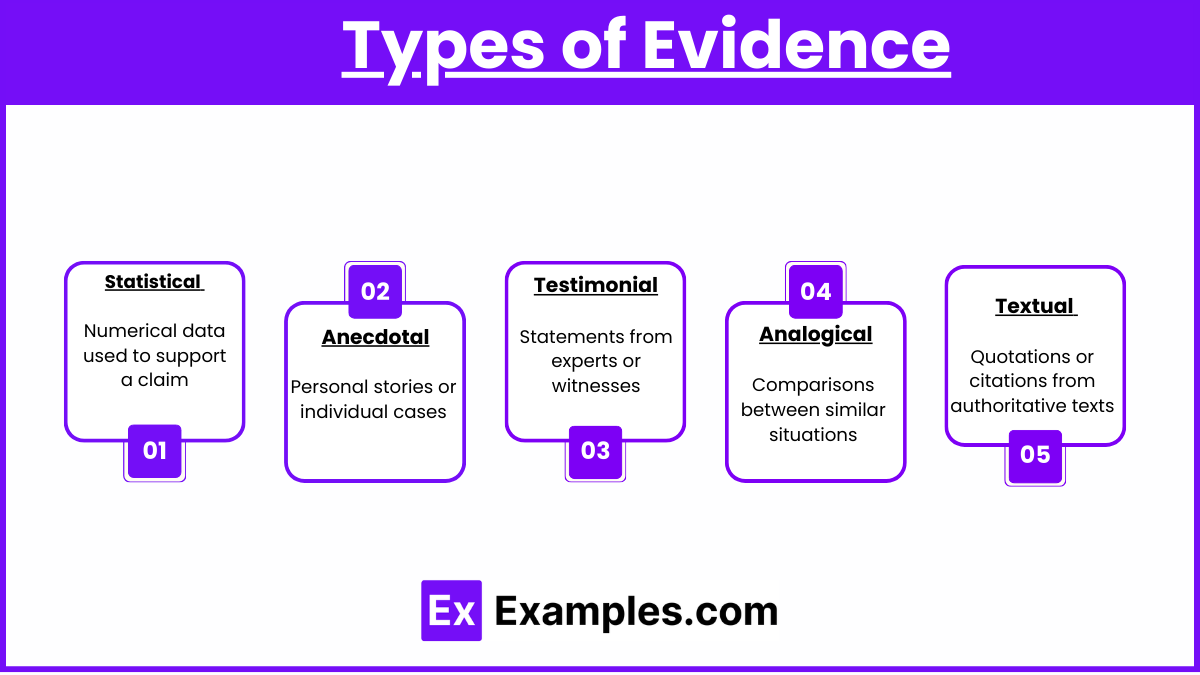
Let's break these down.
a) Statistical Evidence
This is the use of numerical data, surveys, and verifiable facts to demonstrate the scale, frequency, or reality of a point.
- Strength: Statistics provide an air of objectivity and can powerfully illustrate the magnitude of an issue. They are difficult to dismiss without counter-data.
- When to use it: When you need to show that your point isn't an isolated incident but a significant trend. For example, instead of saying "a lot of people are concerned about climate change," you could say, "A 2023 Pew Research Center poll found that 64% of Americans describe climate change as a major threat."
- Caution: Statistics can be misinterpreted or "cherry-picked." Always be prepared to discuss the source of your data (e.g., the sample size of a poll, the time frame of a study).
b) Expert Opinion (or Testimonial Evidence)
This involves quoting or paraphrasing individuals who have recognized credentials, experience, or authority on the subject.
- Strength: It leverages the credibility of the expert to bolster your own. You aren't just one person with an opinion; you are channeling the findings of a specialist.
- When to use it: When the topic is complex and requires specialized knowledge. For example, in a discussion about vaccine safety, citing a study from The Lancet or a statement from the CDC carries more weight than personal belief.
- Caution: The expert must be relevant. An astrophysicist's opinion on macroeconomics, while potentially interesting, is not expert evidence in that context.
c) Analogical Evidence
This is the use of a comparison between two different things to clarify a concept or support a claim.
- Strength: Analogies can make abstract or complex ideas intuitive and memorable. They create a mental shortcut for your audience.
- When to use it: When you need to explain a difficult concept or want to make your argument more vivid and relatable.
- Caution: The analogy must be a fair and accurate comparison. A weak or "false" analogy can be easily dismantled, undermining your argument.
To better understand these types in action, please watch the following video.
5 Types of EVIDENCE to Improve Your Essays! (Includes Activity)
The video '5 Types of EVIDENCE to Improve Your Essays!' from TolentinoTeaching gives clear, quick definitions and examples of these evidence types. While it's framed for writing, the principles are identical for speaking.
Please watch the sections on Statistical Evidence (01:05 - 02:00), Testimonial Evidence (03:07 - 03:56), and Analogical Evidence (03:56 - 04:59).
3. Deep Dive: The Power and Peril of Analogy
Of the three evidence types, analogies are perhaps the most creative but also the most dangerous. A great analogy can spark a revolution in thinking; a poor one can lead millions astray. Given your interest in fields like physics and neuroscience, which often rely on analogies to explain complex phenomena (e.g., the atom as a solar system, the brain as a computer), this is a particularly valuable tool for you to master.
This TEDx talk by John Pollack beautifully illustrates the dual nature of analogies.
The Hidden Power of Analogy | John Pollack | TEDxUofM
In 'The Hidden Power of Analogy,' John Pollack explores how analogies have changed the world, for better and for worse. This will give you a much deeper appreciation for how to use them effectively and ethically.
Please watch the following segments: The story of the meatpacking plant and the Ford assembly line (02:59 - 05:34). Notice how an analogy revolutionized an industry. The story of the 'three strikes and you're out' law (05:34 - 08:42). Notice how a seductive but flawed analogy led to negative consequences. The story of Steve Jobs and the 'desktop' analogy (08:42 - 11:14). Notice how an analogy made a complex technology accessible to everyone.
The key takeaway is that analogies simplify. Your job as a critical thinker is to ensure the simplification is helpful and illuminating, not misleading.
4. Choosing and Using Your Evidence
Knowing the types of evidence is step one. Step two is learning how to select high-quality evidence and integrate it into your arguments effectively. It's not enough to simply drop a statistic into a conversation; you must frame it.
The following resource provides a framework for this.
Incorporating Evidence - Writing Lab
The 'Incorporating Evidence' guide from Clemson University's Writing Lab offers an excellent checklist for both evaluating and using evidence. This adds a crucial layer of critical thinking to our discussion.
First, read the section titled 'Evaluating Evidence' and familiarize yourself with the four criteria: Credibility, Relevance, Currency, and Bias. Then, read the section 'Effective Evidence Incorporation,' focusing on the principles of how to introduce, attribute, and analyze the evidence you present.
To summarize those key principles:
- Evaluate First: Before using a piece of evidence, subject it to scrutiny. Is the source credible? Is it directly relevant? Is it recent enough to matter (currency)? Does the source have a clear bias?
- Introduce and Attribute: Don't just state a fact. Introduce where it came from. This is called verbal citation.
- Instead of: "80% of projects fail."
- Try: "A recent report from the Project Management Institute found that..."
- Analyze and Explain: Don't assume the evidence speaks for itself. Tell your audience what it means and why it supports your point.
Test your understanding!
Imagine you are debating whether your city should ban single-use plastics. Your opponent says, "It's a minor issue. We have bigger problems."
You want to counter this by showing the scale of the problem. You find a statistic from the UN Environment Programme stating that up to 13 million metric tons of plastic leak into the ocean each year.
How would you use the Introduce-Attribute-Analyze method to present this evidence?
Show answer
Here's one possible approach:
- (Introduce): "While it might seem like a small local issue, the global scale of the problem is staggering."
- (Attribute): "According to a major report by the UN Environment Programme, as much as 13 million metric tons of plastic leak into our oceans every single year."
- (Analyze): "To put that in perspective, that's the equivalent of dumping a garbage truck full of plastic into the ocean every minute. By acting locally, we contribute to solving this massive global crisis, rather than being part of the problem."
Finally, let's see these principles in a complete argument. The sample persuasive speech in the "Communication in the Real..." resource you viewed earlier masterfully weaves in evidence.
11.4 Persuasive Strategies – Communication in the Real ...
Let's return to the 'Persuasive Strategies' resource. The sample speech it contains is a case study in supporting claims with evidence.
Please read the first major point in the 'Body' of the sample speech (Section II, subsection 1, A-C). Notice how the speaker doesn't just make claims; they support each one by citing sources like the journal 'Corrections Today' and specific statistics about educational attainment.
Conclusion
Today, we've moved from structuring an argument to fortifying it. A claim without evidence is just an opinion. A claim backed by credible, well-chosen, and clearly presented evidence is a powerful tool of persuasion.
Key Takeaways:
- Evidence is the foundation of Logos (logical appeal). It's what makes your argument rational and compelling.
- You have a versatile toolkit of evidence types, including statistics (for scale), expert opinion (for credibility), and analogies (for clarity and impact).
- Always evaluate your evidence using the criteria of Credibility, Relevance, Currency, and Bias. Your argument is only as strong as its weakest piece of evidence.
- Effectively incorporate evidence by introducing it, attributing the source, and analyzing its significance for your audience.
Preview of the Next Lesson:
We have now completed our module on Structured Argumentation and Debate, focusing on the logical construction of your message. However, the most logical argument in the world can be derailed by high emotions. To become a truly effective communicator, you must also be able to manage the emotional climate of an interaction.
Our next module, "Navigating Difficult Conversations," will tackle this head-on. In the first lesson, you will learn to "Recognize the verbal and nonverbal signs of conversational escalation and conflict," giving you the crucial ability to spot trouble before it starts.