Hello! Welcome to the tenth module of your course, "Navigating Difficult Conversations."
In the previous module, we focused on the logical side of communication, culminating in how to support your arguments with credible evidence. You learned to build a strong, rational case. However, as you know, conversations—especially debates or high-stakes interactions—are rarely purely rational. When emotions run high, even the most well-reasoned argument can fall on deaf ears.
This is where our new module comes in. We will shift our focus from the content of a message to its emotional climate. Your goal for this lesson is to recognize the verbal and nonverbal signs of conversational escalation and conflict.
Mastering this skill is a direct step toward addressing one of the key challenges you've mentioned: reading non-verbal cues. It's also fundamental to your goal of "energy management." By spotting the early warning signs of conflict, you can choose to de-escalate the situation, steer the conversation in a more productive direction, or gracefully exit before it becomes emotionally draining.
1. The Biology of Conflict: Why Nonverbals Matter Most
When a conversation starts to feel tense, it's often because one or more people perceive a threat. This threat doesn't have to be physical; it can be a threat to one's ego, status, or beliefs. As you'll see in the video below, this perception activates the primitive "survival brain."
Calming & De-escalation Strategies
To understand why nonverbal signs are so crucial in conflict, let's start with a brief look at the neuroscience. This clip from the Dartmouth Trauma Interventions Research Center explains how a perceived threat changes the way our brains process information.
Watch the first 51 seconds of the video (00:00 - 00:51). Pay close attention to the concepts of the 'survival brain' and why nonverbal cues become more important than words during moments of stress.
The key takeaway is that when people feel threatened, their capacity for logic and reason diminishes, while their sensitivity to nonverbal signals skyrockets. They are no longer listening closely to what you're saying, but are intensely focused on how you're saying it and what your body is communicating.
This is why your ability to both read others' nonverbal signals and manage your own is paramount in preventing or navigating conflict.
2. The Telltale Signs: When Words and Actions Don't Match
The most reliable indicator of rising tension or hidden conflict is a mismatch between verbal and nonverbal communication. Someone might say, "I'm fine," but their clenched jaw, crossed arms, and lack of eye contact tell a very different story. Researchers call this "nonverbal leakage"—when true feelings leak out through the body, despite words to the contrary.
This video provides an excellent breakdown of how nonverbal cues can contradict, and therefore reveal the truth behind, a verbal message. It also introduces the fascinating concept of microexpressions.
Verbal and Nonverbal Communication
In this video, communication coaches Alex and Mary Daphne discuss the various ways verbal and nonverbal cues interact. We will focus on two key concepts: how nonverbals can contradict words, and how true emotions 'leak' out.
Please watch two segments from this video: Contradicting Cues (06:50 - 07:48): Focus on the examples of when nonverbal signals conflict with spoken words. Nonverbal Leakage and Microexpressions (08:02 - 10:10): Pay close attention to the definition of nonverbal leakage and the seven universal microexpressions. These are fleeting but powerful signs of concealed emotions.
To spot these signs, you need to know what to look for. Nonverbal communication happens through several channels at once.

3. The Five "Conflict Languages"
When faced with conflict, people tend to fall into habitual communication patterns. Recognizing these patterns, or "conflict languages," gives you a powerful framework for quickly diagnosing the type of conflict you're facing.
The following article offers a clear and practical guide to these patterns.
What is Your Conflict Language
The article 'What is Your Conflict Language?' from Nurture Your Nature Psychotherapy provides an excellent breakdown of the typical verbal and nonverbal patterns people adopt during a conflict.
Please read from the section 'Defining Conflict Language' down to the end of the section 'Five Common Conflict Languages'. Focus on the specific hallmarks (verbal and nonverbal signs) of The Critic, The Defender, The Avoider, The Stonewaller, and The Peacemaker.
Here is a summary of the key verbal and nonverbal signs for each conflict language:
| Conflict Language | Primary Goal | Verbal Signs | Nonverbal Signs |
|---|---|---|---|
| The Critic | Regain control | Uses absolutes ("always," "never"), accusations, sarcasm. | Finger-pointing, aggressive posture, intense stare. |
| The Defender | Protect self-esteem | Makes excuses, counter-accusations ("I only did it because you..."), whiny tone. | Defensive posture (crossed arms), shifting gaze, looking away. |
| The Avoider | Minimize discomfort | Changes the subject, uses humor to deflect, vague affirmations ("Yeah, maybe"). | Forced smile, physically turning away, breaking eye contact. |
| The Stonewaller | Shut down | Silence, one-word answers, muttering. | No eye contact, rigid body, looking at phone or leaving the room. |
| The Peacemaker | Preserve connection | Quick apologies ("You're right, it's my fault"), over-validating others. | Submissive posture, nodding excessively, anxious fidgeting. |
Test your understanding!
You're in a team meeting discussing a project timeline. You suggest moving a deadline forward by a week. Your colleague, Sarah, says in a flat tone, "Sure, whatever works for the team," while leaning back, crossing her arms, and staring intently at her laptop screen without looking at you.
Which conflict language is Sarah most likely using, and what specific verbal and nonverbal cues tell you this?
Show answer
Sarah is most likely using the Stonewaller language.
- Verbal Cues: Her phrase "Sure, whatever works" is a form of disengagement rather than genuine agreement. The flat tone suggests she is emotionally withdrawn from the conversation.
- Nonverbal Cues: The combination of leaning back (creating distance), crossing her arms (a classic blocking gesture), and staring at her laptop (refusing engagement and eye contact) are all hallmark signs of stonewalling. She is shutting down communication.
4. The Escalation Ladder: How Conflicts Grow
Conflicts rarely explode out of nowhere. They typically escalate through a series of predictable stages, with the verbal and nonverbal signs becoming more intense at each step. Recognizing which "rung" of the ladder you are on is crucial for intervening effectively.
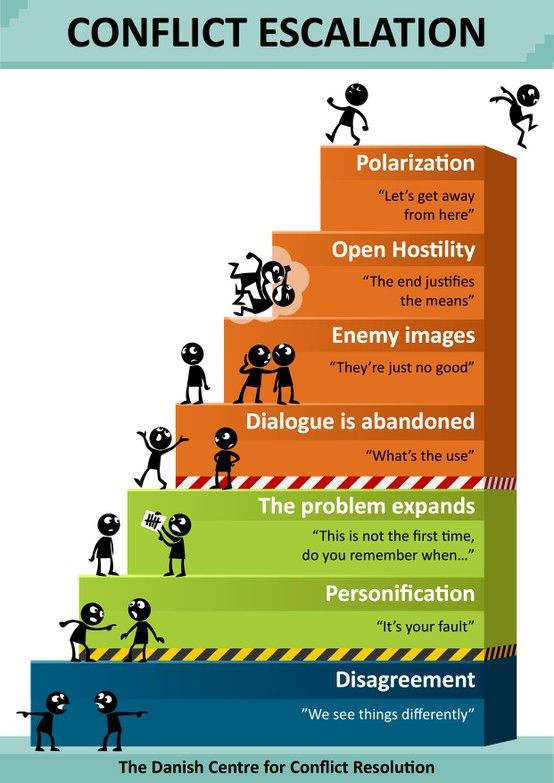
This visual is a great starting point. For a more detailed, theoretical understanding—which aligns with your interest in frameworks—we can turn to Glasl's Nine-Stage Model of Conflict Escalation. We'll focus on the first four stages, as they are the most common in everyday interactions and offer the best opportunity for de-escalation.
Here are the key verbal and nonverbal signs for each of the initial stages, based on Glasl's model:
Stage 1: Hardening
The issue is still the focus, but positions become rigid.
- Verbal: Arguments become circular and repetitive. Opinions are stated as fixed facts.
- Nonverbal: Subtle signs of tension and irritation like foot-tapping, frequent sighing, or a tight facial expression.
Stage 2: Debates and Polemics
The focus shifts from solving the problem to winning the argument.
- Verbal: Use of sarcasm, exaggeration, and rhetorical questions. Arguments become black-and-white. The other person's competence is questioned.
- Nonverbal: More pronounced gestures like waving a hand dismissively. More direct and challenging eye contact, almost like a stare-down.
Stage 3: Actions, Not Words
Parties lose faith in talk and start taking unilateral action.
- Verbal: Communication drops sharply. You might hear phrases like, "There's no point in talking about this anymore."
- Nonverbal: Actions are taken without consultation. People might deliberately ignore each other, turn their backs, or leave the room while the other is speaking. Empathy disappears.
Stage 4: Images and Coalitions
The focus is now on the person, not the issue. The goal is to damage the opponent's reputation.
- Verbal: Spreading rumors or negative stories. Use of stereotypes and generalizations ("You people always..."). Veiled insults and "deniable" attacks.
- Nonverbal: Eye-rolling, smirking, and other gestures of contempt. Actively recruiting allies and creating "us vs. them" dynamics in a group.
Noticing the shift from Stage 1 to Stage 2, for example—when the conversation turns from discussing an issue to attacking a person's logic—is a critical moment. It's an alarm bell telling you that the conflict is escalating.
Conclusion
Today we've built a multi-layered system for detecting conflict. You now have the tools to move beyond just hearing words to actively perceiving the emotional reality of a conversation.
Key Takeaways:
- Conflict triggers a "survival brain" response, making nonverbal cues more significant than words.
- A contradiction between what is said and what the body does is the most telling sign of hidden tension (nonverbal leakage).
- People often default to one of five "conflict languages" (Critic, Defender, Avoider, Stonewaller, Peacemaker), each with distinct verbal and nonverbal tells.
- Conflict escalates through predictable stages, with the signals shifting from subtle irritation to open hostility. Recognizing the stage helps you understand the severity of the situation.
Preview of the Next Lesson:
Recognizing the signs of escalation is the essential first step. But what do you do once you've spotted them? In our next lesson, we will build directly on this foundation and learn how to apply active listening and validation as primary de-escalation tools, giving you the ability to actively calm a tense situation.