Introduction
Welcome back! In our last lesson, we established the high-level strategic framework for your portfolio. You learned how to set your overall asset allocation—the mix of stocks and bonds—based on your personal Investment Policy Statement. We also explored the Core-Satellite model as a practical way to combine long-term, passive investing with more active, tactical trades.
Today, we're going to zoom in on the equity (stock) portion of your portfolio. Simply owning stocks isn't enough; which stocks you own matters. This lesson is dedicated to the next layer of portfolio construction: diversification within your equity holdings. Your goal is to learn how to measure and manage your portfolio's exposure across three critical dimensions: geography, economic sector, and company size (market capitalization). Mastering this will help you build a more resilient portfolio that is not overly dependent on the success of a single country, industry, or type of company.
The Three Pillars of Equity Diversification
A well-diversified equity portfolio is balanced across three main pillars. Let's examine each one.
1. Geographic Diversification: Looking Beyond Your Home Market
It's natural for investors to favor companies from their own country, a phenomenon known as "home bias." While the U.S. market is the largest in the world, relying on it exclusively exposes you to the risks of a single economy and currency. True diversification means going global.
To understand the powerful case for international investing, please watch the following video from Ben Felix. He methodically breaks down why global diversification is considered "the only free lunch in investing."
This video, titled 'International Diversification', challenges the common arguments for a U.S.-only portfolio and explains both the theoretical and empirical reasons for investing globally.
Please focus on these key segments: Challenging U.S. Outperformance (02:17 - 05:12): Pay attention to the explanation of why past U.S. market success might not predict future returns. This addresses the common 'recency bias' many investors have. Historical Performance Cycles (07:13 - 08:37): This section provides concrete data showing long periods when international stocks outperformed U.S. stocks, highlighting that market leadership is not permanent. The Multinational Myth (08:49 - 09:57): This debunks the popular belief that owning U.S. multinational companies provides sufficient international exposure. This is a crucial concept for building a truly diversified portfolio.
As the video argues, you cannot reliably predict which country's market will perform best in the future. A globally diversified portfolio ensures you have exposure to growth wherever it occurs and protects you from the poor long-term performance of any single country.
2. Sector Diversification: Avoiding Industry Bets
Just as you don't want to bet on a single country, you also don't want your portfolio's fate tied to a single industry. In recent years, technology stocks have performed exceptionally well, tempting many to overload their portfolios with them. However, economic cycles and consumer trends shift, and the leading sectors of one decade are often the laggards of the next.
To understand how to structure your portfolio across different parts of the economy, please read the following sections from the guide by Edward Jones.
[PDF] Digging deeper into stock diversification
This guide, 'Digging deeper into stock diversification,' provides excellent practical rules for building a balanced portfolio. We will focus on the sections discussing sector allocation.
Please read the following two sections: Start at the section titled 'Balance Across the Sectors' on page 3. Focus on the concept of 'Offense vs. Defense' sectors and how they perform differently depending on the economic environment. Continue to the section 'Subsectors: A Deeper Layer of Diversification' on page 4. This explains how you can further refine your diversification even within a broader sector.
The key idea here is to own a mix of cyclical (or "offense") sectors like Consumer Discretionary and Technology, which do well in a strong economy, and defensive sectors like Consumer Staples and Health Care, which are more stable during downturns. This balance helps smooth your portfolio's performance over a full economic cycle.
3. Market Capitalization Diversification: Mixing Giants and Innovators
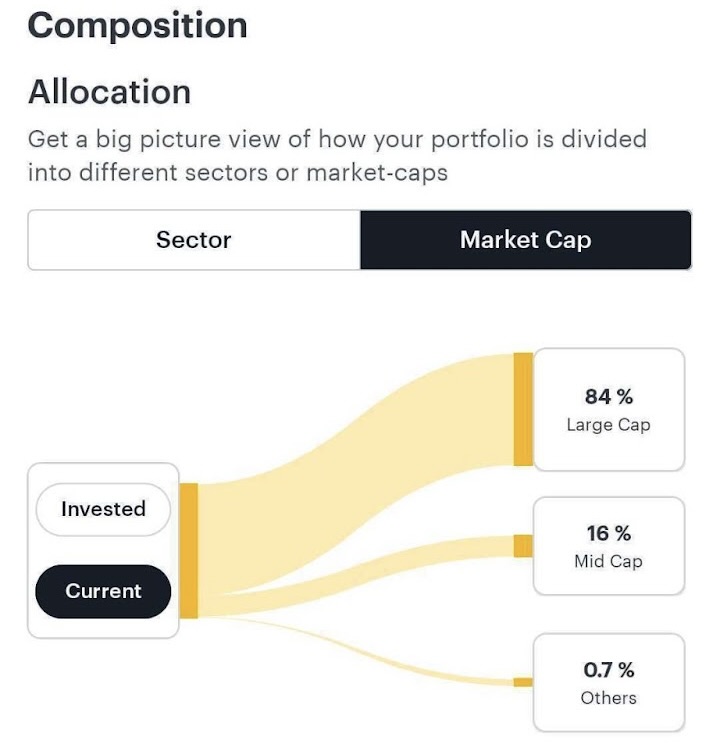
Finally, diversification applies to company size. Companies are typically grouped by their market capitalization (total value of all outstanding shares):
- Large-Cap: Large, established industry leaders (e.g., Apple, Johnson & Johnson).
- Mid-Cap: Medium-sized companies, often in a growth phase.
- Small-Cap: Smaller, often younger companies with high growth potential but also higher risk.
A balanced portfolio includes exposure to all three. Large-caps provide stability, while mid and small-caps offer greater growth potential. Total market ETFs, which we discussed in the last lesson, automatically provide this mix. When you build the "satellite" portion of your portfolio with individual stocks, it's important to be mindful of the size of the companies you are selecting.
How to Measure and Manage Your Diversification
Understanding the theory is one thing; applying it is another. How do you know if your collection of ETFs and stocks is actually diversified?
The Problem of ETF Overlap
A common mistake is assuming that owning multiple ETFs automatically equals good diversification. Often, different ETFs hold many of the same underlying stocks, leading to a problem called ETF overlap. This can unintentionally re-concentrate your portfolio and undermine your diversification goals.
How to avoid duplicate ETF exposure in your portfolio
This article explains the concept of ETF overlap, its risks, and how to avoid it. This is a critical skill for managing a modern portfolio built with ETFs.
Please read the article from the beginning, focusing on these sections: 'What is ETF overlap?' 'What are the implications of duplicate ETF exposure?' 'How to identify and avoid ETF overlap.' Pay close attention to the examples given, such as the overlap between an S&P/ASX 300 fund and an S&P/ASX 200 fund.
As the article points out, owning both a NASDAQ 100 ETF and a FANG+ ETF means you have significant duplicate exposure to a handful of big tech companies, making your portfolio highly sensitive to their performance.

Using Tools to See Your True Exposure
The only way to know your true diversification is to look "under the hood" of your ETFs and aggregate all your holdings. While this sounds complex, many tools can do this for you. Brokerage platforms often have built-in analysis tools, and third-party services like Morningstar offer them as well.
The following video demonstrates how a simple spreadsheet can be used to track and visualize a portfolio's diversification. The specific tool isn't as important as the process it illustrates.
ETF Portfolio Tracker | Find Where Your Money Is Being Allocated
This video, 'ETF Portfolio Tracker', gives a practical demonstration of how to aggregate ETF holdings to get a clear picture of your geographic and sector allocations.
Watch the following segments to see the tool in action: Visualizing the Data (02:03 - 02:36): See how the tracker creates charts and maps to show the portfolio's breakdown by geography and sector. Managing Diversification (02:36 - 04:31): Observe the practical example of adding an emerging markets ETF to deliberately change the portfolio's geographic exposure. This is the essence of 'managing' your diversification.
From Measurement to Management
Once you can measure your diversification, you can actively manage it. Here are some key strategies:
- Set Targets: Decide on your ideal allocation. For example, you might aim for 70% U.S. / 30% International, with no single sector making up more than 20% of your portfolio.
- Use Complementary Funds: When adding a new ETF, choose one that fills a gap. If your core holding is a U.S. large-cap fund (like an S&P 500 ETF), a good complement would be an international fund or a U.S. small-cap fund, not another U.S. large-cap fund.
- Apply the 5% Rule: A good rule of thumb, mentioned in the Edward Jones guide, is to avoid letting any single stock grow to more than 5% of your total portfolio. This prevents a single company's misfortune from having an outsized negative impact.
- Rebalance: Periodically review your portfolio. If one position or sector has grown significantly, consider trimming it back to your target weight and reallocating the funds to an underweight area.
Your Turn: A Quick Thought Exercise
Imagine you've analyzed your portfolio and found the following:
- Geography: 95% U.S., 5% International
- Sector: 40% Technology, 15% Consumer Discretionary, with other sectors making up the rest.
- Holdings: Your top holding is Apple (AAPL), which now accounts for 8% of your portfolio.
Based on what you've learned today, list 2-3 specific and concrete actions you could take to improve this portfolio's diversification.
Conclusion
In this lesson, we moved from high-level asset allocation to the crucial details of equity diversification. A truly robust portfolio is balanced not just between stocks and bonds, but also within its stock holdings.
Key Takeaways:
- Effective equity diversification involves balancing your portfolio across geography, economic sectors, and market capitalization.
- Relying solely on your home market (home bias) or today's winning sectors introduces unnecessary risk.
- ETF overlap is a common pitfall that can unknowingly concentrate your portfolio. Always look at the underlying holdings.
- Use portfolio analysis tools to measure your true exposure, and then actively manage it by rebalancing and selecting complementary assets.
You now have a multi-layered framework for structuring the equity portion of your portfolio. In our next lesson, we will formalize this by looking at how to identify and manage specific portfolio-level risks, such as concentration risk and correlation risk, which are the very things that proper diversification helps to mitigate.