Introduction
Welcome to your second lesson. In our first session, we focused on creating your personal Investment Policy Statement (IPS) to act as your strategic roadmap. You defined your goals, time horizon, and started to assess your relationship with risk. That was the crucial "why" of your investment plan.
Today, we transition from strategy to structure. We'll take the principles from your IPS and use them to answer the question: "How should I actually build my portfolio?" This lesson is all about asset allocation, which is the single most important decision you'll make in determining your long-term investment outcomes. Your background in business strategy will be useful here, as we are essentially deciding on the capital allocation for your personal "company."
By the end of this lesson, you will be able to apply asset allocation principles to structure a portfolio of stocks and ETFs that aligns with the IPS you started building.
The Core Principle: Asset Allocation Drives Returns and Risk
Before we dive into specific models, let's establish the fundamental concept. Asset allocation is simply the process of deciding how to divide your investment capital among different asset categories, primarily stocks (equities) and bonds (fixed income). This mix is the main lever you can pull to control your portfolio's balance between potential growth and potential volatility.
The image below illustrates this trade-off. It shows four sample portfolios, ranging from "Conservative" (heavy on bonds) to "Aggressive Growth" (heavy on stocks), along with their historical performance.
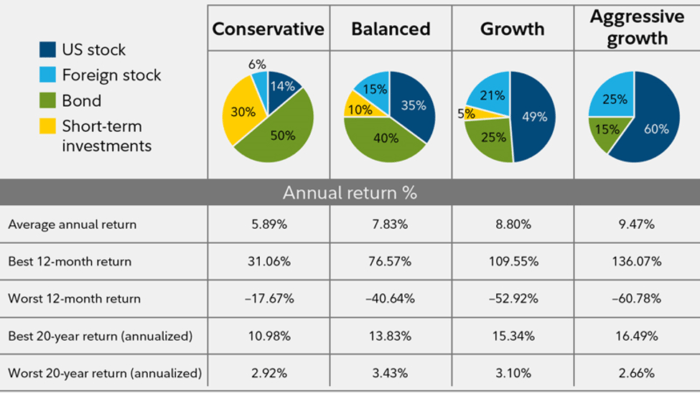
Notice how a higher allocation to stocks generally leads to higher average returns but also a wider range of outcomes, including larger potential drawdowns. Your choice of where to be on this spectrum should be a direct reflection of the risk tolerance and time horizon you defined in your IPS.
The Building Blocks: Understanding Risk and Time
To make an informed allocation decision, it's essential to have a nuanced understanding of risk. It's more than just the possibility of your portfolio's value going down.
Please watch the following video from Ben Felix. It provides a sophisticated framework for thinking about risk that will be highly valuable as you structure your portfolio.
Choosing an Asset Allocation (How Much in Stocks vs. Bonds?)
This video breaks down risk into three key dimensions and discusses how the nature of risk changes over long time horizons. It provides the 'why' behind choosing a specific allocation.
Please watch the following segments: Introduction (00:00 - 01:22): Focus on the three dimensions of assessing risk: behavioral tolerance, ability to take risk, and need to take risk. This directly builds on our last lesson. Long-Term Risk (08:03 - 10:44): Pay close attention to the argument that for long-term investors, higher equity allocations can sometimes be safer when considering inflation and purchasing power risk. Compensated vs. Uncompensated Risk (10:44 - 13:01): Understand the difference between market risk (which you get paid for) and specific stock risk (which you can diversify away).
As the video highlights, the key is to take on compensated risks (like the general risk of the stock market) while diversifying away uncompensated risks (like the risk of a single company failing). Asset allocation is your primary tool for achieving this.
Practical Models for Asset Allocation
Now, let's look at how to put this into practice. There is no single "perfect" portfolio. The goal is to find a structure that is effective, that you understand, and that you can stick with.
Simple, Effective Models: The 1, 2, and 3-Fund Portfolios
For many investors, simplicity is key. The following video introduces some of the most popular and time-tested portfolio structures. They are built using broad-market, low-cost index funds or ETFs.
9 Most Popular Investment Portfolio Strategies
This video from Tae Kim provides a great overview of several practical portfolio strategies. We'll focus on the first three, which form the foundation of many investment plans.
Please watch the sections covering these three strategies: One-Fund Strategy (01:52 - 03:11): 100% in a total stock market fund. Two-Fund Strategy (03:11 - 04:09): A mix of a total stock market fund and a total bond market fund. Three-Fund Strategy (04:09 - 05:25): Adds an international stock fund for global diversification.
These simple models are powerful. For example, a two-fund portfolio with an 80% stock ETF / 20% bond ETF split is a common and effective allocation for an investor with a long time horizon and a moderate-to-high risk tolerance.
A Flexible Model: Core-Satellite Investing
Given your goal to engage in equity trading while also managing your long-term wealth, the Core-Satellite model is an excellent framework to consider. It combines the stability of passive investing with the targeted growth potential of active investing.

To understand this strategy in more detail, please read the following article.
Core-Satellite Investing: Balance Risk & Growth in Your Portfolio
This article from Waterloo Capital provides a clear and concise guide to the Core-Satellite investing strategy, explaining how to structure it and the roles of each component.
Please read the first three main sections: 'What is Core-Satellite Investing?' 'Build a Strong Core Portfolio' 'What Are Satellite Investments?' Focus on the typical allocation splits (e.g., 70-90% core) and the different purposes of the core versus the satellites.
Here's how this model aligns perfectly with your goals:
- The Core (70-90% of your portfolio): This is your foundation for long-term wealth. It would consist of broad, low-cost ETFs, like a Total US Stock Market ETF (e.g., VTI) and perhaps a Total International Stock ETF (e.g., VXUS). This part of your portfolio is designed to be low-maintenance and capture market returns.
- The Satellites (10-30% of your portfolio): This is where you can be more tactical. You can use this portion to invest in individual stocks you've analyzed, sector-specific ETFs (like technology or healthcare), or thematic ETFs (like clean energy). This allows you to act on your research and ideas without jeopardizing your entire portfolio.
Adding Another Layer: Diversification Within Your Allocation
Once you have your high-level asset allocation (e.g., 80% stocks, 20% bonds, using a Core-Satellite structure), the next step is to ensure your stock allocation is well-diversified. We will cover this in detail in the next lesson, but here are the key principles.
The document "Digging Deeper into Stock Diversification" by Edward Jones provides some excellent guidelines. Here are the main takeaways:
- Diversify by Geography: Hold both domestic (U.S.) and international stocks. The three-fund portfolio does this automatically.
- Diversify by Company Size (Market Cap): Include large, mid-size, and small companies. A "total stock market" ETF will hold all of these.
- Diversify by Sector: Ensure your portfolio isn't overly concentrated in one sector (like technology). A broad index fund helps, but this is especially important to watch in your satellite portfolio.
- The 5% Rule: A useful rule of thumb from the Edward Jones paper is to avoid having more than 5% of your total portfolio in any single stock. This is a simple but effective risk management technique for your satellite holdings.
Your Turn: Structuring Your Portfolio
Let's connect this back to your IPS. Take about 10 minutes to think through these questions based on the draft you started in the last lesson.
- Your Stock/Bond Split: Considering your time horizon and risk tolerance, what initial stock/bond allocation feels appropriate for you? (e.g., 90% stocks / 10% bonds, 80/20, etc.). Remember the trade-offs shown in the "Four different investment portfolio allocations" chart.
- Choosing a Model: Does a simple model (like a two or three-fund portfolio) or the Core-Satellite model appeal more to you? Why?
- Drafting a Core-Satellite Structure (if applicable): If you like the Core-Satellite idea, what would you put in your core? What are some sectors or types of companies you might be interested in exploring for your satellite portion?
Jot down your initial thoughts. This is the blueprint we will continue to refine throughout the course.
Conclusion
In this lesson, we bridged the gap between your investment strategy and a tangible portfolio structure. You learned how asset allocation is the primary tool for balancing risk and reward, directly translating your IPS into action.
Key Takeaways:
- Asset allocation is the decision of how to split your capital between asset classes like stocks and bonds, and it's the main driver of your portfolio's performance.
- Your chosen allocation should directly reflect the goals, time horizon, and risk profile you defined in your Investment Policy Statement.
- Simple models like two or three-fund portfolios offer a powerful, low-cost way to build a diversified portfolio.
- The Core-Satellite model provides a disciplined framework for combining a stable, passive core with smaller, active "satellite" investments, which is ideal for investors who also want to trade individual stocks or sectors.
You now have the principles and models needed to structure a portfolio. In our next lesson, we will dive deeper into diversification, learning how to measure and manage your exposure across different sectors, geographies, and market capitalizations to build an even more resilient portfolio.