A useful menstrual-pain diary does more than mark which days hurt. It shows when pain occurs in relation to bleeding, what it feels like, what changes after treatment, and what the pain prevents you from doing. Those details can make a healthcare conversation more precise without turning the diary into a self-diagnosis.
In this lesson, you will see how to turn a short fictional account into a usable daily record. Allow about 35–40 minutes, including the reading.
Build a record around the cycle
Start with two anchors: the date bleeding begins and the first day of that bleeding as cycle day 1. Record pain that starts before bleeding as well as pain during or after it. A date is often more useful than “the second day of my period” alone: it lets you compare one cycle with another. Note any uncertainty—for example, “spotting began Tuesday; full bleeding began Wednesday”—rather than forcing a precise start date.
The Endometriosis UK Pain & symptom diary offers both background questions and a one-week daily form. Its prompts are useful even if you prefer a notebook or phone note to the printed form.
Read Endometriosis UK's diary to see how background information and daily entries complement each other.
On the opening pages, read the “General questions,” “Pain,” and “Symptoms” prompts, beginning at the background prompts. The symptoms questions continue through printed p. 3. Then find the “Week beginning DD / MM / YY” table on the following page. Read the weekly diary, including the notes beneath it. Focus on how it separates pain, other symptoms, attempts at relief, and effects on daily life.
A daily entry can follow the same consistent pattern:
- Timing and bleeding: date, cycle day, whether bleeding has begun, flow or spotting, products used and how saturated they were, and clots if noticed.
- Pain and associated symptoms: location, character, start and end times, worst severity, and symptoms such as nausea, bowel changes, or fatigue.
- Effect on daily life: sleep lost, activities missed or changed, or normal activities maintained.
- Treatment and what followed: the treatment, its time and—if it was a medicine—its name and dose; pain before and afterward; and any unwanted effects.
Use a severity scale consistently, such as 0 for no pain and 10 for the worst pain imaginable. A number becomes more informative when paired with a concrete observation: “7/10; could not attend the morning activity” says more than “bad cramps.” If you did not check something, write “not recorded” rather than “none.” “No nausea noticed” and “nausea not asked about” are different pieces of information.
Bleeding descriptions are estimates, not measurements of exact blood loss. A product count is more meaningful when it includes the product type, size if known, and whether products were lightly used or soaked. The illustrated heavy-period diary provides a visual example of recording these details alongside pain, medication, and daily-life difficulties.
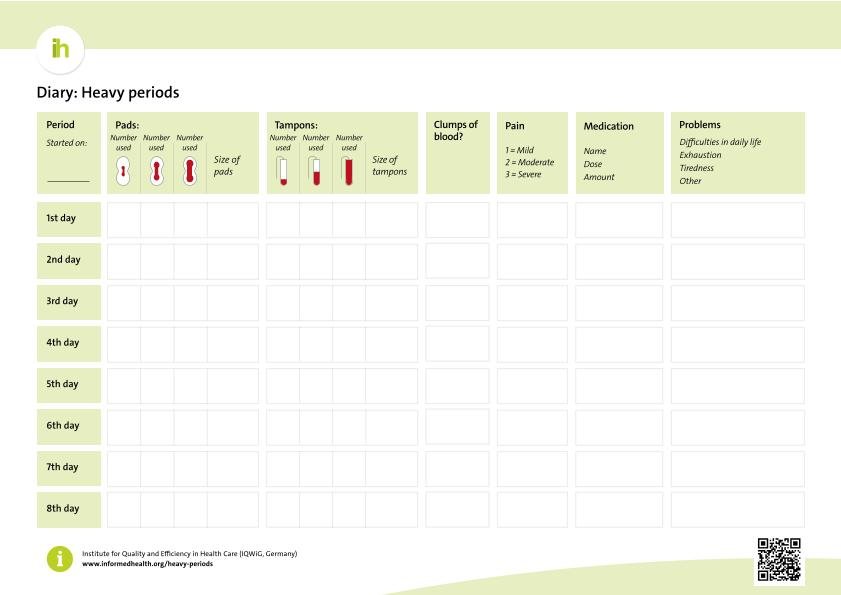
From an account to a completed diary
Consider this fictional case. The previous period began on April 4, and the next began on May 2, an interval of 28 days. On May 1, there was no bleeding, but midline lower-abdominal cramps spread to the lower back from 19:00 to 21:00. Pain peaked at 5/10. A cloth-wrapped heat pack was used at 19:30 for 20 minutes; pain was 3/10 at 20:10, and no unwanted effect was noticed. Evening plans were shortened.
On May 2, cramps began at 06:30 and bleeding began at 07:00. The pain reached 7/10 and eased by 15:00. Nausea and one loose bowel movement occurred before any medicine was taken. Four regular pads were used, two of them soaked; no clots were noticed. Ibuprofen 200 mg was taken at 08:00. Pain was 4/10 at 09:30, and mild stomach burning was noticed at 10:00. A morning commitment was missed. On May 3, pain reached 6/10 from 09:00 to 14:00. Five regular pads were used, three soaked, and one small clot was noticed. Heat was used at 09:15 for 20 minutes; pain was 4/10 at 10:00, with no unwanted effect noticed. An afternoon activity was cancelled. On May 4, bleeding was light, with two lightly used pads. Cramps reached 2/10 from 08:00 to 09:00. No treatment was used, and usual activities continued.
Here is one way to enter those facts without adding anything the account does not establish:
| Date and cycle timing | Completed daily entry |
|---|---|
| May 1 — cycle day 28 of the cycle that began April 4; no bleeding | Pain: Midline lower-abdominal cramping spreading to lower back, 19:00–21:00; worst 5/10. Other symptoms: Not recorded. Daily life: Evening plans shortened. Relief: Cloth-wrapped heat pack at 19:30 for 20 minutes; pain 3/10 at 20:10. No unwanted effect noticed. |
| May 2 — cycle day 1; bleeding began 07:00 | Bleeding: Four regular pads, two soaked; no clots noticed. Pain: Lower-abdominal cramps, worst 7/10; began 06:30, eased by 15:00. Other symptoms: Nausea and one loose bowel movement before medicine. Daily life: Missed a morning commitment. Relief: Ibuprofen 200 mg at 08:00; pain 4/10 at 09:30. Mild stomach burning noticed at 10:00. |
| May 3 — cycle day 2 | Bleeding: Five regular pads, three soaked; one small clot noticed. Pain: Cramps, worst 6/10, 09:00–14:00; location not newly recorded. Other symptoms: Not recorded. Daily life: Cancelled an afternoon activity. Relief: Heat at 09:15 for 20 minutes; pain 4/10 at 10:00. No unwanted effect noticed. |
| May 4 — cycle day 3 | Bleeding: Light; two pads, both lightly used. Pain: Cramps, worst 2/10, 08:00–09:00; location not newly recorded. Other symptoms: Not recorded. Daily life: Usual activities continued. Relief: None used; treatment adverse effects not applicable that day. |
The medicine dose in this example is a recorded event, not a dosing recommendation. Treatment choices and safe doses depend on the product label and individual health circumstances.
Notice what the completed entry preserves. The nausea on May 2 occurred before ibuprofen; the stomach burning occurred after it. That timing is worth reporting, but the diary alone cannot establish whether the medicine caused the burning. Likewise, pain fell after heat on May 3, but an individual entry cannot prove how much of the change was due to heat rather than the pain’s natural course. Recording observations accurately is more valuable than assigning a cause too early.
Make the diary useful without making it burdensome
A compact entry made near the time of symptoms is often better than a detailed reconstruction weeks later. Record a worst pain score and, when trying relief, a before-and-after score with times. If pain comes and goes, note that pattern instead of implying it was constant throughout the day. Include symptoms outside the bleeding days: they may be important to the overall pattern.
For bleeding, record what you can actually observe. “Five pads, three soaked” is clearer than “very heavy”; neither should be treated as an exact blood-volume measurement. For daily life, name the effect rather than merely checking “affected”: missed work or study, interrupted sleep, or completed usual activities all give useful context.
Keep gaps visible. The fictional account does not say whether there was nausea on May 3, so its diary says “not recorded,” not “no nausea.” It also does not establish a new pain location on May 3 or 4. A diary is a record of evidence, not a form that must be filled with guesses.
Tracking over more than one cycle can reveal whether timing, severity, bleeding, or response to relief changes. Do not wait to collect several cycles of entries before seeking care for sudden severe pain or other concerning symptoms; a diary supports assessment but does not replace it.
Key takeaways
A strong menstrual-pain entry links cycle timing, bleeding, pain, associated symptoms, daily-life impact, and treatment timing and response. Specific observations—and honest “not recorded” gaps—make the record more reliable than a label such as “bad period.” The next lesson looks at how a clinician may use this history in an initial assessment, including what an examination or test can and cannot establish.