Welcome back. In the previous lesson, you built a diary that records when pain occurs, what accompanies it, how it affects daily life, and what happens after treatment. An initial clinical assessment uses that record to look for patterns and decide what needs attention—not to assign a diagnosis from symptoms alone.
This lesson follows a possible visit from history to examination to selected tests. The central question is what each part can reveal, and what it cannot. Allow about 35–40 minutes, including the video and readings.
The history does more than establish a pain score
Persistent menstrual pain deserves attention even when it has long been described as “just cramps.” A clinician will usually begin by asking about timing: whether pain is confined to the first days of bleeding, starts earlier, lasts afterward, or occurs between periods. They may ask whether its severity or pattern has changed, and how it affects sleep, work, study, or other activities. Your diary makes these distinctions easier to describe.
Other symptoms help direct the assessment. Depending on what is relevant to you, the discussion may include bleeding, bowel or urinary symptoms, pain during or after sex, and any plans concerning pregnancy. A clinician may also ask about previous treatments and unwanted effects, relevant medical history, and family history of endometriosis. Questions about possible pregnancy or infection help determine whether a different assessment is needed promptly. You need not have a perfect record—or be menstruating on the appointment day—for the conversation to be useful.
The NHS video How is endometriosis diagnosed? Scans, laparoscopy and support shows how a consultation can use symptom detail, examination, and imaging. Watch the selected passages for the purpose of each step rather than treating the video as a fixed sequence every person must follow.
How is endometriosis diagnosed? Scans, laparoscopy and support | NHS
The NHS video introduces the first appointment for suspected endometriosis. These short passages show why symptoms remain important even when a scan is considered.
Watch symptom discussion at the start of the consultation. Then skip to exam and scan, which describes an abdominal or pelvic examination, ultrasound options, and discussion of referral when symptoms persist despite a clear scan.
A history can raise or lower suspicion of a condition, but symptoms often overlap. Pain with periods that disrupts daily life, for example, warrants assessment; it does not establish endometriosis. Equally, no single symptom has to be present before persistent pain can be taken seriously.
Examination is an offer, not a condition of being heard
An abdominal examination may check for tenderness or a mass. If appropriate, a clinician may also offer an internal vaginal examination to look for tenderness, reduced movement of pelvic organs, or other findings that could guide the next step. A normal examination cannot rule out endometriosis, and an abnormal finding needs interpretation alongside the history.
An internal examination should be explained and performed only with your consent. You can discuss concerns beforehand, ask for a chaperone, and say if you want the examination paused or stopped. You can decline it. If it is declined or unsuitable, the clinician can still take a history, offer an abdominal examination, and discuss other ways to investigate and manage the pain. Not proceeding with an internal examination does not make your symptoms less valid.
The Royal College of Obstetricians and Gynaecologists’ patient information explains these choices in its Physical examinations section.
[PDF] Endometriosis - Information for you
Read this patient-information section for its account of explanation, consent, chaperones, and alternatives when an examination is difficult or declined.
Find “Physical examinations” near the page break before printed p. 6. Read examination choices, then continue on printed p. 6 from “After explaining to you about the physical examination…” through consent and support. Focus on what remains your choice throughout.
Tests are chosen for a reason—and have limits
There is no single routine test that explains every case of menstrual pain. A clinician selects investigations according to the history, examination findings, and what needs to be ruled out. If pregnancy is possible, a pregnancy test may be important: pain in a pregnancy needs a different assessment, particularly if it is severe or one-sided. Depending on symptoms, urine testing, tests for infection, or blood tests for the effects of heavy bleeding may also be appropriate. These tests address specific questions; they are not general tests that rule endometriosis in or out.
A pelvic ultrasound is often useful. It can identify some visible causes of symptoms, such as fibroids or ovarian cysts, and may show an ovarian endometrioma or signs of deep endometriosis. In suspected endometriosis, NICE recommends offering a transvaginal ultrasound even when an examination is normal. If that internal scan is declined or unsuitable, a transabdominal ultrasound can be considered. The options and their suitability can be discussed before a scan is arranged.
The diagram below shows why location matters. Endometriosis can occur on an ovary or in spaces around the uterus and neighbouring organs; it is not simply a change inside the uterine cavity.
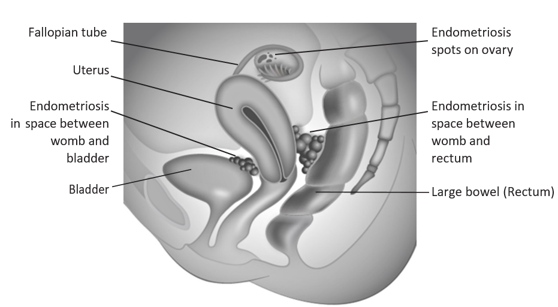
A normal ultrasound does not exclude endometriosis. A scan can detect some forms and help look for other conditions, but not all endometriosis is visible on imaging; small or superficial areas may be missed. What a scan can detect also depends on the type and location of disease and how the scan is performed and interpreted. A normal result means that the scan did not show an abnormality it could identify—not that the pain is imagined, or that further care is unnecessary.
NICE’s guidance is useful here because it links symptom assessment, examination, scanning, and referral without making a normal scan the end of the investigation.
Recommendations | Endometriosis: diagnosis and management | Guidance | NICE
Read these selected NICE recommendations to see how findings guide decisions while leaving room for uncertainty. They are clinical guidance; the lesson will help translate their implications for an initial visit.
In section 1.3, “Endometriosis symptoms and signs,” read recommendations 1.3.1–1.3.6. Start with symptom clues, and continue through the diary and examination options. In section 1.5, “Diagnosis and referral for women or people with suspected or confirmed endometriosis,” read 1.5.1–1.5.4 under “Ultrasound,” from scan guidance. Continue through 1.5.5–1.5.6 for referral criteria. Finally, skim 1.5.8–1.5.11 under “Serum CA125,” “MRI,” and “Diagnostic laparoscopy,” from later options. Focus on why no single normal examination or scan settles the question.
The later investigations in that reading are possibilities, not automatic next steps. A specialist MRI may help assess suspected deep endometriosis. Laparoscopy is surgery that may be considered to investigate suspected endometriosis, including after normal imaging, but it has risks and is not required before every discussion of treatment or referral. NICE also advises against using the blood marker CA125 to diagnose endometriosis.
The practical distinction is between a test’s finding and the decision that follows. A scan finding may help direct treatment or specialist referral. If the scan is normal but pain persists, recurs, disrupts daily life, or treatment is ineffective or unsuitable, those facts still matter when deciding what to do next.
Putting an initial assessment together
Imagine a diary showing increasingly disruptive period pain and painful bowel movements around bleeding days. An examination reveals no clear abnormality, and an ultrasound is reported as normal. The history still warrants attention: the scan has helped look for visible changes and other possible causes, but it has not excluded endometriosis or resolved the effect on daily life. A follow-up discussion can consider symptom relief, whether further assessment or referral is appropriate, and when to review the plan.
An initial assessment is therefore best understood as a working assessment with a follow-up plan. Its purpose is to identify anything needing prompt attention, investigate plausible causes, relieve symptoms, and decide when reassessment is needed. It may not produce a definite diagnosis at the first visit.
The timing of care still matters. A planned appointment for persistent pain is different from seeking urgent assessment for sudden severe or one-sided pain, pain with possible pregnancy or fainting, fever, unusual discharge, or very heavy bleeding. As covered earlier in the course, those features should not wait for more diary entries or a routine follow-up.
Key takeaways
Your symptom history and diary show the pattern and impact of pain; examination and selected tests add information but do not replace that history. An internal examination requires consent and can be declined. Ultrasound can reveal important findings, yet a normal ultrasound does not rule out endometriosis. Persistent symptoms and their effect on daily life remain reasons to discuss treatment, follow-up, or referral.
In the next lesson, you will turn the diary and these assessment principles into a concise brief for a healthcare consultation.