In the previous lesson, you saw how prostaglandins can cause uterine contractions and pain around the start of a period. That mechanism explains primary dysmenorrhea, or menstrual pain without an identified underlying pelvic condition. It does not, by itself, tell you the cause of any particular episode of pain.
This lesson compares the pattern of typical primary cramps with patterns that may suggest a secondary cause. The aim is to recognize useful clues—not to diagnose endometriosis, adenomyosis, fibroids, or pelvic infection from symptoms alone. Allow about 35–40 minutes, including the short video and readings.
Start with the pattern over time
Primary dysmenorrhea often begins during adolescence, after periods have started. The pain is usually crampy and low in the abdomen, sometimes spreading to the back or thighs. It starts shortly before or around the beginning of bleeding, is strongest early in the period, and then eases over the next few days. Nausea, diarrhea, headache, or dizziness can accompany it. Primary pain can be severe; “primary” does not mean “mild.”
Secondary dysmenorrhea means that menstrual pain is associated with an underlying condition. Clues that make assessment for another cause more important include pain that is new or progressively worsening, starts well before bleeding or persists after it, occurs between periods, or comes with changes such as bleeding between periods, unusually heavy bleeding, or pain during sex. A change from a person’s usual pattern can matter more than whether their pain matches a textbook description.
Dysmenorrhea: Painful Periods | ACOG
Read the American College of Obstetricians and Gynecologists’ comparison of primary and secondary dysmenorrhea to establish the usual timing of each.
In the FAQ, begin at the paragraph opening “Primary dysmenorrhea is the cramping pain.” Read the comparison through the paragraph explaining how secondary pain may continue after a period. Focus on timing and progression, rather than treating age of onset as a firm rule.
A predictable early-period pattern makes primary dysmenorrhea plausible, not certain. Conversely, an underlying condition can cause pain that still peaks during menstruation. Symptoms provide reasons to investigate; they are not a reliable way to assign a diagnosis.
Should Periods Hurt? - Causes, Treatments, Medication
Watch the pattern comparison in “Should Periods Hurt? - Causes, Treatments, Medication” by Dr Simi Adedeji. Use it as a clinical way of thinking about changes in pain, alongside the reading.
Watch changing patterns for later-onset pain, pain outside bleeding days, and associated bleeding changes. Then skip to further clues about heavy bleeding and limited treatment response. The ages mentioned are examples, not diagnostic cutoffs; neither age nor response to a pain medicine can settle the cause.
What different underlying conditions can look like
The conditions below affect different parts of the pelvis, which helps explain why their symptoms can differ. There is considerable overlap: heavy bleeding, for example, does not uniquely identify a fibroid or adenomyosis, and its absence does not rule either out.
Endometriosis involves tissue similar to the uterine lining outside the uterus. Pain may be especially noticeable around periods, but it can also occur at other times. Pain during sex, bowel movements, or urination—sometimes particularly around menstruation—can be useful clues. Some people have difficulty becoming pregnant; others do not. Endometriosis can be present even when pain resembles ordinary cramps.
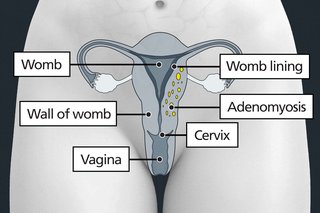
Adenomyosis involves lining-like tissue within the uterus’s muscular wall. It can be associated with painful, heavy periods, pelvic pressure, or bleeding between periods. These features suggest a reason to assess the pain, not proof that adenomyosis is present.
Fibroids are noncancerous growths in or around the uterus. Many cause no symptoms. Depending partly on their size and location, they may be associated with heavy bleeding, pelvic pressure, or pain. Finding that periods are painful and heavy therefore raises a question for assessment, but it does not establish that fibroids are the cause.
Dysmenorrhea: Painful Periods | ACOG
Return to the ACOG FAQ for concise descriptions of where endometriosis, fibroids, and adenomyosis occur.
Immediately after the sentence “Some of the conditions that can cause secondary dysmenorrhea include the following,” read the first three bullets, from Endometriosis through Adenomyosis. Concentrate on where each condition occurs. The age description for adenomyosis is a tendency, not a requirement.
The MSD Manual’s comparison table adds the symptoms that may accompany these conditions. It is most useful when read as a set of possible features, not a checklist that every affected person must satisfy.
Menstrual Cramps - Women's Health - MSD Manual Consumer Version
Use the MSD Manual Consumer Version’s table to compare symptom clusters while noticing how much they overlap.
Under “Evaluation of Menstrual Cramps,” find the table “Some Causes and Features of Menstrual Cramps.” Read the Common Features entries for adenomyosis, endometriosis, and fibroids. For the fibroids row, also note its opening phrase, “Often no other symptoms.” You can leave the tests column for a later lesson.
Pelvic infection does not have to follow the menstrual schedule
Pelvic inflammatory disease (PID) is an infection and inflammation of the upper reproductive tract. It is another possible cause of pelvic pain, but unlike the typical primary-cramp pattern, the pain need not be confined to the first days of bleeding. Fever, unusual vaginal discharge, bleeding between periods, or pain during sex may accompany it. Not everyone has every symptom, and the absence of fever does not rule out infection.
This distinction matters because a new episode of pelvic pain with possible infection symptoms should not be dismissed as “just a difficult period.” Other conditions can also cause new pelvic pain, so the appropriate step is medical assessment rather than trying to identify the cause from the symptom list.
Menstrual Cramps - Women's Health - MSD Manual Consumer Version
Read the MSD Manual’s brief mention of pelvic inflammatory disease and its separate list of symptoms that warrant concern.
Under “Causes of Menstrual Cramps,” locate “Less common causes” and read the list that includes pelvic inflammatory disease. Then, under “Evaluation of Menstrual Cramps” and its “Warning signs” subsection, read the warning signs. Notice that sudden or constant pain, fever, and pus-like discharge do not fit a reassuring, familiar cramp pattern.
Use clues to guide a conversation, not to name a condition
Imagine two descriptions. In one, cramps have followed much the same early-period pattern for years and ease as bleeding continues. That is consistent with primary dysmenorrhea, though it does not prove it. In the other, previously predictable cramps have become worse over several cycles, begin earlier, and are now accompanied by bleeding between periods. That change supports assessment for a secondary cause; it does not tell you which cause is present.
The most useful distinctions to retain are timing, change over time, and accompanying symptoms. Pain with bowel movements or urination, heavy bleeding or pelvic pressure, and fever or unusual discharge point toward different questions for a clinician, but none works as a stand-alone test. Severe pain that repeatedly disrupts daily life also deserves attention even if its timing seems typical of primary cramps.
Do not wait for a future lesson if pain is suddenly severe, occurs with possible pregnancy or fainting, or comes with fever or unusual discharge: seek prompt medical advice. The next lesson will make the choices between emergency, same-day, and routine assessment more precise.
Key takeaways
Primary menstrual pain commonly follows a familiar pattern: cramps around the start of bleeding that ease over the first few days. New, worsening, prolonged, or between-period pain, especially with other pelvic or bleeding symptoms, increases the need to consider a secondary cause. Endometriosis, adenomyosis, fibroids, and pelvic infection can produce different clues, but their symptoms overlap too much to diagnose by pattern alone.
The next lesson focuses on how soon different presentations need medical attention.