Menstrual cramps can be explained as a response to changes in the uterine lining, but the explanation does not make severe pain something you must simply put up with. This first module starts with how cramps arise. Later lessons will distinguish patterns that may suggest an underlying condition and cover when to seek care.
In this lesson, you will follow the events around the start of a period: a change in progesterone, the shedding of the uterine lining, and the effects of chemicals called prostaglandins. Together, these explain much of primary dysmenorrhea—menstrual pain without an identified underlying pelvic condition.
The uterus is active during a period
The endometrium is the lining inside the uterus. If pregnancy does not occur, this lining is shed during menstruation. The uterus has a muscular wall, called the myometrium, that contracts as the lining is shed. Contractions are part of menstruation; the question is why they become painful for some people.
Dysmenorrhea is the medical term for menstrual pain. Primary dysmenorrhea refers to cramps that occur without an identified underlying pelvic condition. Secondary dysmenorrhea refers to pain associated with an underlying condition. These are descriptions of possible causes, not labels you can assign reliably from pain intensity alone.
3 things that can cause painful periods - Chen X. Chen
Watch “3 things that can cause painful periods” from TED-Ed for a short visual introduction to menstrual pain and prostaglandins.
Watch the introduction for the range of symptoms and the distinction between primary and secondary pain. Then skip ahead to prostaglandins and cramps. Focus on what happens to uterine muscle and blood flow; the brief mention of medicines is a preview for a later module.
The video’s central point is that the pain has a physical mechanism. “No identified underlying condition” does not mean that the cramps are imagined or that they cannot interfere with daily life.
Why prostaglandins rise as bleeding begins
After ovulation, a temporary structure in the ovary called the corpus luteum produces progesterone. If pregnancy does not occur, the corpus luteum regresses and progesterone levels fall. That drop is associated with the breakdown and shedding of the endometrium. At the same time, processes in the lining increase production of prostaglandins.
Prostaglandins are locally acting chemical messengers made in many body tissues. Two involved in menstrual cramps are called PGF2α and PGE2. You do not need to memorize their names. The useful distinction is that progesterone is a cycle-related hormone whose level falls, while prostaglandins are chemicals produced in the uterine lining that act on nearby tissue. A falling progesterone level does not itself squeeze the uterus; it helps set the stage for the lining changes and prostaglandin production that accompany menstruation.
Primary Dysmenorrhea: Pathophysiology, Diagnosis, and Treatment Updates
Read the “PATHOPHYSIOLOGY” section of this clinical review to connect the cycle change with the source and effects of prostaglandins. It uses some technical vocabulary, so concentrate on the overall mechanism rather than the enzyme names.
Under “PATHOPHYSIOLOGY,” read the first two paragraphs. Start with the paragraph describing prostaglandins and uterine contractions; stop at the end of the next paragraph, which describes corpus luteum regression, falling progesterone, and prostaglandin production. “Myometrial” means relating to the uterine muscle, “vasoconstriction” means blood-vessel narrowing, and “ischemia” means reduced blood supply.
The review includes a molecular pathway for making prostaglandins. For this lesson, its purpose is to show that there are steps between the hormonal change and the cramp—not to suggest that every person’s pain can be predicted from a single hormone or chemical level.
How a contraction becomes a cramp
Prostaglandins encourage the myometrium to contract and can narrow blood vessels in the uterus. When contractions are strong or frequent, and blood flow is reduced, parts of the uterine muscle can temporarily receive less oxygen. This reduced supply, called ischemia, contributes to pain. Prostaglandins and other locally produced substances also affect pain-sensing nerve endings.
The result is more than one source of discomfort acting together: muscular squeezing, temporarily reduced blood flow, and activation or sensitization of pain nerves. Higher prostaglandin levels are associated with more painful cramps, but pain is not a precise measure of a person’s prostaglandin level. Pain experience varies, and the mechanism is not fully understood.
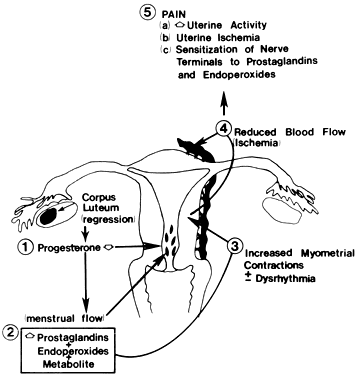
In the diagram, “uterine ischemia” refers to reduced blood supply to uterine tissue during the process shown. The figure also uses the technical term endoperoxides for compounds in prostaglandin production; you do not need that detail to explain the cramp mechanism.
Why the timing of pain often follows the period
Prostaglandin levels in the uterine lining are high around the start of menstruation. As bleeding continues and the lining is shed, those levels tend to fall. This helps explain a common primary-dysmenorrhea pattern: cramping begins shortly before or around the start of bleeding, is often strongest early in the period, and then eases.
Dysmenorrhea: Painful Periods | ACOG
Read the American College of Obstetricians and Gynecologists’ patient FAQ for its concise account of why primary cramps happen and why they often ease after the first days of bleeding.
In the opening part of the FAQ, after the statements describing how common menstrual pain is, find the answer beginning “Primary dysmenorrhea is the cramping pain.” Read that explanation through the sentence about pain lessening. Pay particular attention to what prostaglandins do to both muscle and blood vessels.
This timing is a tendency, not a diagnostic rule. Cramps that fit it are not automatically primary dysmenorrhea, and pain that does not fit it deserves attention rather than a guess about its cause. Pain can also come with symptoms such as nausea or diarrhea. The next lesson will examine which pain patterns may warrant investigation for a secondary cause, without treating any one symptom as a diagnosis.
Key takeaways
In primary dysmenorrhea, the fall in progesterone near the end of a cycle is associated with shedding of the uterine lining and increased prostaglandin production. Prostaglandins promote uterine contractions and blood-vessel narrowing; reduced blood flow and stimulation of pain nerves contribute to cramps. Prostaglandin levels tend to decline as the period progresses, helping explain why pain often eases after its early days.
This mechanism explains how many menstrual cramps occur, not why any particular person has pain. The next lesson builds on it by comparing common primary-pain patterns with patterns that may suggest an underlying condition.