In our last lesson, we established the fundamental principle behind the German case system: it uses changes in word forms, or declensions, to assign grammatical roles to nouns. This is what gives German its flexible sentence structure. Now that you understand why cases exist, it's time to learn what they are.
Today, we will officially meet the four German cases. Our goal is to name each one—Nominativ, Akkusativ, Dativ, and Genitiv—and to understand its core function within a sentence. By the end of this lesson, you'll have a conceptual map of the "job" each case performs, setting the stage for learning how to apply them.
The Four Grammatical Roles
In German, there are four cases, each corresponding to a specific grammatical role. Think of them as the primary "job titles" a noun can have in a sentence.
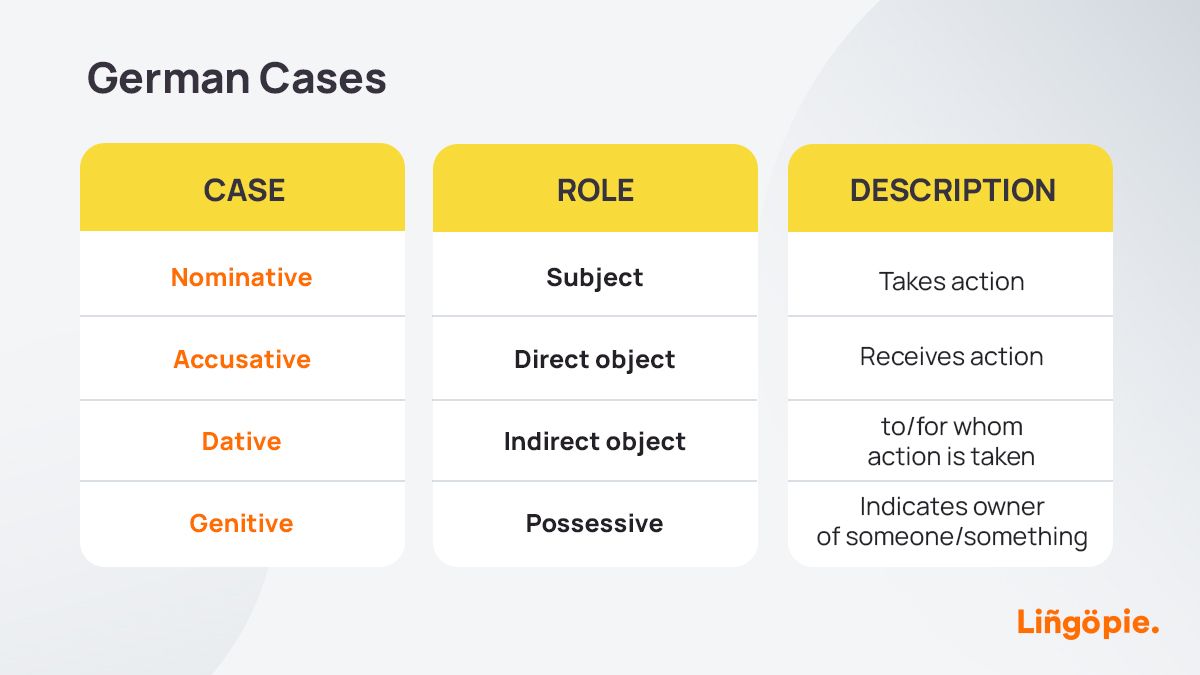
These are the four cases you will learn to master:
- Nominativ (Nominative)
- Akkusativ (Accusative)
- Dativ (Dative)
- Genitiv (Genitive)
From a linguistic perspective, these cases are the morphological markers that define the relationships between the participants in an action described by the verb. Let's examine the specific role of each one.
The Nominative Case (Nominativ): The Subject
The Nominative case is the most fundamental. It marks the subject of the sentence—the person or thing that is performing the action or is the main topic. It's the "doer" or the star of the show.
- Der Hund schläft. (The dog sleeps.) -> Der Hund is the subject.
- Die Frau liest. (The woman reads.) -> Die Frau is the subject.
To formally define this role, let's turn to a clear explanation.
German Cases: A Complete Guide
This section from the "Complete Guide to German Cases" on Clozemaster clearly defines the Nominative case and its function as the subject.
Please read the section titled The Nominative Case. Pay close attention to the explanation that it marks the subject of the verb and is the version you find in a dictionary.
The Accusative Case (Akkusativ): The Direct Object
While the Nominative is the "doer," the Accusative case typically marks the direct object. This is the person or thing that is directly receiving or being affected by the action of the verb.
- Ich sehe den Hund. (I see the dog.) -> The dog isn't doing anything; it is being seen.
- Die Frau liest das Buch. (The woman reads the book.) -> The book is being read.
The following reading provides a concise definition.
German Cases: A Complete Guide
This next section from the same guide explains the role of the Accusative case.
Now, read the section titled The Accusative Case. Focus on the definition of the Accusative as the marker of the direct object.
The Dative Case (Dativ): The Indirect Object
The Dative case most often identifies the indirect object. Think of the indirect object as the recipient or beneficiary of the action. It's the person or thing "to whom" or "for whom" the action is done. It often appears in sentences that already have a direct object.
- Ich gebe dem Hund einen Knochen. (I give a bone to the dog.) -> The dog is the recipient of the bone (the direct object).
- Die Frau liest dem Kind ein Buch vor. (The woman reads a book to the child.) -> The child is the recipient of the reading.
Let's get the formal definition for this role.
German Cases: A Complete Guide
This part of the guide defines the role of the Dative case as the indirect object.
Please read the section The Dative Case. The key concept here is its function as the marker of the indirect object, described as the recipient.
The Genitive Case (Genitiv): The Possessive
Finally, the Genitive case is used to show possession or a close relationship between two nouns. It answers the question "whose?". It functions much like "'s" or "of the" in English.
- Das Halsband des Hundes ist neu. (The collar of the dog is new.)
- Das ist das Auto der Frau. (That is the car of the woman.)
This last reading will complete our set of definitions.
German Cases: A Complete Guide
This final section from the guide explains the Genitive's role in expressing possession.
Read the section titled The Genitive Case. The main takeaway is that its most common use is to signify possession.
A Conceptual Summary
You now have the names and core functions for all four cases. The following video from the Bausteine eins channel, which you've seen before, provides an excellent conceptual summary of how these roles fit together.
THIS MIGHT HELP | The GERMAN CASES | Bausteine zwei
This video offers a concise summary of the primary jobs of each of the four German cases.
Please watch the summary segment, from this timestamp to the end. It will help you consolidate the function of each case in your mind.
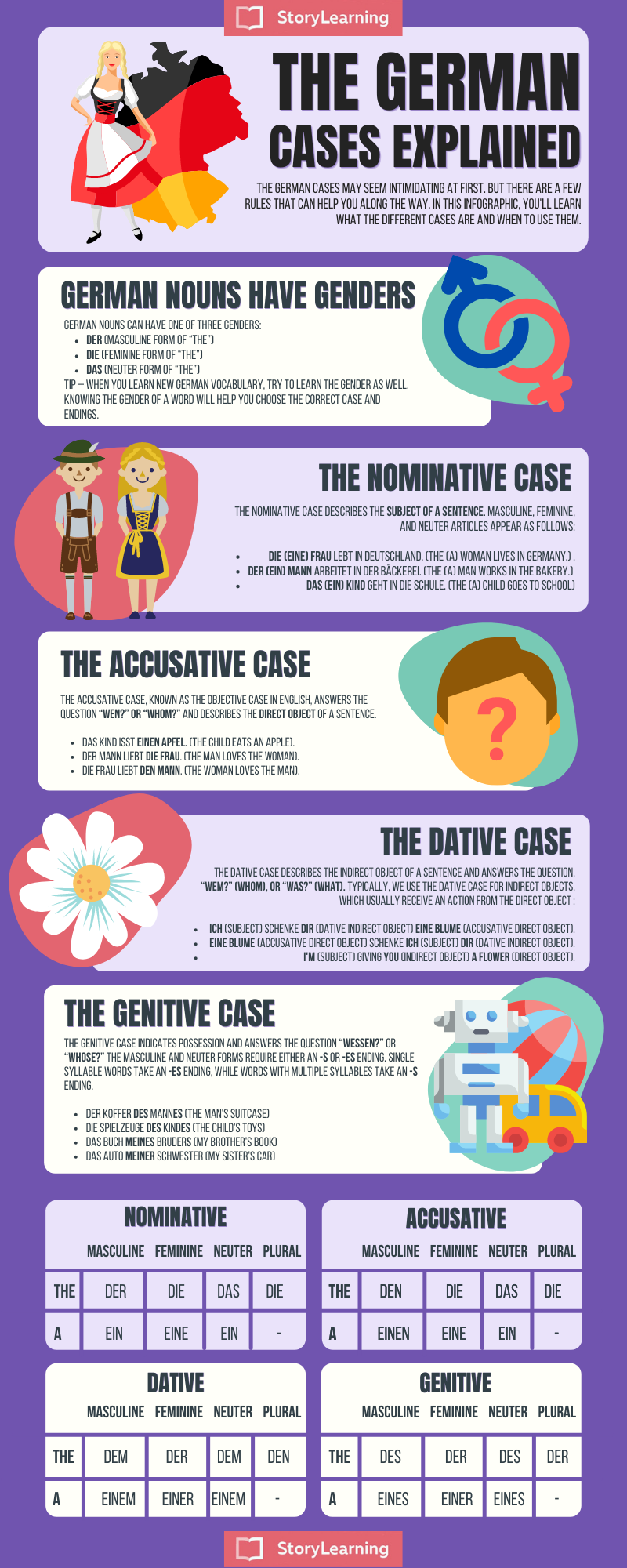
To visualize all of this information in one place, the infographic below is very helpful. It recaps the functions and provides a preview of the article changes (declensions) associated with each case, which we will study in detail in upcoming lessons.
Key Takeaways
You've now put names to the concepts from our first lesson. The flexible structure of German is built upon these four grammatical roles. Here are their core functions:
- Nominative: Marks the Subject (the doer).
- Accusative: Marks the Direct Object (the thing being acted upon).
- Dative: Marks the Indirect Object (the recipient of the action).
- Genitive: Marks Possession (the owner).
You now have a solid "what" to add to the "why." In our next lesson, we'll focus on a practical tool to help you identify which case is which in a real sentence. We will learn the German "question words" (Fragewörter) that correspond to each case, giving you a systematic way to start analyzing sentences.