Welcome back. In our previous lesson, we established a conceptual map of the four German cases, defining the core function of each one: the Nominative as the subject, the Accusative as the direct object, the Dative as the indirect object, and the Genitive as the possessor.
Today, we will build directly on that knowledge by learning a practical, systematic method to identify which case a noun is in. This lesson focuses on using German question words, or Fragewörter, as a diagnostic tool. Your goal is to be able to transform a statement into a series of questions to reveal the grammatical role—and thus the case—of each noun. This technique will provide a logical procedure to analyze sentences, which should help demystify the case system.
The Question Test: An Algorithm for Case Identification
From a linguistic standpoint, cases mark the grammatical role of a noun phrase in a sentence. A very effective way to determine this role is to ask a question to which the noun phrase is the answer. German has specific question words that correspond directly to each case. By learning which question word to use, you can reliably identify the case of any noun in a sentence.
This "question test" is your first algorithmic tool for mastering the cases. Let's look at the question words for people. The infographic from our last lesson provides a quick reference.
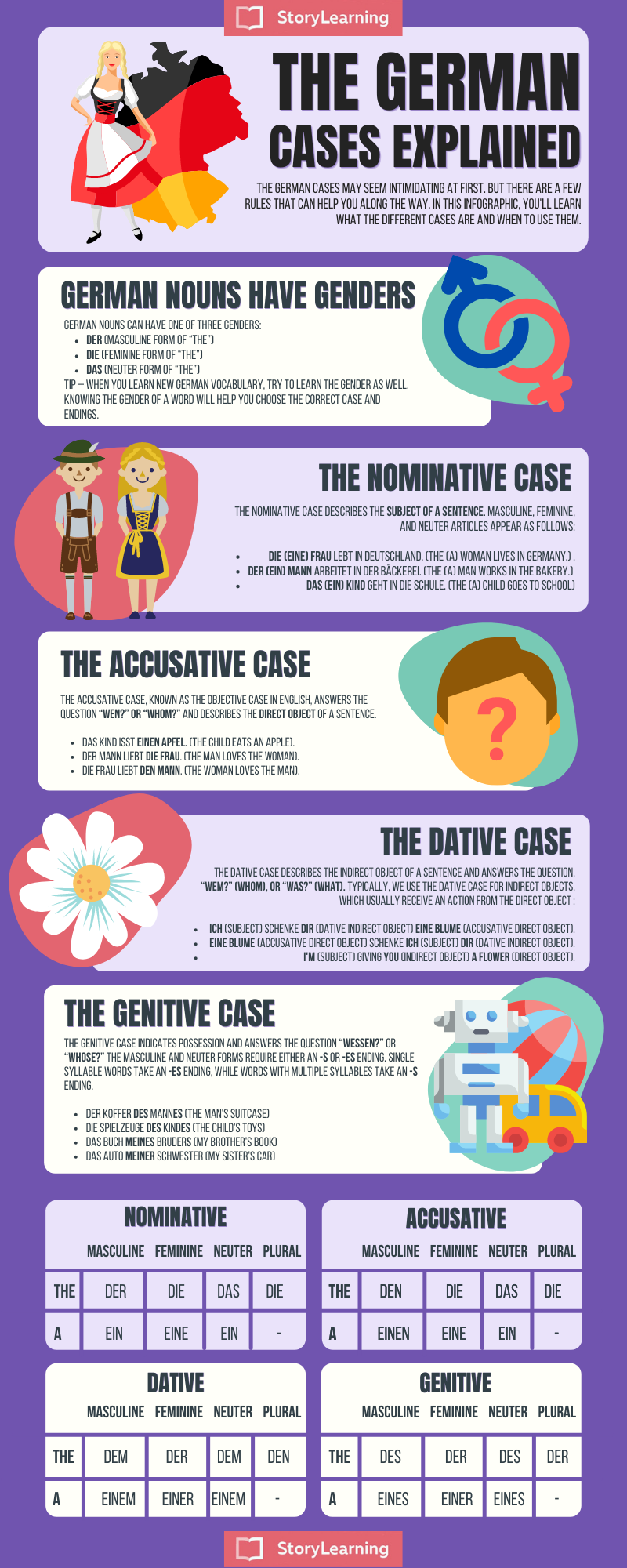
The video "wer vs wen vs wem vs wessen" by Learn German with Herr Antrim offers a clear and structured walkthrough of how to use these question words. We'll watch it in segments as we discuss each case.
wer vs wen vs wem vs wessen - A2 German Grammar
This video provides a detailed explanation of the four primary question words used for people, linking each one directly to a specific German case.
As we go through the cases, I will direct you to the relevant parts of this video.
1. Nominative: The Subject (Who? / What?)
To find the subject of a sentence (the "doer"), you ask Wer? (Who?) for people, or Was? (What?) for things. The noun phrase that answers this question is in the Nominative case.
Consider the sentence:
Der Mann liest das Buch. (The man reads the book.)
To find the subject, ask:
Frage (Question): Wer liest das Buch?
Antwort (Answer): Der Mann.
Therefore, Der Mann is the subject and is in the Nominative case.
Now, let's watch the first segment of the video for a detailed explanation.
wer vs wen vs wem vs wessen - A2 German Grammar
This section focuses on wer as the question word for the Nominative case.
Please watch from the start of the explanation of the Nominative question word. Notice how it's used exclusively to find the subject.
2. Accusative: The Direct Object (Whom? / What?)
To find the direct object (the thing being directly acted upon), you ask Wen? (Whom?) for people, or Was? (What?) for things. The noun that answers this question is in the Accusative case.
Let's use our example sentence again:
Der Mann liest das Buch. (The man reads the book.)
To find the direct object, ask:
Frage: Was liest der Mann?
Antwort: Das Buch.
Therefore, das Buch is the direct object and is in the Accusative case.
Now for a sentence with a person as the direct object:
Die Frau sieht den Mann. (The woman sees the man.)
Frage: Wen sieht die Frau?
Antwort: Den Mann.
Therefore, den Mann is in the Accusative case.
Let's continue with the video.
wer vs wen vs wem vs wessen - A2 German Grammar
This part explains how wen is used to identify the Accusative case.
Watch the segment from the introduction of wen until the discussion of the Dative case begins. Pay attention to the distinction between wer (subject) and wen (object).
3. Dative: The Indirect Object (To/For Whom?)
To find the indirect object (the recipient of the action), you ask Wem? (To whom? / For whom?). The answer will be in the Dative case.
Consider a sentence with three elements:
Der Mann gibt dem Kind einen Apfel. (The man gives the child an apple.)
We can already identify the Nominative (Wer gibt...? -> Der Mann) and the Accusative (Was gibt der Mann...? -> einen Apfel). To find the indirect object, ask:
Frage: Wem gibt der Mann einen Apfel?
Antwort: Dem Kind.
Therefore, dem Kind is the indirect object and is in the Dative case.
The next part of the video explains this.
wer vs wen vs wem vs wessen - A2 German Grammar
This segment covers wem as the question word for the Dative case.
Now watch the section covering the Dative, from the start of the wem explanation up to the "German grammar power tip".
4. Genitive: The Possessor (Whose?)
Finally, to identify possession, you ask Wessen? (Whose?). The noun that answers this question is in the Genitive case.
Das ist das Auto des Mannes. (That is the man's car.)
To find the owner, ask:
Frage: Wessen Auto ist das?
Antwort: Des Mannes.
Therefore, des Mannes is in the Genitive case.
Let's watch the final explanation from the video.
wer vs wen vs wem vs wessen - A2 German Grammar
This final section explains wessen for the Genitive case.
Please watch the segment from the explanation of wessen to the end of that section.
A Pattern-Matching Trick for Verification
You may have noticed a pattern in the endings of wer, wen, and wem. This pattern provides a powerful and simple heuristic for verifying the case, especially when you start working with pronouns.
The ending of the masculine personal pronoun for each case (er, ihn, ihm) mirrors the ending of the corresponding question word.
- Nominative: wer -> er (he)
- Accusative: wen -> ihn (him)
- Dative: wem -> ihm (to him)
You can test this by replacing the noun phrase in your answer with a masculine pronoun. The pronoun that fits grammatically will confirm the case.
- Frage: Wer liest? -> Antwort: Der Mann. -> Test: Er liest. (Correct)
- Frage: Wen siehst du? -> Antwort: Den Mann. -> Test: Ich sehe ihn. (Correct)
- Frage: Wem hilfst du? -> Antwort: Dem Mann. -> Test: Ich helfe ihm. (Correct)
This pattern-matching approach is a very reliable way to double-check your work. The video you've been watching explains this exact trick.
wer vs wen vs wem vs wessen - A2 German Grammar
This part of the video explains the useful "power tip" connecting the question words to masculine pronouns.
Please watch the "German grammar power tip" section, from this timestamp. This is an excellent technique to internalize.
To practice this, you can try the interactive quiz from the yourdailygerman blog. It will challenge you to pick the right question word.
Questions in German - Complete Beginner's Guide
This quiz provides a good opportunity to apply what you've just learned.
Scroll down to the quiz section just after the author's "muffin break". Try Question 5, which asks you to match the English question to the German wer-form. This directly tests your understanding of the case functions.
Conclusion
You have now added a powerful analytical tool to your German grammar toolkit. By systematically using question words, you can dissect a sentence and determine the grammatical case of each noun. This transforms the "unpredictable" nature of cases into a logical, step-by-step process.
Key Takeaways:
- To identify a noun's case, rephrase the sentence as a question that the noun answers.
- Nominative (Subject): Wer? (Who?) / Was? (What?)
- Accusative (Direct Object): Wen? (Whom?) / Was? (What?)
- Dative (Indirect Object): Wem? (To whom?)
- Genitive (Possession): Wessen? (Whose?)
- You can verify the Nominative, Accusative, and Dative cases by checking if the ending of the question word (-r, -n, -m) matches the ending of the corresponding masculine pronoun (er, ihn, ihm).
With this foundation in place, we are ready to move from identifying cases to actively using them. In our next module, we will begin our deep dive into each case, starting with the Nominative. You will learn how to correctly decline articles for the subject of a sentence based on its gender and number.