Welcome to your first lesson! I'm excited to guide you on your journey to mastering the German cases. Your experience with Duolingo has given you a great foundation and a feel for the language's patterns. You've likely noticed how articles like der can change to den or dem without a clear reason. This course is designed to replace that feeling of unpredictability with a systematic understanding.
Today, we will start with the most fundamental question: why do German cases even exist? Our goal is to explain the role of grammatical cases in defining the function of nouns in a German sentence. By the end of our session, you'll understand the core principle that governs much of German grammar and sets it apart from English.
Why Word Order Isn't Enough
In English, we understand who is doing what to whom primarily through word order. The structure is typically Subject-Verb-Object (SVO). Consider this sentence:
The dog sees the man.
It's clear that the dog is the one doing the seeing (the subject) and the man is the one being seen (the object). If we swap them:
The man sees the dog.
The meaning is completely reversed. The positions of the nouns in the sentence dictate their roles.
German operates on a different principle. While it can use the same SVO structure, it doesn't have to. The language uses a system of cases to assign a role to each noun. This system acts like a set of grammatical labels.
Let's look at the German version:
Der Hund sieht den Mann. (The dog sees the man.)
Now, let's change the word order, moving the object to the front for emphasis:
Den Mann sieht der Hund.
Even though "the man" is now at the beginning of the sentence, the meaning is identical: the dog is still the one seeing the man. How does a German speaker know this? The answer lies in the small changes to the articles: der Hund vs. den Mann. The form den signals that "Mann" is the object, no matter where it appears.
To see a fantastic visual explanation of this core difference between English and German, the following video is highly recommended. The presenter uses color-coded "slots" to demonstrate the rigidity of English word order versus the flexibility of the German system.
German Cases - Get the big picture for a CLEARER understanding | German with Laura
This video, from the channel German with Laura, provides an excellent comparison between English and German sentence structures.
Please watch the segment from the beginning to where she explains why German is flexible. Pay close attention to the analogy of the colored slots and how they move around in German but not in English. This is the key to the case system.
Cases as Grammatical Roles
As you saw in the video, the German case system is what allows for this flexible word order. But what exactly is a case?
A case is a grammatical category that marks the function of a noun (or pronoun) within a sentence. Think of it as a "job title" for the noun. It tells you if the noun is the one performing an action, the one receiving an action, or something else entirely. Given your interest in linguistics, you can think of this as the core difference between an analytic language like English, which relies on syntax (word order), and an inflected language like German, which uses morphology (word forms) to convey grammatical relationships.
To solidify this idea, please read the following section from the article "German Cases Made Simple".
German Cases Explained: Charts, Rules + Practice Quizzes
This text clearly defines what cases are and directly contrasts the German inflected system with the word-order-dependent system of English, using another clear example.
In the article, please read the section titled What Are German Cases? (And Why They Matter). Start from the beginning of the section and read down to the end of the paragraph that says The meaning is the same. This will reinforce the concept we just discussed.
German has four of these "job titles," or cases. For now, we only need to know their basic function.
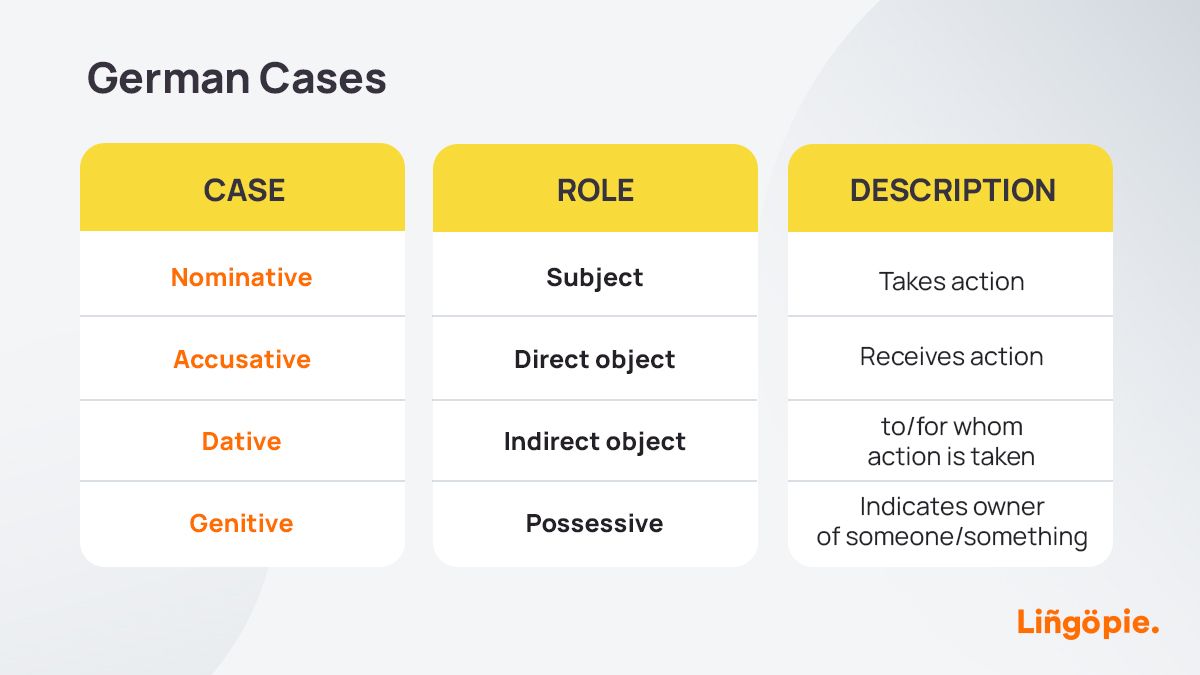
From your background in coding, you could think of a noun as an object in a program. The case is a property of that object (e.g., noun.role) that defines how it interacts with other elements, like the verb. The process of assigning this property and changing the noun's article accordingly is called declension.
How Cases Signal a Noun's Role
So, these roles are assigned, but how are they made visible? As we saw in the Hund/Mann example, the signal comes from changes to the words connected to the noun—most importantly, the article (der, die, das). This is why you've seen der change to den on Duolingo. It's not random; it's the language explicitly marking the noun's job.
This concept of form indicating function is a powerful one. The next video offers a simple but effective analogy.
THIS MIGHT HELP | The GERMAN CASES | Bausteine zwei
The channel Bausteine eins uses a helpful analogy to explain how the form of a word signals its function.
Watch the short segment from this part of the video. The comparison of cases to cutlery—a knife, fork, and spoon—is a great way to think about how an object's form tells you what its job is.
These changes to articles, pronouns, and adjectives are the "clues" that make the German sentence structure work. They carry the grammatical information that in English is conveyed by word order.
Key Takeaways
- Function over Position: While English relies on a fixed word order (Subject-Verb-Object) to show a noun's role, German uses a case system.
- Cases as Roles: A case assigns a specific grammatical role to a noun (e.g., subject, direct object). This is why German word order can be flexible without creating ambiguity.
- Declension as the Signal: The case of a noun is made visible through changes in the form of its article and other related words. This process is called declension. This is the system behind the changes you've already observed in the language.
Understanding this fundamental principle is the first and most important step to mastering the cases. You now have the conceptual framework to understand why the grammar works the way it does.
In our next lesson, we will build directly on this foundation. We will officially name the four German cases, explore their core functions in more detail, and learn the essential "question words" (Fragewörter) that help you identify which case to use in any given sentence.