Hello! Welcome back to our course on building and managing your beauty mini-market.
In our last lesson, we focused on how to collect customer feedback, establishing various channels to listen to your customers. We created a plan to gather insights through in-store methods like QR codes and post-visit surveys. Now that you have a plan to collect this valuable information, the crucial next step is to make sense of it.
This lesson directly addresses our learning outcome: to analyze customer feedback to identify and implement improvements to store operations. Simply collecting feedback isn't enough; the real value lies in systematically analyzing it to uncover patterns and turning those insights into concrete actions that enhance the customer experience. This process is the engine of continuous improvement for your store.
1. The Goal of Feedback Analysis: From Raw Data to Actionable Insight
Your background in digital marketing has likely exposed you to analyzing metrics like click-through rates and customer comments on social media. The process for physical retail feedback is conceptually similar: you're looking for trends in data to make informed decisions. The goal is to move beyond one-off comments and see the bigger picture.
Customer Feedback Analysis: Step-By-Step + Template
To start, let's ground ourselves in the fundamentals of feedback analysis. This article from SentiSum provides a clear definition and explains why this process is so critical for business success.
Please read the first two main sections: 'What Is Customer Feedback Analysis?' and 'Why is Analyzing Feedback Important?'. Focus on how analysis transforms qualitative comments into quantitative data you can act on.
As the article highlights, companies that systematically listen to and act on feedback grow faster. For your beauty mini-market, this process will be your key to making customer-centric decisions, improving retention, and building a loyal following that generates positive word-of-mouth.
2. A Step-by-Step Guide to Manually Analyzing Feedback
For a new, small store, you don't need expensive software. A simple, manual system will be highly effective. We'll walk through a process you can manage with a basic spreadsheet.
This approach involves four main stages: collating, categorizing, quantifying, and identifying the root cause.
Customer Feedback Analysis: Step-By-Step + Template
The SentiSum article we just looked at provides an excellent, practical guide for manual analysis. We will walk through these steps together.
Now, read the section 'How to Analyze Customer Feedback Manually (Step-by-Step With Template)'. Don't worry about downloading the template just yet; focus on understanding Steps 2 through 5: choosing channels, collating data, categorizing, and root cause analysis.
Let's break down these steps for your beauty mini-market:
Step 1: Collate Your Feedback
Gather all feedback into a single spreadsheet. Your data will come from the channels you set up in the last lesson:
- Notes from in-person conversations
- Responses from email/SMS surveys
- Reviews from your Google Business Profile and social media pages
- Comments from a digital kiosk or suggestion box
Your spreadsheet should have columns for: Date, Source (e.g., Google Review, Survey), the Feedback Itself, and any customer data you have.
Step 2: Categorize and Tag the Feedback
This is the most critical step. You'll read each piece of feedback and assign it one or more "tags" or categories. This turns unstructured text into structured data. For a beauty store, your categories might include:
- Product: Availability, Selection, Quality, Price
- Staff: Friendliness, Product Knowledge, Helpfulness
- Store Environment: Lighting, Cleanliness, Music, Layout
- Checkout: Wait Time, Payment Process, Friendliness
- Operations: Store Hours, Return Policy

Step 3: Quantify and Identify Patterns
Once your feedback is tagged, you can start counting. Create a simple summary table or chart. For example, you might find:
Product Availability: 12 mentions in DecemberStaff Product Knowledge: 8 mentionsStore Lighting: 5 mentions
This quantification immediately shows you where to focus your energy. A single comment about lighting might be an opinion, but five similar comments indicate a real problem affecting the customer experience.
Step 4: Perform a Root Cause Analysis
Identifying a pattern is good, but understanding why it's happening is what leads to a real solution.
Why Customer Complaints Are Good for Business (Yes, Really)
This article from SuperOffice, 'Why Customer Complaints Are Good for Business', provides great questions to ask when decoding feedback to find the underlying issue.
Read the sections 'From Feedback to Insight: How to Decode Customer Complaints' and the 'Customer Recovery Playbook', focusing on steps 3 ('Log, Categorize, and Track the Issue') and 4 ('Fix the Root Cause'). Notice the emphasis on asking 'Why did this happen?'.
For every major pattern you identify, ask "why?".
- Pattern: Multiple complaints about long checkout lines on Saturdays.
- Root Cause Analysis: Is it because the credit card machine is slow? Is only one staff member scheduled? Does a specific promotion cause a bottleneck? Digging deeper helps you fix the actual problem, not just the symptom.
3. From Analysis to Action: Implementing Improvements
Once you've analyzed your feedback and identified root causes, you must act on it. A structured process ensures that insights lead to tangible improvements.
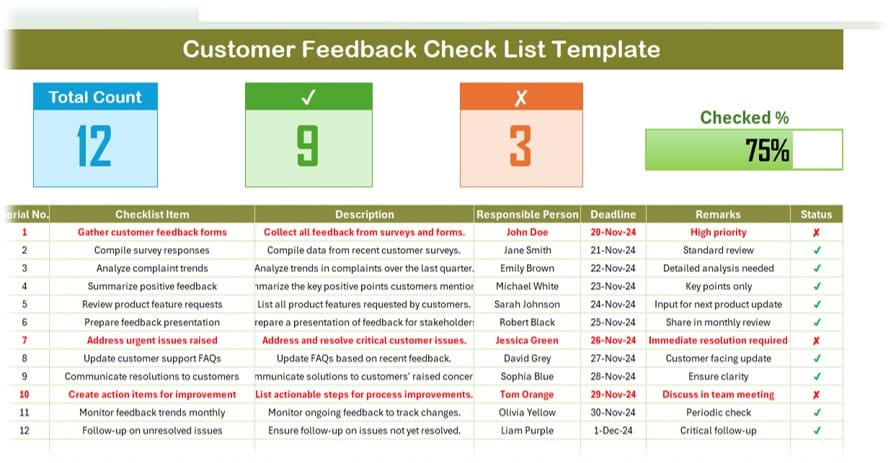
Here is a simple 4-step process to turn your analysis into action:
-
Prioritize Issues: You can't fix everything at once. Prioritize based on:
- Frequency: How many customers are mentioning this issue?
- Impact: How severely does this issue affect the shopping experience? (e.g., poor lighting that prevents a sale is high impact).
-
Define Action Items: For each priority issue, create a clear, specific action plan.
- Issue: "Staff lacks knowledge about vegan product lines."
- Action Item: "By [Date], develop a one-page info sheet on all vegan brands. Schedule a 30-minute training session with all staff to review."
-
Assign Ownership and Deadlines: Even if you're the only employee initially, get into the habit of assigning a 'who' and a 'when' to each action item. This creates accountability.
-
Close the Loop: Where possible, let customers know you've listened. This is incredibly powerful for building loyalty. It can be as simple as responding to a Google review: "Thank you for your feedback on our lighting! We heard you and have just installed brighter, color-correct bulbs in our makeup section. We hope you'll find it makes a big difference on your next visit!"
4. Application: Analyze Sample Feedback
Let's practice with a realistic scenario for your beauty mini-market. Imagine you've collected the following pieces of feedback over the past month.
- Feedback 1 (Email Survey): "I was really excited to try the new serum I saw on your Instagram, but it was sold out when I came in on Saturday."
- Feedback 2 (In-person comment at checkout): "You guys should really carry more of that foundation in the darker shades, it's always gone."
- Feedback 3 (Google Review): "Love this store, but it's the second time I've come for a specific product and it was out of stock. A bit frustrating."
- Feedback 4 (Email Survey): "Your staff was super friendly, but couldn't tell me when the sold-out face masks would be back in stock."
Exercise: Based on this feedback, answer the following questions.
- Categorize: What is the primary category or tag you would assign to all four of these comments?
- Identify the Pattern: What is the recurring theme or problem these customers are facing?
- Root Cause Analysis: What are two potential root causes for this recurring problem? (Think about inventory management, ordering, or communication).
- Define Action Items: Based on your analysis, propose two specific, actionable steps you could take to address this issue and improve store operations.
Take your time to think through the steps. This exercise simulates the exact process you will use in your own store.
Conclusion
You've now learned a complete cycle: from establishing feedback channels to collecting comments, and now, to analyzing them for actionable insights. This process transforms customer feedback from a collection of random opinions into a strategic guide for your business.
Key Takeaways:
- Systematize Your Analysis: Use a simple spreadsheet to collate, tag, and quantify feedback to identify real patterns.
- Ask "Why?": Move beyond identifying a problem to understanding its root cause.
- Prioritize and Act: Focus on the issues with the highest frequency and impact, and create clear, time-bound action plans.
- Close the Loop: Let customers know their feedback led to positive change to build loyalty and trust.
Next Lesson Preview:
One of the most common areas of feedback for a specialty store like yours will relate to staff interactions. Our next lesson, "Design a repeatable process for delivering personalized product recommendations to customers," will build directly on this. By understanding what customers are asking for, you can better train your team to provide the expert, personalized advice that will make your store a go-to destination.