Introduction
Welcome back! In our last lesson, we focused on the micro-level of your store's finances: calculating the markup and retail price for each of your beauty products. This was a crucial step in ensuring that every sale contributes to your profitability. Now, we're going to zoom out and look at the bigger picture.
This lesson addresses the learning outcome: to create a monthly operating budget for a beauty mini market. A budget is your financial roadmap. It's a plan that details your expected income and all your expenses over a specific period, typically a month. While your digital marketing background gives you experience with campaign budgets, an operating budget for a physical store encompasses every aspect of the business, from rent to electricity to your own salary.
By the end of this lesson, you will understand the components of an operating budget and have a practical template to create the first draft for your beauty mini-market. This will be an essential tool for managing your cash flow, making informed spending decisions, and steering your business toward sustainable profitability.
1. What is a Business Budget and Why is it Essential?
Before we start building one, it's important to understand what a budget is and the role it plays in a new business. At its core, a budget is a financial plan that helps you control your money, rather than letting your expenses control you.
To get a clear overview of why budgeting is so critical for a small business, let's watch a short segment from LYFE Accounting.
Small Business Budgeting Simplified: How to Create a Budget for Your Small Business
This video, 'Small Business Budgeting Simplified,' explains the core purpose of a budget and its main benefits, such as guaranteeing profitability and preventing the mismanagement of funds.
Please watch the segment from 03:31 to 06:59. Pay attention to the three main reasons why a budget is important for a small business.
As the video highlighted, a well-planned budget helps you:
- Plan for Profitability: By setting limits on spending, you can build your desired profit margin directly into your financial plan.
- Prioritize Spending: It forces you to make strategic decisions about where to allocate your resources, especially in the early stages.
- Assign a Purpose to Every Dollar: This prevents reactive spending and ensures you have funds set aside for crucial obligations like inventory, bills, and taxes.
For a physical retail store, this financial discipline is non-negotiable, as you'll be managing significant fixed costs like rent that are absent in a purely e-commerce model.
2. The Anatomy of a Monthly Operating Budget
A standard operating budget is built from a few key components. Understanding them is the first step to creating your own.
Sample business budget templates
This article from QuickBooks, 'Sample business budget templates,' provides a great breakdown of the core elements of a business budget. It clearly distinguishes between different types of income and expenses.
Please read the sections titled 'What’s included in a business budget?' and the first three steps under 'How to create a budget for a business' (steps 1, 2, and 3). Focus on the definitions of income, fixed expenses, and variable expenses.
Based on that reading, your monthly budget will have three main sections:
- Income (Revenue): This is the total amount of money you expect to generate from sales.
- Cost of Goods Sold (COGS): As we covered in the last lesson, this is the direct cost of the products you sell, including wholesale price and shipping. This is your largest variable expense.
- Operating Expenses (OpEx): These are the costs required to run the business, which are not directly tied to a specific product sold. They are typically broken down into:
- Fixed Expenses: Costs that stay the same each month regardless of sales volume (e.g., rent, insurance, software subscriptions).
- Variable Expenses: Costs that fluctuate with business activity (e.g., utilities, marketing spend, packaging, credit card processing fees).
To make this concrete for your beauty mini-market, let's look at a list of typical expenses you'll need to account for.
12 Monthly Salon Expenses You Should Expect
The article '12 Monthly Salon Expenses You Should Expect' gives a specific and relevant list of costs you'll face in the beauty retail industry. While it says 'salon,' almost all these expenses apply directly to your mini-market.
Scan through the 12 expenses listed, from Rent to Technology and Payment Fees. You don't need to read in-depth, but use this as a checklist to ensure you don't forget any key categories when building your budget.
This gives you a solid checklist for your OpEx, including rent, utilities, payroll, product inventory, marketing, insurance, licenses, and technology fees.
3. Building Your First Monthly Budget: A Step-by-Step Guide
Now for the practical part. We'll walk through the creation of a draft budget. Since you are starting from scratch, many of these numbers will be estimates. The goal is to create a realistic financial model, which you can refine over time.
Step 1: Forecast Your Monthly Revenue
For a new business without historical data, forecasting is an educated guess. A simple way to start is:
- Average Sale Value x Number of Customers per Day x Number of Operating Days
For example: If you estimate an average purchase of $40, anticipate serving 20 customers a day, and plan to be open 25 days a month, your forecast would be:$40 x 20 x 25 = $20,000 in monthly revenue.
Step 2: Calculate Your Cost of Goods Sold (COGS)
This connects directly to our last lesson. If you aim for an average 60% profit margin on your products, then your COGS will be 40% of your revenue.
COGS = Monthly Revenue x (1 - Desired Margin)COGS = $20,000 x (1 - 0.60) = $8,000
Your Gross Profit is Revenue minus COGS. In this case, $20,000 - $8,000 = $12,000. This is the money available to pay for all your other operating expenses.
Step 3: List and Estimate Your Operating Expenses (OpEx)
Using the checklist from the Homebase article, start listing your fixed and variable expenses. You will need to do some local research for these numbers (e.g., looking at commercial real estate listings for rent estimates).
Example Fixed Expenses:
- Rent: $3,500
- Business Insurance: $100
- POS System/Software: $150
- Owner's Salary: $3,000 (It's crucial to pay yourself as a fixed expense!)
- Total Fixed Expenses: $6,750
Example Variable Expenses:
- Utilities (Electricity, Water, Wi-Fi): $400
- Marketing & Advertising: $500 (You can set this as a fixed amount initially)
- Cleaning & Store Supplies: $150
- Credit Card Processing Fees (~2.5% of sales):
$20,000 x 0.025 = $500 - Contingency Fund (for unexpected costs): $300
- Total Variable Expenses: $1,850
Step 4: Calculate Your Net Profit
This is the final calculation that shows whether your business is projected to be profitable.
- Net Profit = Gross Profit - Total Operating Expenses
- Total Operating Expenses = Fixed + Variable =
$6,750 + $1,850 = $8,600 - Net Profit =
$12,000 - $8,600 = $3,400(before taxes)
A positive number here is a great sign! If it were negative, you would need to adjust your assumptions: Can you increase revenue? Can you reduce costs? This is why a budget is such a powerful planning tool.
4. Putting it into Practice: Your Budget Template
To make this process easy to manage, you should use a spreadsheet. Below is an image of a simple income and expense tracker for a beauty business that shows what your final budget could look like.
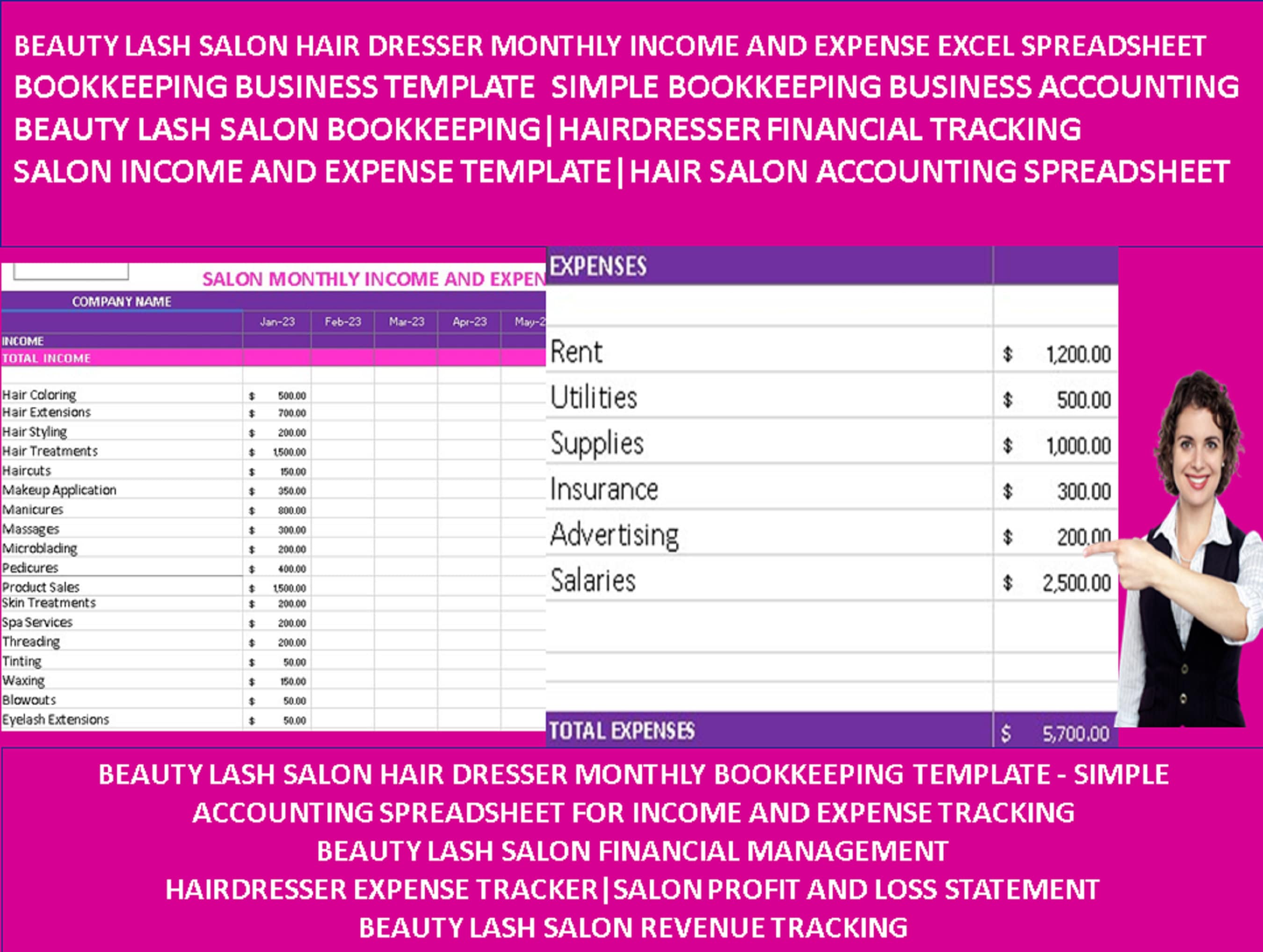
For a more detailed and functional tool, you can use a pre-built template. The QuickBooks article you reviewed earlier provides free, downloadable templates that are perfect for getting started.
Sample business budget templates
Now it's time to get hands-on. The same QuickBooks article provides excellent, ready-to-use templates. I recommend downloading the Excel version as it has built-in formulas.
Scroll down to the section 'Free business budget templates'. Download the 'Business budget template for Excel.' Open the file and explore its structure. The instructions in the section 'How to use the Excel budget template' can guide you, but for now, just focus on the 'Budget' tab and see how it aligns with the expense categories we've discussed.
Your Action Item: Take the Excel template you just downloaded and start creating a draft monthly operating budget for your beauty mini-market. Use the steps outlined above and fill in the categories with your own researched estimates. This will be your foundational financial document moving forward.
Conclusion
In this lesson, we transitioned from pricing individual items to mapping out the complete financial landscape of your store. Creating a monthly operating budget is not just an accounting exercise; it's the most effective way to plan for success, manage your cash, and make strategic decisions with confidence.
Key Takeaways:
- An operating budget is a financial plan that forecasts your monthly income and details your expenses.
- Expenses are broken down into Cost of Goods Sold (COGS), Fixed Expenses (like rent), and Variable Expenses (like utilities).
- The fundamental formula for profitability is: Net Profit = (Revenue - COGS) - Operating Expenses.
- For a new business, budgeting involves making educated estimates, which can be refined as you gather real data.
Preview of the Next Lesson:
Your budget is based on a sales forecast, but what is the absolute minimum you need to sell to avoid losing money? In our next lesson, we will use the expense figures from your new budget to perform a break-even analysis. This will tell you the exact sales volume required to cover all your costs, providing a critical first target for your business.