Introduction
Welcome to the next lesson in our financial management module. In the previous lesson, you created a draft monthly operating budget for your beauty mini-market. That budget is your financial plan, detailing your estimated sales and, crucially, your expected fixed and variable costs. Today, we'll put those cost figures to work.
This lesson focuses on a critical financial milestone: performing a break-even analysis for the store. Your background in digital marketing has likely exposed you to concepts like break-even Return On Ad Spend (ROAS). The principle here is similar, but we're applying it to your entire retail operation. We'll determine the exact amount of sales you need to generate each month just to cover all your costs. At this point, you're not losing money, but you're not making a profit either—you're "breaking even."
By the end of this 60-minute lesson, you will understand the components of a break-even analysis, be able to calculate it for your store, and know how to use this powerful number to set realistic sales goals and make informed business decisions.
1. What is the Break-Even Point?
The break-even point is a fundamental concept in business. It's the moment your total revenue equals your total costs. Every dollar you earn after reaching the break-even point contributes to your profit.
To get a clear and concise introduction to this idea, let's start with a short video.
Break even point explained - 5 Steps to understanding break even in business
The video 'Break even point explained' by Sarah Harkness provides an excellent overview of what the break-even point is and why it's so important for business owners to understand.
Please watch the first two minutes (from 00:00 to 01:58). Pay close attention to the definition of the break-even point and the distinction between fixed and variable costs.
As the video explained, the analysis hinges on understanding three key components, which should be familiar from our last lesson on budgeting:
- Fixed Costs: These are the expenses you have to pay regardless of your sales volume, like rent, insurance, and salaries. You've already identified these in your monthly operating budget.
- Variable Costs: These are costs that are directly tied to the product you sell. For your store, the primary variable cost is the Cost of Goods Sold (COGS)—what you pay suppliers for your products.
- Sale Price: The retail price you charge customers for a product.
Let's look at how these elements come together in the break-even formula.

2. The Break-Even Formula in Action
To understand the mechanics, let's first read a clear explanation tailored for retailers and then apply it to a simple example for your beauty mini-market.
How to Calculate Break-Even Point Formula
The article 'How to Calculate Break-Even Point Formula' from Lightspeed is written specifically for retailers. It does a great job of breaking down the formula and its components.
Please read the sections titled 'Understanding the break-even point formula' and 'Break-even point examples'. Focus on the definitions of Fixed Costs, Variable Costs, and Contribution Margin, and how they are used in the two formulas (for units and for sales dollars).
As the article details, there are two key formulas. The first calculates how many units you need to sell:
The denominator, Sale Price - Variable Cost, is called the Contribution Margin. It's the amount of money from each sale that "contributes" to paying off your fixed costs.
Single-Product Example: A Popular Face Cream
Let's imagine your store's numbers are as follows, based on the budget you created:
- Total Monthly Fixed Costs: $5,500 (rent, your salary, insurance, utilities, etc.)
- You want to find the break-even point for a single, popular face cream.
- Sale Price of the cream: $60
- Variable Cost (your cost from the supplier): $25
First, calculate the Contribution Margin per unit:
This means every time you sell one unit of this cream, you generate $35 that can be used to cover your fixed costs.
Now, calculate the Break-Even Point in Units:
Since you can't sell a fraction of a product, you round up. You need to sell 158 units of this face cream per month just to cover your fixed costs.
To find the break-even point in sales revenue, you simply multiply the break-even units by the sale price:
This means you need to generate $9,480 in revenue per month to break even.
3. The Multi-Product Challenge: Weighted-Average Margin
The single-product example is useful for understanding the concept, but your beauty mini-market will sell hundreds of different products (SKUs), each with its own price and margin. You can't calculate the break-even point for each one individually.
This is where we need to use a weighted-average contribution margin. This approach accounts for the fact that different products contribute differently to your profits and make up different proportions of your total sales (your sales mix).
This video explains the concept clearly.
Multiproduct Break Even Analysis
The video 'Multiproduct Break Even Analysis' by Edspira expertly explains how to handle break-even calculations when you have more than one product. It introduces the crucial concepts of sales mix and weighted-average contribution margin.
Please watch from the beginning until 03:30. Focus on how the 'sales mix' (the percentage of sales for each product type) is used to calculate a single 'weighted average unit contribution margin'.
4. Performing a Multi-Product Break-Even Analysis for Your Store
Let's apply this weighted-average concept to your beauty mini-market. Since calculating this for hundreds of SKUs is impractical, we'll group them into logical categories.
Step-by-Step Guide:
-
Categorize Your Products: Group your inventory into broad categories. For example:
- Skincare (face wash, moisturizers, serums)
- Makeup (foundation, lipstick, mascara)
- Haircare (shampoo, styling products)
- Tools & Accessories (brushes, sponges)
-
Estimate Your Sales Mix: For a new store, you'll need to make an educated guess. Based on market research (which we'll cover later), you might estimate that your sales will be:
- Skincare: 50%
- Makeup: 30%
- Haircare: 15%
- Tools & Accessories: 5%
(These percentages must add up to 100%)
-
Calculate Average Margin for Each Category: Determine the average sale price and average variable cost for products in each category to find the average contribution margin.
- Skincare: Avg. Price $40, Avg. Cost $16 → Contribution Margin = $24
- Makeup: Avg. Price $25, Avg. Cost $10 → Contribution Margin = $15
- Haircare: Avg. Price $20, Avg. Cost $8 → Contribution Margin = $12
- Tools & Acc.: Avg. Price $15, Avg. Cost $5 → Contribution Margin = $10
-
Calculate the Weighted-Average Contribution Margin: Multiply each category's contribution margin by its sales mix percentage, then add them all up.
| Category | Contribution Margin (A) | Sales Mix (B) | Weighted Margin (A x B) |
|---|---|---|---|
| Skincare | $24 | 50% | $12.00 |
| Makeup | $15 | 30% | $4.50 |
| Haircare | $12 | 15% | $1.80 |
| Tools & Acc. | $10 | 5% | $0.50 |
| Total | 100% | $18.80 |
Your Weighted-Average Contribution Margin per unit sold is $18.80.
- Calculate the Overall Break-Even Point: Now you can use the simple formula with your total fixed costs and this new weighted-average margin.
Using our fixed costs from before:
You need to sell roughly 293 items in total per month, across all categories according to your sales mix, to break even.
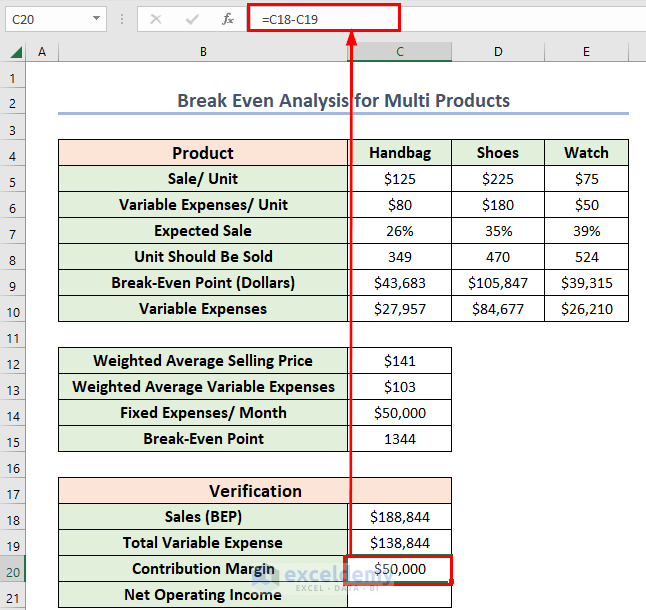
The image below shows what a more detailed version of this analysis can look like in a spreadsheet, which is the best tool for this job.
Your Action Item: Calculate Your Store's Break-Even Point
Now it's your turn. This practical exercise will give you one of the most important numbers for your business plan.
- Get Your Fixed Costs: Open the monthly operating budget you created in the last lesson. Find the total for your monthly fixed costs.
- Estimate Your Average Margin: For simplicity, you don't have to do a full weighted analysis yet. Start by estimating an average contribution margin percentage for your entire store. Based on the 60% profit margin we discussed, your average contribution margin would also be 60%. (Profit margin and contribution margin are often very close in retail).
- Use the Revenue Formula: The easiest formula for a multi-product store is the one for break-even revenue: (Where the Contribution Margin Ratio is your margin as a decimal, e.g., 60% = 0.60)
- Calculate Your Target: Plug in your numbers and calculate your monthly break-even revenue.
- Break It Down: Divide your monthly break-even revenue by the number of days you plan to be open (e.g., 25 days) to find your daily sales target. This is the amount of money you need to bring in every single day to avoid losing money.
Conclusion
Today, you've learned how to translate the costs from your budget into a tangible, actionable sales target. This break-even number is your financial baseline—the first major goal your new store must achieve.
Key Takeaways:
- The break-even point is where your Total Revenue equals your Total Costs.
- The calculation relies on separating your fixed costs (rent, salaries) from your variable costs (product costs).
- The contribution margin is the profit from a single sale that goes towards covering fixed costs.
- For a retail store with many products, using a weighted-average contribution margin based on your sales mix provides a more accurate break-even point.
- Your break-even point gives you a clear, minimum daily and monthly sales target.
Preview of the Next Lesson:
Knowing your break-even point is about ensuring profitability over time. However, a business can be profitable on paper but still fail if it runs out of cash. In our next lesson, we will address this by explaining the principles of cash flow management. We'll look at how to manage the timing of money coming in and going out to ensure you can always pay your bills, suppliers, and yourself.