Introduction
Welcome to Module 4: Location Selection and Lease Negotiation. In our last lesson, we concluded our work on the legal and regulatory foundations of your business by identifying the essential insurance policies needed to protect your store, your customers, and your future employees. With that critical groundwork complete, we can now move to one of the most significant and exciting decisions you'll make: choosing the physical location for your beauty mini-market.
Today's lesson addresses the learning outcome: List criteria for evaluating potential store locations including foot traffic, demographics, and competition proximity.
In e-commerce, your "location" is your domain name and your "traffic" is generated through SEO and digital ads. In the physical world, your location is a tangible asset that can make or break your business. A great location acts as a 24/7 marketing tool, while a poor one can render even the best products invisible. We will break down the key factors you must analyze to make a strategic and informed choice.
1. From Area to Site: A High-Level Overview
The first step in location selection is to understand the difference between choosing a general area (a neighborhood or district) and a specific site (a particular storefront or unit within a shopping center). The process typically moves from the macro to the micro. You'll first identify promising neighborhoods and then drill down to evaluate specific available properties within them.
Let's begin with two short videos that introduce the fundamental concepts of site evaluation.
Factors Affecting the Retail Store Location | Selection Criteria of Retail Store Location
This first video from the Retail & Marketing Concepts channel will help you distinguish between selecting a broader 'area' and a specific 'site' within it. This distinction is the starting point for any location search.
Watch the segments on 'Selection of the area' (00:30 - 01:02) and 'Choice of the site' (01:02 - 01:33). Notice how the process moves from a wide view to a narrow focus.
Now that you have a sense of the two-step process, let's expand on the key parameters involved in evaluating a potential site.
Site Evaluation Process of Retail Store | Retail Store Location and Site Selection Process
This next video, also from Retail & Marketing Concepts, details the core factors to consider during site evaluation. It provides a solid, general framework for any retail business.
Please watch the sections covering 'Population size and characteristics' (01:10 - 01:42), 'Computation [Competition] surrounding the location' (01:42 - 02:25), and 'Transportation access' (02:25 - 03:10). These align with the three main pillars we'll be discussing today: demographics, competition, and accessibility.
These videos introduce the three core pillars of location analysis:
- Demographics: Who lives, works, and shops in the area? Do they match your target customer?
- Accessibility & Traffic: How visible is the location, and how easy is it for customers to get there?
- Competition: Who are your direct and indirect competitors, and are they a threat or an opportunity?
2. A Deep Dive: Criteria for a Beauty Mini-Market
General retail principles are a great start, but the beauty industry has its own nuances. A customer's decision to visit a beauty store is influenced by factors like convenience for a quick purchase, the desire for a pleasant browsing experience, and the proximity to other "self-care" businesses.
The following resource is an excellent guide for evaluating locations specifically within the beauty sector. While it focuses on salons, the criteria for visibility, demographics, and competition are perfectly aligned with the needs of your beauty mini-market.
Choosing a Salon Location: Key Factors & Guide 2025
We'll use this guide from Cooviphair as our primary reference for this section. It translates general retail advice into actionable insights for a beauty business. Pay close attention to the practical, 'how-to' suggestions for evaluating each factor.
Please read the following three sections: '1. Foot Traffic & Visibility', '4. Competition & Market Demand', and '5. Target Demographics'.
Let's organize the insights from this reading into our three key criteria.
Criterion 1: Target Demographics
In your digital marketing work, you use data to build a profile of your target audience. For a physical store, you must find where that audience already exists in the real world.
- Who is your customer? Based on your business plan, you have a profile of your ideal customer for a women's beauty mini-market. The key demographic questions to ask about a potential area are:
- Income Level: Can the local population afford your products?
- Age Group: Does the area attract the age range you are targeting?
- Lifestyle: Is the area populated by young professionals, students, families, or wellness-focused individuals? The Cooviphair article's table gives great examples of matching business type to location.
- Population Density & Growth: A growing, dense population suggests long-term sustainability.
Your goal is to find a location where your ideal customer already lives, works, or spends her leisure time.
Criterion 2: Foot Traffic, Visibility, and Accessibility
This is the physical world's equivalent of website traffic and user experience. If customers can't see you or can't easily get to you, they won't visit.
- Foot Traffic & Visibility: This refers to the number of people who pass by your potential storefront. As the Cooviphair article notes, high visibility leads to more walk-in customers and brand awareness.
- How to Evaluate: Don't just rely on numbers from a real estate agent. Visit the location at different times of the day and on different days of the week (e.g., Tuesday morning vs. Saturday afternoon) to observe the flow of people.
- Accessibility: This is about the convenience of reaching your store.
- Parking: Is there ample, safe, and preferably free parking? As the article states, "If parking is a struggle, they will not return."
- Public Transportation: Is the location easily reachable by bus or train?
- Storefront Access: Is the entrance clearly visible, well-lit, and easy to access?
Criterion 3: Competition and Complementary Businesses
The businesses surrounding your location form a retail ecosystem that can either help or hinder your success.
- Competition: As both the videos and the article point out, being near a competitor is not automatically a negative. A cluster of similar stores can create a "shopping destination." Your digital marketing experience with competitor analysis is relevant here; the goal is the same: differentiate.
- Analyze Nearby Competitors: What brands do they carry? What are their price points? What are their weaknesses (e.g., poor customer service, limited selection of indie brands)? Your store can succeed by filling a gap they've left in the market.
- Complementary Businesses: These are non-competing businesses that attract your target demographic. For a beauty mini-market, the best neighbors are businesses that create a "self-care" hotspot. Think of them as sources of referral traffic.
- Ideal Neighbors: Gyms, yoga studios, nail salons, clothing boutiques, cafes, and upscale grocery stores. A location next to a popular coffee shop could expose your brand to hundreds of your target customers every single day.
3. Creating a Location Evaluation Checklist
To make an objective, data-driven decision, you need a systematic way to compare potential locations. Relying on "gut feeling" is risky. The best approach is to use a checklist to score each potential site against the same criteria.
First, let's look at how large retailers formalize this process.
Retail Site Selection Checklist
This professional checklist from Accruent shows how established brands approach site selection. It organizes the criteria we've discussed into a structured, data-centric framework. This will help you think like a seasoned retail strategist.
Review the first three sections: '1. MARKET DEMOGRAPHICS & CONSUMER BEHAVIOR', '2. LOCATION AND ACCESSIBILITY', and '3. COMPETITION AND MARKET SATURATION'. Notice how these points formalize the concepts we've covered.
That professional checklist is comprehensive. For a more streamlined visual summary, this image captures the essential points.
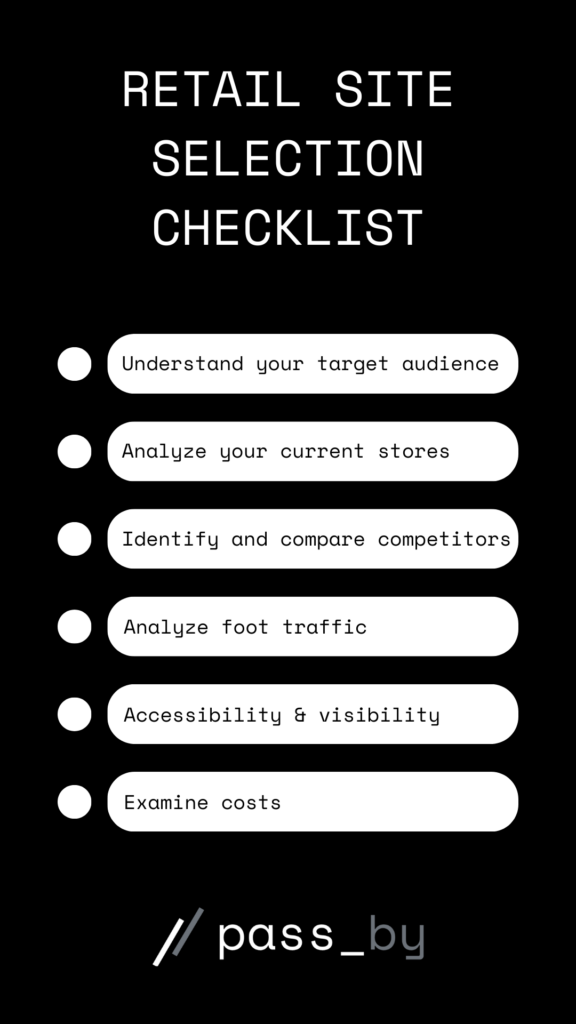
Finally, the Cooviphair article we reviewed earlier provides a simple but powerful scoring tool. This is a practical checklist you can adapt and use immediately when you start visiting potential sites.
Your Beauty Mini-Market Location Scorecard
(Adapted from "Choosing a Salon Location: Key Factors & Guide 2025")
Use this table to score each potential location from 1 (poor) to 5 (excellent). A location that scores above 40 is likely a strong contender.
| Evaluation Category | Site 1 Score (1-5) | Site 2 Score (1-5) | Site 3 Score (1-5) |
|---|---|---|---|
| Foot Traffic Volume | |||
| Storefront Visibility & Signage | |||
| Parking Convenience & Safety | |||
| Public Transport Access | |||
| Neighborhood Safety & Environment | |||
| Demographic Alignment | |||
| Proximity to Complementary Businesses | |||
| Competitive Landscape (Opportunity to Differentiate) | |||
| Total Score (out of 40) |
Conclusion
Choosing your store's location is one of the most consequential decisions you will make. Unlike a digital strategy that can be pivoted quickly, a physical location is a long-term commitment. By systematically evaluating potential sites against a clear set of criteria, you move from a speculative guess to a strategic business decision.
Key Takeaways:
- Location evaluation is a three-pillar process: You must analyze the Demographics of the area, the Foot Traffic & Accessibility of the site, and the surrounding Competition & Complementary Businesses.
- Think like your customer: A great location is one that is a natural and convenient fit for your target customer's daily life.
- Competition can be an opportunity: It validates market demand. Your job is to analyze competitors to find a unique angle or niche you can own.
- Use a checklist: A scoring system allows you to compare different locations objectively, removing emotion and bias from the decision-making process.
Preview of the Next Lesson:
Now that you know what to look for in a location, our next lesson will focus on how to find and analyze the necessary information. We will learn how to assess a potential location using foot traffic analysis and demographic data. This will involve moving from this qualitative checklist to more quantitative, data-driven analysis.