Introduction
Welcome back! In our last lesson, we navigated the critical regulations for the products you'll sell, focusing on FDA rules for labeling, safety, and shelf life. This ensures you protect your customers and build their trust. Now, we shift from protecting the customer to protecting the business itself.
Today's lesson addresses the learning outcome: Identify insurance types needed for a physical retail store. While your experience in e-commerce has exposed you to risks like data breaches, a physical store introduces a new set of liabilities, from a customer slipping on a wet floor to your inventory being damaged in a fire. Think of insurance as the financial safety net that allows your business to withstand the unexpected.
We will explore the essential insurance policies for a retail business, paying special attention to those most relevant for your beauty mini-market.
1. The Core Protections for a Retail Store
Every physical retail store, regardless of what it sells, faces a common set of fundamental risks. These are typically covered by a few core insurance policies. Many small businesses opt for a Business Owner's Policy (BOP), which conveniently bundles the first two types of insurance we'll discuss into a single, often more affordable, package.
To start, let's watch a short video that introduces the most common types of business insurance.
Small Business Insurance Explained - What Kinds of Business Insurance Do I Need?
The video 'Small Business Insurance Explained' by small business coach Ginny Silver provides a clear, high-level overview of the essential insurance policies you'll need to consider. We'll focus on the foundational coverages first.
Please watch the segments explaining General Liability Insurance (00:37 - 01:03) and Business Property Insurance (01:03 - 01:45).
As the video explained, these two policies form the bedrock of your protection:
-
General Liability Insurance: This is your primary defense against claims that your business caused bodily injury to a third party (like a customer) or damaged their property.
- Scenario: A customer trips over a display stand in your store and breaks their wrist. General liability insurance would help cover their medical expenses and your legal fees if they decide to sue.
-
Commercial Property Insurance: This protects your physical assets. For your beauty mini-market, this includes:
- Your inventory of products.
- Store fixtures, shelving, and displays.
- Computers, your Point-of-Sale (POS) system, and other electronics.
- Any improvements you make to the leased space.
- It covers losses from events like fire, theft, and vandalism.
This next reading from Insureon focuses specifically on cosmetic stores and introduces the concept of the Business Owner's Policy (BOP).
Cosmetics Store Liability Insurance
This article, 'Cosmetics Store Liability Insurance', directly addresses your business niche. It explains how these policies apply to a beauty retailer and introduces the Business Owner's Policy (BOP).
Read the section titled 'What types of business insurance do cosmetics retailers need?'. Focus on the descriptions for General Liability Insurance and the Business Owner's Policy (BOP).
As you can see, a BOP is an excellent starting point because it combines general liability and commercial property insurance, which are the two most critical coverages for a new retail store.
2. Insurance Specific to Your Products and Operations
Beyond the basics, your specific business activities—selling beauty products and eventually hiring staff—create the need for additional, specialized insurance.
Product Liability Insurance
This is non-negotiable for a beauty business. What if a customer has a severe allergic reaction to a lotion you sold them? Even if you didn't manufacture the product, you could be named in a lawsuit. Product liability insurance covers claims of injury or property damage caused by a product you sell.
Let's return to the first video to understand this coverage.
Small Business Insurance Explained - What Kinds of Business Insurance Do I Need?
We'll now watch the segment from 'Small Business Insurance Explained' that covers product liability.
Please watch from 02:54 to 03:18 to learn what product liability insurance covers.
Important Note: When purchasing a Business Owner's Policy (BOP), you must confirm with the insurance provider whether it includes product liability coverage or if it needs to be added separately. Given your business, this is a crucial detail.
Workers' Compensation Insurance
As soon as you hire your first employee—even a part-time sales associate—most states legally require you to have workers' compensation insurance. It covers medical expenses and lost wages for employees who are injured or become ill as a result of their job.
Watch THIS Before You Open Your Retail Store | 5 Things to Consider
The video 'Watch THIS Before You Open Your Retail Store' by Fusco Orsini & Associates Insurance Services discusses insurance from a retail-specific perspective. Let's hear what they say about policies related to employees and operations.
Watch the segment from 08:28 to 08:43, which explains the requirement for Workers' Compensation.
3. Protecting Against Disruption and Data Breaches
Two final types of insurance are crucial for ensuring your business's long-term survival in the face of major disruptions or modern threats.
-
Business Interruption Insurance: If a fire, flood, or other covered disaster forces you to close your store for repairs, how would you cover expenses like rent and payroll with no sales coming in? Business interruption insurance is designed to replace this lost income, helping you stay afloat during the shutdown. It's often included in or can be added to a BOP.
-
Cyber Liability Insurance: Your background in e-commerce makes you very familiar with online risks. A physical store is not immune. You will handle sensitive data through your POS system (credit card numbers) and potentially a customer loyalty program (names, emails). Cyber liability insurance helps you recover from a data breach by covering costs like credit monitoring for affected customers, public relations, and legal fees.
This article from Desjardins provides excellent, concise definitions for these coverages.
The article 'Understanding the main types of business insurance coverage' gives clear summaries of several policies. We'll use it to solidify our understanding of Business Interruption and Cyber Liability.
Please read the sections titled 'Business interruption insurance' and 'Cyber liability insurance'.
Your Insurance Checklist
To bring this all together, here is a visual summary of the most common insurance types for a small business.
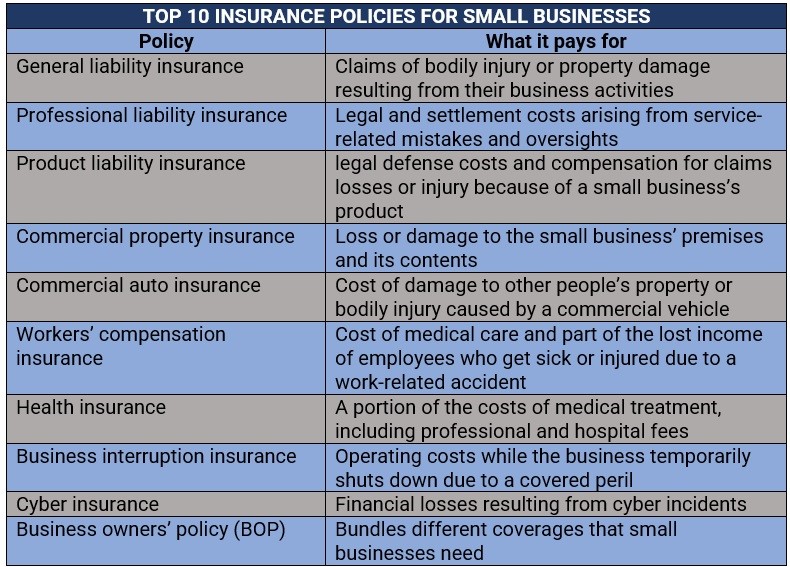
Here is a prioritized checklist for your beauty mini-market:
-
Essential from Day 1: Business Owner's Policy (BOP)
- Make sure it includes General Liability and Commercial Property insurance.
- Crucially, verify that it also includes Product Liability. If not, add it as a separate policy or endorsement.
- Consider adding Business Interruption coverage to your BOP.
-
Essential When You Hire: Workers' Compensation
- This is a legal requirement in most states once you have even one employee.
-
Strongly Recommended: Cyber Liability Insurance
- This protects the customer data you'll collect via your POS system and any marketing efforts.
When you're ready to seek quotes, use these three questions from the Desjardins article to guide your conversation with an insurance agent:
- What is the most critical threat to my business? (For you, this includes customer injury in-store and adverse reactions to products).
- Which coverage am I legally or contractually required to carry? (Workers' Comp when you hire. Your lease will also require General Liability).
- Which complementary options could strengthen my security? (Business Interruption and Cyber Liability are key here).
Conclusion
Just like registering your business and complying with FDA regulations, securing the right insurance is a foundational step in building a resilient retail operation. It protects your investment, your reputation, and your ability to operate through unexpected challenges.
Key Takeaways:
- A Business Owner's Policy (BOP) is an efficient way to get core coverage, bundling General Liability and Commercial Property insurance.
- For a beauty store, Product Liability Insurance is not optional; it's an essential protection against claims related to the products you sell.
- Workers' Compensation is legally mandated as soon as you hire employees.
- Business Interruption and Cyber Liability insurance provide critical protection against lost income and data breaches, respectively.
Preview of the Next Lesson:
With this final piece of your legal and regulatory foundation in place, we are ready to move on to one of the most exciting decisions: finding a home for your store! In our next lesson, we will begin Module 4 by exploring the criteria for evaluating potential store locations, including foot traffic, demographics, and competition proximity.