Introduction
Welcome back! In our last lesson, we outlined the landscape of licenses and permits you'll need, from the state-level Seller's Permit to your local Certificate of Occupancy. We ended by highlighting that for a beauty store, compliance with the U.S. Food and Drug Administration (FDA) is a critical, industry-specific responsibility.
Today, we'll dive deep into that topic. Our learning outcome is to describe regulations related to selling cosmetics and beauty products such as labeling, expiration, and safety standards. As a retailer, you are the final gatekeeper ensuring that every product you sell is safe and legally compliant. This knowledge is not just about avoiding legal trouble; it’s about building trust with your customers.
Your background in digital marketing has taught you the importance of clear, truthful communication and complying with regulations like FTC guidelines for advertising. Think of FDA cosmetic regulations in a similar way—they are about ensuring the information presented on a physical product is accurate, transparent, and protects the consumer.
1. The Foundation: FDA's Role and Key Definitions
Before we look at a product label, we need to understand the fundamental rules of the road set by the FDA. The most important concepts for you as a retailer are knowing what a "cosmetic" is and understanding what makes a product illegal to sell.
To get the official definitions, please read a few short sections from the FDA's website.
Summary of Cosmetics Labeling Requirements
This page from the FDA, 'Summary of Cosmetics Labeling Requirements', is our foundational text. It provides the legal definitions that govern the entire industry.
Please read the sections titled 'Legal Definition of "Cosmetics"', 'Cosmetics That Are Also Drugs', and 'Adulterated or Misbranded Cosmetics'. These are short but crucial for understanding your responsibilities.
Let's break down the key takeaways from that reading:
-
Cosmetic vs. Drug: A product's intended use determines its category.
- Cosmetic: Intended for "cleansing, beautifying, promoting attractiveness, or altering the appearance" (e.g., a simple moisturizer, lipstick, shampoo).
- Drug: Intended to "treat or prevent disease, or affect the structure or functions of the human body" (e.g., acne cream, dandruff shampoo).
- Both: Some products, like moisturizers with SPF or anti-dandruff shampoos, are regulated as both. This is important because drugs have stricter requirements, including mandatory expiration dates.
-
Adulterated vs. Misbranded: These are the two main reasons the FDA can take action against a product. As a retailer, it is illegal for you to sell products that fall into these categories.
- An adulterated cosmetic is contaminated, contains a harmful substance, or is prepared in unsanitary conditions. It's about the physical safety and integrity of the product itself.
- A misbranded cosmetic has false, misleading, or incomplete labeling. It's about truthful and complete information. Much of what we discuss today is aimed at preventing you from selling misbranded products.
2. Deconstructing the Label: What to Look For
Now, let's get practical. When you're considering a new product line, you need to be able to pick up the box and perform a quick compliance check. Every compliant cosmetic label has two main parts: the Principal Display Panel (PDP) and the Information Panel.
This video provides an excellent walkthrough of the required elements.
How to Correctly Label Cosmetics
In 'How to Correctly Label Cosmetics,' business owner Charmeas Edris gives a clear, practical summary of FDA labeling requirements from the perspective of a small brand.
Watch from 01:06 to 08:50. The video is divided into three parts that perfectly match our focus: the Principal Display Panel (front), the Information Panel (back/side), and the Ingredient List.
Based on the video and FDA regulations, here is a checklist of what you must find on a product's label:
On the Principal Display Panel (PDP) - The Front
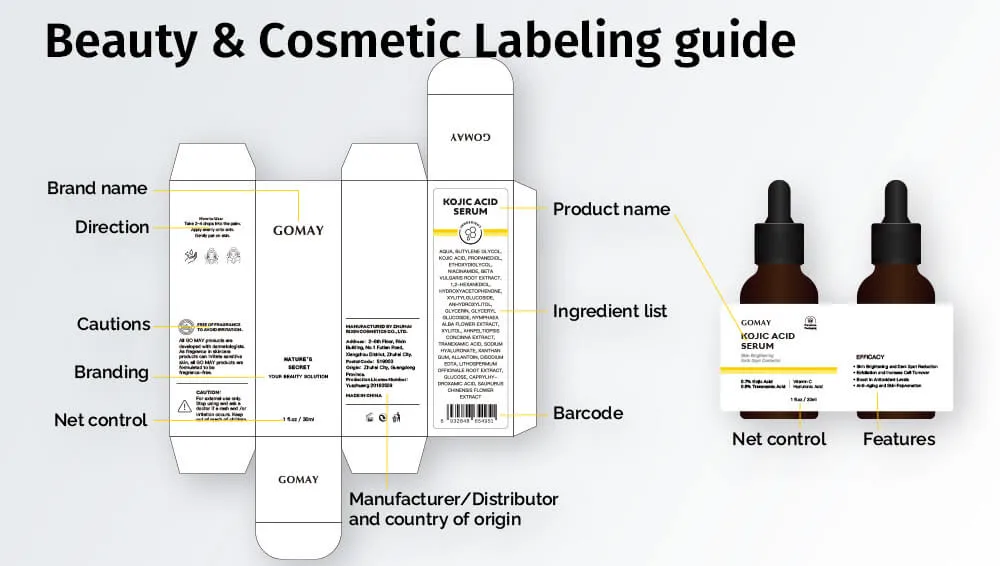
- Statement of Identity: The common name of the product (e.g., "Face Oil," "Lipstick").
- Net Quantity of Contents: The amount of product, placed in the bottom 30% of the panel (e.g., "Net Wt. 1 oz / 28 g").
On the Information Panel - The Back or Side
- Name and Place of Business: The name and address of the manufacturer, packer, or distributor. If it's a distributor, it must say "Distributed by..."
- Country of Origin: Required for imported products.
- Directions for Safe Use: Instructions on how to use the product correctly.
- Warnings or Cautions: Any necessary safety warnings (e.g., "For external use only," "May make tub slippery").
- Ingredient Declaration: This is one of the most critical parts. Ingredients must be:
- Listed in descending order of predominance (by weight).
- Ingredients under 1% concentration and color additives can be listed at the end in any order.
- Named using the standard INCI (International Nomenclature of Cosmetic Ingredients) names.
This image provides a fantastic visual summary, showing where these elements typically appear on the packaging.
3. The Question of Time: Expiration Dates and Shelf Life
A common question is whether cosmetics need an expiration date. The answer in the U.S. is generally no, but with important nuances.
Shelf Life and Expiration Dating of Cosmetics | FDA
Let's turn to the FDA's official page, 'Shelf Life and Expiration Dating of Cosmetics', to get a definitive answer.
Read the section 'Does FDA have rules for cosmetic shelf life and expiration dates on cosmetic labels?'. It's a direct and clear explanation of the U.S. regulations.
As you just read, there are no U.S. laws requiring expiration dates on cosmetics, unless the product is also classified as a drug (e.g., contains SPF).
However, the manufacturer is still responsible for ensuring the product is safe for its entire shelf life. In practice, you will often see one of two symbols on packaging, especially on products imported from Europe where these are mandatory.
As a retailer, understanding these symbols is key for inventory management. You'll need to implement a "First-In, First-Out" (FIFO) system to ensure you sell older stock first and rotate products to avoid keeping them past their recommended shelf life.
4. A Look Ahead: MoCRA and Supplier Vetting
The world of cosmetic regulation saw its biggest change in over 80 years with the passing of the Modernization of Cosmetics Regulation Act (MoCRA) in late 2022. While many of its provisions are aimed at manufacturers, they give you, the retailer, significant new leverage to ensure your suppliers are compliant.
This video provides an excellent overview of the key changes.
New FDA Cosmetic Regulations WILL Affect Small Businesses
In 'New FDA Cosmetic Regulations WILL Affect Small Businesses,' cosmetic formulator Kenna Whitnell breaks down the impact of MoCRA. We'll focus on the parts that empower you as a retailer.
Please watch the following segments: Facility Registration (04:26 - 05:20) Mandatory Product Listing (07:21 - 08:05) Substantiation of Safety (12:05 - 12:45) Focus on what these new requirements mean for the companies that will supply your products.
Here’s what MoCRA means for you when vetting suppliers:
- Mandatory Facility Registration: Your suppliers who manufacture products must now register their facilities with the FDA. Your Action: You can (and should) ask potential suppliers for proof of their FDA facility registration.
- Mandatory Product Listing: Every product must be listed with the FDA, including its ingredients. This creates a federal database of products on the market.
- Adequate Safety Substantiation: Manufacturers are now legally required to maintain records proving their products are safe. Your Action: You can ask your suppliers to confirm they have performed safety substantiation for their products.
Essentially, MoCRA professionalizes the industry and shifts the burden of proof for safety squarely onto manufacturers, making it easier for you to source products from responsible, compliant partners.
Conclusion
Navigating FDA regulations is a non-negotiable part of running a beauty retail business. By understanding these rules, you protect your customers, your reputation, and your company.
Key Takeaways:
- You are legally responsible for not selling adulterated (unsafe/contaminated) or misbranded (improperly labeled) cosmetics.
- A compliant label must include a Principal Display Panel (with product identity and net quantity) and an Information Panel (with manufacturer details, warnings, and an ordered ingredient list).
- In the U.S., expiration dates are only mandatory for cosmetic-drug products (like sunscreens). For other cosmetics, look for Period After Opening (PAO) symbols to guide customers and manage inventory.
- The Modernization of Cosmetics Regulation Act (MoCRA) has increased manufacturer accountability. Use this to your advantage by asking suppliers for proof of facility registration and safety substantiation.
Preview of the Next Lesson:
We've now covered the legal requirements for your business entity and the products you'll sell. But what about protecting your physical store and operations from unforeseen events like accidents or theft? In our next lesson, we will identify the insurance types needed for a physical retail store.