Introduction
Welcome back! In our previous lesson, you created a detailed training outline for product knowledge, focusing on what your team needs to know to be expert Beauty Advisors. This lesson builds directly on that foundation. Knowing the products is the 'what'; exceptional customer service is the 'how'.
This lesson addresses the learning outcome: Outline a training module on customer service based on the store's service protocol.
You've already designed your store's five-stage customer service protocol. Now, we will build the training program that teaches your future employees how to execute that protocol flawlessly. We'll focus on the essential skills, behaviors, and communication techniques that transform a simple transaction into a memorable customer experience, which is crucial for building loyalty in a physical retail setting.
By the end of this lesson, you will have a comprehensive outline for a customer service training module, ready to implement for your first hire.
1. The Foundations of Excellent Customer Service
In e-commerce, customer service often happens reactively through emails or chatbots. In your beauty mini-market, every in-person interaction is a live, real-time opportunity to build your brand. This training will ensure those moments are consistently positive.
First, let's establish a clear definition of what "great" service looks like and why it's so critical for a new retail business.
CUSTOMER SERVICE TRAINING COURSE! (Customer Service Skills) How to Be GREAT at CUSTOMER SERVICE!
The video 'CUSTOMER SERVICE TRAINING COURSE!' from CareerVidz provides a concise and clear introduction to the fundamentals of customer service. It defines what great service is and explains its importance for business success.
Watch the sections 'The Definition of Great Customer Service' (03:50 - 06:24) and 'The Importance of Excellent Customer Service' (06:24 - 09:03). Pay attention to the impact of both positive and negative experiences on a business.
The video highlights that excellent service encourages repeat business and word-of-mouth referrals—essentially free, highly effective marketing.
At its core, great service meets three fundamental psychological needs. Understanding these will help frame your entire training program.
What is customer service ? The 7 Essentials To Excellent Customer Service
In 'What is customer service ?', David Brownlee breaks down the core psychological needs of every customer. This provides the 'why' behind specific service techniques.
Watch the section covering the three things every customer wants (01:22 - 02:56). Note these three needs: to be heard, to be understood, and to be cared for. Your service protocol is designed to meet these needs at every stage.
Every part of your training should reinforce these three pillars: making the customer feel heard, understood, and cared for.
2. The Core Skills for a Beauty Advisor
Exceptional service isn't an abstract personality trait; it's a concrete set of trainable skills. For your beauty mini-market, these skills go beyond a simple friendly greeting. They empower your staff to act as trusted consultants.
The following article, written for beauty businesses, outlines these essential skills and provides actionable training ideas.
Customer Service Training for Staff That Actually Works
The article 'Customer Service Training for Staff That Actually Works' from GoHappyBeauty is tailored specifically to the beauty industry. It details the core skills needed and provides a very useful table with example training activities.
Read the section 'The Core Skills That Create Exceptional Experiences' and carefully study the table under 'Core Customer Service Skills and Training Activities'. This table provides a perfect blueprint for the 'what to teach' and 'how to teach it' sections of your module.
As the article shows, your training module must cover:
- Active Listening: To understand the customer's true needs, not just what they initially ask for.
- Clear Communication: To explain product benefits and routines without confusing jargon.
- Empathy: To connect with a customer's feelings, whether they are excited or frustrated.
- Conflict Resolution: To turn negative experiences into opportunities to build loyalty.
- Product Knowledge: (Which you've already planned for!) To provide credible, confident advice.

3. Structuring an Engaging and Practical Training Module
A successful training program is interactive and practical. Your digital marketing background has shown you that engagement is key to getting a message across, and the same applies here. We need to move beyond lectures and use methods that build muscle memory for customer interactions.
Role-playing is one of the most effective tools for this. Let's look at some creative and practical training ideas.
18 Customer Service Training Ideas and Examples (2025)
The Shopify article '18 Customer Service Training Ideas and Examples' offers a wealth of practical methods for making training engaging and effective. We won't use all 18, but we'll select the most relevant ones for a small, in-person retail environment.
Skim the section 'Best customer service training ideas for retailers'. Focus on these specific ideas: 'Use small-group role-playing' (Idea #5), 'Hold live demonstrations' (Idea #12), and 'Shadow senior team members' (Idea #11). Think about how you could apply these in your store.
A great training module for your store will blend:
- Instruction: Explaining the principles and techniques.
- Demonstration: Showing what great service looks like.
- Practice: Using role-play to try out the skills in a safe environment.
- Feedback: Providing constructive guidance to improve performance.
A key part of the training will be handling difficult situations. Let's watch a segment on a structured method for resolving customer complaints.
CUSTOMER SERVICE TRAINING COURSE! (Customer Service Skills) How to Be GREAT at CUSTOMER SERVICE!
Let's return to the 'CUSTOMER SERVICE TRAINING COURSE!' video. It offers two excellent, easy-to-remember frameworks for handling complaints, which will be a critical part of your training module.
Watch the sections on the 'seven-step process for handling customer complaints' (21:46 - 25:52) and the 'LAST method' (25:52 - 26:45). The LAST method (Listen, Apologize, Solve, Thank) is particularly useful as a simple, memorable tool for new employees.
4. Practical Application: Outline Your Customer Service Training Module
Now it's time to bring all these concepts together. Using the template below, create the outline for your customer service training module. This will be the guide for teaching every new Beauty Advisor how to deliver the exceptional experience defined in your service protocol.
Fill in the blanks and add details specific to your store's vision.
[DRAFT TEMPLATE] Customer Service Training Module Outline
Overall Training Objectives:
(Set 2-3 SMART goals. Example: "After training, the Beauty Advisor will be able to successfully handle a simulated customer complaint using the LAST method, resulting in a positive resolution.")
-
- ...
-
- ...
-
- ...
Part 1: Our Service Philosophy & The First Impression (~1.5 hours)
- Goal: To understand the brand's approach to customer service and master the initial customer greeting.
- Topics to Cover:
- Our Service Mission: How we make customers feel (Heard, Understood, Cared for).
- Review of the 5-Stage Customer Service Protocol.
- The Power of the First 10 Seconds: Body language, tone, and the initial greeting.
- The SEC Technique: Smile, Eye Contact, Comment (e.g., "Welcome in! Is this your first time visiting us?").
- Training Activities:
- Discussion of the "why" behind our service standards.
- Role-playing initial greetings and opening lines.
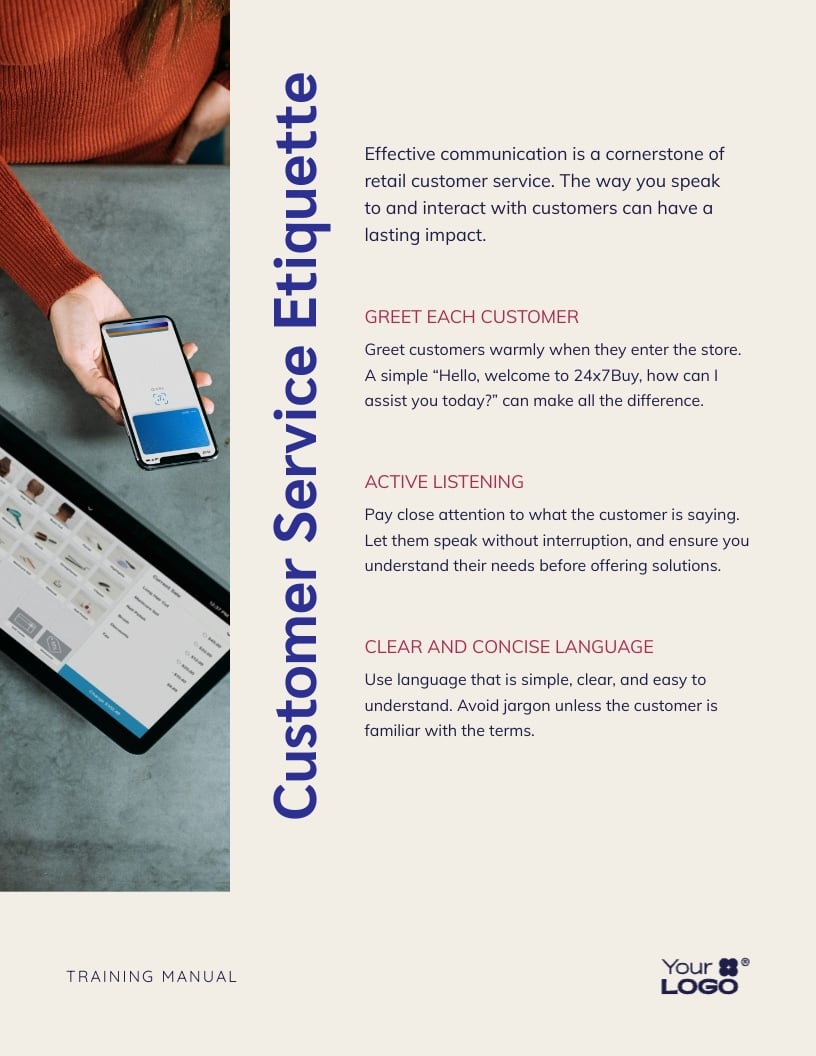
Part 2: The Art of Consultation & Communication (~2.5 hours)
- Goal: To develop the skills needed to be a trusted advisor, not just a salesperson.
- Topics to Cover:
- Active Listening: Asking open-ended questions ("What are your main concerns with your skin right now?") vs. closed questions ("Do you have dry skin?"). Summarizing needs to confirm understanding.
- Empathetic Communication: Using phrases like "I understand how frustrating that can be."
- Clear Explanations: Translating product features into customer benefits without jargon.
- Positive Phrasing: How to say "no" without saying "no" (e.g., Instead of "We don't have that," say "That product is out of stock, but I can show you a fantastic alternative with similar benefits.").
- Training Activities:
- Role-Play Scenario 1 (The Undecided Customer): Trainee practices active listening to help a customer who "doesn't know what they want" identify their needs and find a suitable product.
- Role-Play Scenario 2 (The Expert Customer): Trainee practices communicating with a knowledgeable customer, adding value without being condescending.
Part 3: Handling Difficult Situations & Complaints (~2 hours)
- Goal: To build confidence in turning negative situations into positive outcomes.
- Topics to Cover:
- De-escalation techniques: Staying calm, letting the customer vent.
- The LAST Method: Listen, Apologize, Solve, Thank.
- Store Policies Review: Returns, exchanges, and customer satisfaction guarantees.
- Training Activities:
- Discussion of "What Would You Do?" scenarios. (e.g., "A customer returns a product saying it caused a breakout," "A customer is upset that their favorite item is out of stock.")
- Role-Play Scenario 3 (The Unhappy Customer): Trainee uses the LAST method to handle a complaint about a product not meeting expectations. The manager provides feedback on their approach.
Part 4: On-the-Floor Practice & Assessment (~2 hours + ongoing)
- Goal: To apply learned skills in a real-world environment with support and feedback.
- Training Activities:
- Shadowing: Trainee observes the store owner/manager interacting with customers for 1-2 hours.
- Live Practice: Trainee begins interacting with customers, with the manager nearby to provide support if needed.
- Feedback Sessions: Short, 5-minute debriefs after a few customer interactions to discuss what went well and identify areas for improvement.
- Assessment:
- Manager's observation of the trainee's performance against the 5-Stage Customer Service Protocol during their first few shifts.
Conclusion
Excellent work. You have now outlined a comprehensive, skills-based training module that will empower your Beauty Advisors to bring your customer service vision to life. By focusing on practical skills, interactive role-playing, and structured methods like SEC and LAST, you are setting a clear standard for excellence from day one.
Key Takeaways:
- Great customer service is built on a foundation of making customers feel heard, understood, and cared for.
- Training must focus on concrete skills: active listening, empathy, clear communication, and conflict resolution.
- Role-playing is the most effective way to build confidence and "muscle memory" for handling real customer interactions.
- Simple, memorable frameworks like SEC (Smile, Eye Contact, Comment) and LAST (Listen, Apologize, Solve, Thank) give staff clear tools to use under pressure.
Preview of the Next Lesson:
With training plans for both product knowledge and customer service now outlined, we shift our focus to the physical and administrative backbone of the store. The next lesson is "Establish daily opening and closing procedures, including cash handling and sales reconciliation." This will involve creating the checklists and processes that ensure your store runs smoothly, securely, and efficiently every single day.