Hello! Welcome back to our study of leg anatomy.
In our last lesson, we focused on the hamstrings, the muscles on the back of the thigh. We ended with the powerful "Fangs and Egg" analogy, where the hamstring tendons were the "fangs" clamping down on the "egg" of the calf muscle. Today, we're going to examine that "egg" in detail.
This lesson fulfills the learning outcome: Identify and draw the calf muscles: gastrocnemius and soleus. These muscles give the lower leg its distinctive shape and are essential for conveying dynamism and stability in your figure drawings.
1. The Anatomy of the Calf
The bulk of the calf is formed by two primary muscles: the gastrocnemius and the soleus. They work together to point the foot downwards (plantar flexion) and are connected to the heel bone by the famous Achilles tendon.
Let's start with a video that breaks down these two muscles from an artist's perspective.
How to Draw Calf Muscles - Leg Anatomy for Artists
This excellent video from Proko will be our primary guide. It clearly explains the form, location, and artistic importance of the gastrocnemius and soleus.
Watch the video from the beginning to 04:54. Focus on the distinct characteristics of each muscle: Introduction (00:00 - 01:06): Get an overview of the two muscles and their connection to the Achilles tendon. Soleus (01:06 - 02:39): Note that this is the deeper, flatter 'mattress' muscle. Pay attention to its visibility on the sides of the leg, peeking out from under the gastrocnemius. Gastrocnemius (02:39 - 04:54): This is the more prominent, superficial muscle. Observe that it has two heads and originates above the knee. Notice the asymmetrical shape—the inner (medial) head is larger and lower, while the outer (lateral) head is smaller and higher.
To solidify your understanding of the placement, here is a clear anatomical diagram.

Let's review the key identification points:
-
Gastrocnemius:
- The most visible calf muscle, often called the "calf belly."
- Has two heads, creating an upside-down heart shape.
- Originates on the femur, above the knee.
- The medial (inner) head is larger and hangs lower.
- The lateral (outer) head is smaller and sits higher.
-
Soleus:
- Lies underneath the gastrocnemius.
- Is wider than the gastrocnemius, so its edges are visible on both sides of the lower leg.
- Originates on the tibia and fibula, below the knee.
- It's a flatter, "mattress" muscle that adds bulk to the sides and lower part of the calf.
2. Simplifying the Calf for Drawing
Now that you can identify the muscles, let's learn how to simplify them into drawable forms. The most important artistic concept for the calf is its overall shape and rhythm.
The Proko video and its companion webpage explain this beautifully.
How to Draw the Calf - Anatomy for Artists
The Proko article provides a great written summary of the drawing concepts. It's a useful reference to have alongside the video.
Read the section titled 'Now for the calf muscle’s final form … the Achilles tendon!' This section summarizes how the two muscles and the tendon combine to create the overall form.
The key takeaway is the asymmetrical slant. The entire calf mass is higher on the outside of the leg and lower on the inside. This rhythm opposes the slant of the ankles (which are higher on the inside and lower on the outside), creating a dynamic zig-zag pattern.
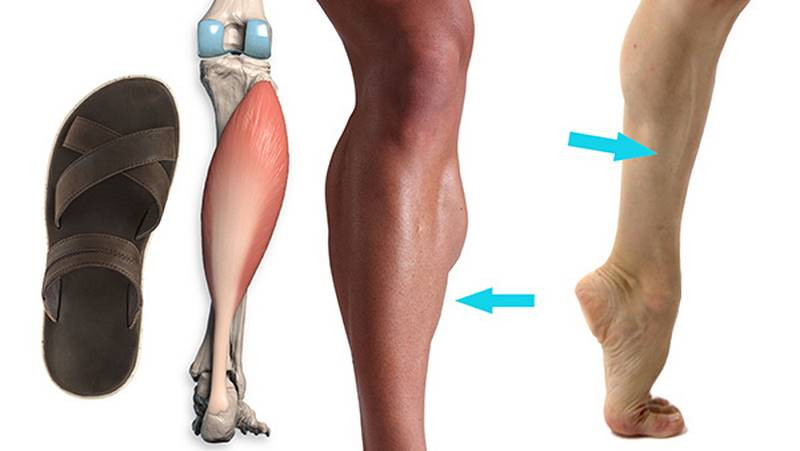
To see how these shapes are constructed from different angles, let's look at another artist's approach.
In this video, S. Michael Hampton demonstrates how to build the calf from simple shapes. This will give you another perspective on construction.
Watch the following segments to see the calf drawn from different views: Posterior View (11:30 - 12:45): Observe how he simplifies the gastrocnemius and Achilles tendon into an 'egg and sword' shape. This reinforces the main posterior form. Anterior View (19:25 - 20:30): See how the soleus and gastrocnemius define the outer contour of the leg from the front, wrapping around the tibia bone. Side View (27:00 - 28:05): Notice the layered 'sandwich' effect, with the gastrocnemius sitting on top of the soleus.
3. Practice: Anatomical Dissection of the Calf (25-30 minutes)
It's time to put this into practice in Procreate. Your task is to analyze a reference photo and map out the underlying anatomy of the calf.
What You'll Need:
- Procreate on your iPad.
- A reference photo of a leg with some calf definition. Poses on tiptoes are excellent for this. Search for "ballerina calf," "runner leg muscles," or "figure drawing calf reference."
Exercise Steps:
- Setup: Import your chosen reference photo into Procreate. On a layer above it, lower the photo's opacity to about 50%.
- Skeletal Landmarks (New Layer): Lightly sketch the underlying bones: the lower end of the femur, the tibia and fibula, and the blocky shape of the heel (calcaneus). This provides the anchor points.
- Anatomy Map (New Layer): Using distinct colors, draw the simplified muscle forms over the photo.
- Soleus (e.g., green): Draw the wide, flat shape first. Remember it starts below the knee and is wider than the gastrocnemius.
- Gastrocnemius (e.g., pink): Draw the two-headed, heart-like shape on top of the soleus. Make sure to capture the asymmetry: the inner head should be larger and lower than the outer head.
- Achilles Tendon (e.g., yellow): Draw the thick tendon connecting the muscles to the heel, noting its V-shaped convergence.
- Refined Contour (New Layer): Hide the anatomy map layer. On a new top layer, draw the final outline of the leg. Use your anatomical understanding to inform every curve. Your goal is not just to copy the outline, but to draw a contour that expresses the volumes of the muscles beneath.
Focus on capturing the overall slanted rhythm of the calf mass. This is the most crucial element for making your drawing look dynamic and accurate.
Conclusion
Excellent work! You have now dissected the final major muscle group of the leg. By understanding the interplay between the gastrocnemius, soleus, and Achilles tendon, you can now construct a convincing and dynamic lower leg.
Key Takeaways:
- The calf consists of the superficial gastrocnemius (two asymmetrical heads) and the deeper, wider soleus.
- Both muscles connect to the heel via the powerful Achilles tendon.
- The most important artistic principle is the asymmetrical slant of the calf: the muscle mass is higher on the outside and lower and heavier on the inside.
- When the calf is tensed (like standing on tiptoes), the individual muscle heads become much more prominent.
In our next lesson, we will put it all together. You will draw the entire leg from both frontal and posterior views in a standing pose, integrating your knowledge of the quadriceps, hamstrings, and calves to create a complete anatomical study.