Introduction
Welcome to our next lesson on cardiopulmonary physiotherapy. In our previous session, we focused on how to position patients for postural drainage and how patients can actively clear their airways using the Active Cycle of Breathing Technique (ACBT). These methods are foundational for mobilizing secretions. Today, we will build directly on that knowledge by exploring the manual techniques that are often performed in conjunction with postural drainage to enhance its effectiveness.
This lesson will address the learning outcome: Explain chest physiotherapy techniques: percussion, vibration, shaking, and indications for suctioning. We will delve into the "how" and "why" of these hands-on techniques, which physically dislodge stubborn mucus from the airway walls. We will also cover suctioning, an essential intervention for patients who are unable to clear secretions on their own. Mastering these skills is vital not only for clinical practice but also for answering the safety and procedure-based questions you'll encounter in your PGET.
Manual Techniques for Airway Clearance
Percussion, vibration, and shaking are all forms of Manual Chest Physiotherapy (MCP) or Chest Physical Therapy (CPT). They involve applying external force to the chest wall to transmit energy into the lungs, which helps to loosen and mobilize secretions. These techniques are typically performed while the patient is in a specific postural drainage position to combine the effects of gravity with mechanical force.
Postural Drainage and Vibration - StatPearls - NCBI Bookshelf - NIH
This article from StatPearls provides a concise medical overview of these techniques. It will help frame their role in managing respiratory conditions.
First, read the Introduction to understand the context of CPT. Then, jump to the "Technique or Treatment" section and read the paragraphs under Manual Chest Physiotherapy. This section explains the basic premise of combining rhythmic percussion with specific patient postures.
The image below illustrates the sequence: positioning the patient (A), followed by applying manual techniques like percussion (B) or shaking/vibrations (C).
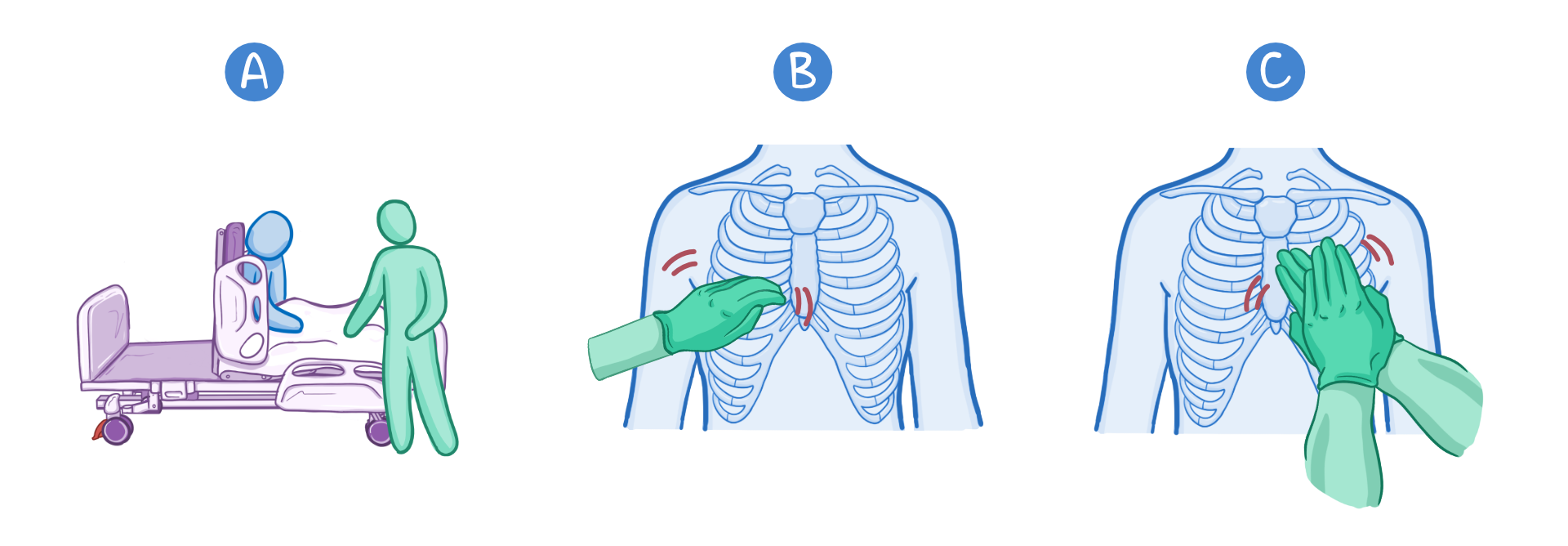
Now, let's examine each technique in detail. The "Manual Techniques" article from the Bronchiectasis Toolbox is an excellent, practical guide.
Manual Techniques - Bronchiectasis Toolbox
This resource offers clear, step-by-step descriptions of how to perform each technique, differentiating them effectively.
First, read the brief introduction. Next, focus on the section for Percussion. Read from the description of the technique down to the rationale. Note the importance of a cupped hand and avoiding bony prominences. Then, read the section on Vibrations. Pay close attention to how it's timed with expiration and the oscillatory nature of the movement. Finally, read the section on Shaking, which explains it as a coarser movement and lists the factors that guide the choice between the two.
To see percussion in action, this short video provides a clear demonstration.
This video from NHS University Hospitals Plymouth Physiotherapy shows the practical application of percussion.
Watch the entire video. Notice the cupped hand technique, the use of a towel for comfort, and how the therapist works systematically over different lung areas in both side-lying and sitting positions.
Key Considerations for Manual Techniques
For your exams, knowing the indications, advantages, and especially the contraindications is critical for questions related to patient safety.
Advantages:
- They are a passive option for patients who are too unwell, sedated, or cognitively unable to cooperate with active techniques like ACBT.
- They are suitable for infants and young children.
- They can be used in intensive care settings to assist with secretion clearance.
Disadvantages:
- They require a trained therapist or family member to administer.
- They can be uncomfortable for the patient.
- They may cause a temporary drop in oxygen saturation (hypoxaemia) or induce bronchospasm in patients with hyper-reactive airways.
Contraindications and Precautions:
It is absolutely essential to know when not to perform these techniques. Applying them in these situations can cause serious harm.
Manual Techniques - Bronchiectasis Toolbox
This section provides a crucial list of contraindications. Memorizing these is high-yield for exams.
Carefully review the list under the heading Contra-indications / precautions. Pay special attention to conditions like recent rib fractures, unstable cardiovascular status (often implied by thoracic/cardiac surgery), clotting disorders, and frank haemoptysis (active coughing up of blood).
Airway Suctioning
What happens when a patient is too weak to cough or huff effectively, even after manual techniques have loosened their secretions? In these cases, especially with an artificial airway (like an endotracheal or tracheostomy tube), we may need to use suctioning. This is an invasive procedure that mechanically removes secretions from the trachea and main bronchi.
Indications for Suctioning
You should only suction a patient when there is a clear clinical need. The following video provides an excellent, easy-to-remember framework for the indications.
Respiratory Therapy - Things to remember when SUCTIONING your patients!
This video by Respiratory Coach is geared towards board exams and breaks down complex information into memorable points.
Watch the first section on indications, from "why would you suction somebody?". The presenter outlines three key reasons: to maintain airway patency, to remove excessive secretions (evidenced by signs like coarse crackles), and to obtain a sputum sample for lab analysis.
Safe Suctioning Technique: The Four Keys
Because suctioning is invasive, it carries risks. Performing it safely requires adherence to strict parameters. The same video provides four critical rules for safe suctioning that are perfect for exam recall.
Respiratory Therapy - Things to remember when SUCTIONING your patients!
This part of the video is dense with exam-worthy numbers and procedures. Pay close attention to the details.
Watch the section covering the four key elements of safe suctioning, from the start of the list. Hyper-oxygenation: Note that this is done before and after the procedure. Suction Pressure: Memorize the pressure ranges provided for adults (-100 to -150 mmHg), pediatrics, and neonates. These are common exam question values. Catheter Size: Learn the formula for estimating catheter size: (Airway size in mm x 2), then go down to the next even French size. For example, for an 8.0 mm endotracheal tube, (8 x 2) = 16, so you would use a 14 French catheter. Suction Time: The total suction event should be less than 15 seconds. Finally, watch the section on hazards, particularly the discussion on cardiac dysrhythmias. Understand that bradycardia can result from a vagal response, and the immediate action is to stop suctioning and provide 100% oxygen.
Conclusion
In this lesson, we have added several crucial hands-on techniques to your airway clearance repertoire. We've moved from the gravity-assist of postural drainage to the active, mechanical loosening of secretions and the invasive removal when a patient cannot clear them independently.
Key Takeaways:
- Percussion, Vibration, and Shaking are manual techniques used to dislodge secretions from airway walls, often combined with postural drainage.
- Percussion uses rhythmic, cupped-hand clapping. Vibration uses fine oscillations during exhalation. Shaking is a more vigorous, lower-frequency version of vibration.
- Knowledge of contraindications for manual techniques (e.g., rib fractures, haemoptysis, unstable cardiac status) is essential for patient safety and exam success.
- Suctioning is an invasive procedure indicated when a patient cannot clear their own airway.
- Safe suctioning technique involves four key principles: hyper-oxygenation, correct pressure, appropriate catheter size, and a duration of less than 15 seconds.
In our next lesson, we will begin to apply this knowledge by discussing the physiotherapy management of specific obstructive and restrictive lung diseases, such as COPD, asthma, and bronchiectasis, where these techniques play a central role.