Introduction
In our last lesson, we charted the full course of cardiac rehabilitation, from Phase I in the hospital to Phase IV long-term maintenance. We established the framework for prescribing exercise using principles like FITT-VP and MET levels. Today, we will zoom in on the very beginning of this journey, focusing on the critical interventions performed in the Intensive Care Unit (ICU) and immediately following cardiothoracic surgery. This period demands a unique blend of vigilance, gentle progression, and specialized techniques.
This lesson is designed to help you master the learning outcome: Explain physiotherapy techniques for positioning and early mobilization in the ICU and post-cardiothoracic surgery. We will cover the rationale for getting patients moving, the crucial safety screenings you must perform, specific positioning and mobilization techniques, and the special precautions required after heart surgery. Mastering these concepts is vital for your PGET preparation, as questions on ICU management and post-surgical care frequently test your knowledge of safety, contraindications, and evidence-based protocols.
Why Early Mobilization? The Fight Against Immobility
A stay in the ICU, particularly after major surgery, often involves prolonged periods of bed rest. While necessary for initial stabilization, immobilization quickly leads to a cascade of negative effects that physiotherapy aims to prevent or reverse.
You are already familiar with the consequences of disuse from your physiotherapy background, but in the critically ill patient, these are amplified. The primary concerns include:
- Pulmonary Complications: Reduced lung volumes, atelectasis (alveolar collapse), and secretion retention, which can lead to pneumonia.
- Musculoskeletal Decline: Rapid loss of muscle mass and strength, known as ICU-acquired weakness (ICU-AW), leading to profound functional disability.
- Cardiovascular Deconditioning: A decrease in overall cardiovascular fitness and orthostatic intolerance (dizziness upon standing).
- Reduced Functional Capacity: Difficulty performing even basic activities of daily living (ADLs).
The following resource provides a strong evidence-based rationale for why early intervention is so critical.
Early Mobilization Prescription in Patients Undergoing Cardiac Surgery: Systematic Review - PMC
This systematic review summarizes the benefits of early mobilization in the ICU for cardiac surgery patients. It provides the "why" behind our interventions.
In the Introduction, please read the section beginning with "Conditions acquired...". Focus on how early mobilization directly counteracts the negative effects of bed rest, improving everything from lung function to muscle strength.
In essence, early mobilization is not just about exercise; it's a proactive strategy to maintain physiological function, reduce the length of hospital stay, and improve long-term outcomes.
Safety First: Screening for Mobilization
Before any mobilization attempt, the most important step is to ensure the patient is stable enough to participate. Mobilizing a critically ill patient without proper screening can be dangerous. ICU physiotherapy protocols are built on a foundation of daily safety checks.
This flowchart illustrates a typical daily protocol. The process begins with a screen to see if the patient is a candidate. If they pass, sedation is often paused (a "sedation vacation") to assess their level of consciousness and ability to follow commands.

The "Physio Classroom" video provides a fantastic, exam-oriented summary of the specific respiratory parameters to check. These are the kind of numerical cut-offs that frequently appear in MCQs.
RESPIRATORY CONSIDERATIONS FOR ICU MOBILIZATION ( PART -1/1 )
This video, "Respiratory Considerations for ICU Mobilization," clearly outlines the key safety thresholds for mobilizing a patient on ventilatory support.
Please watch the following segments: Intubation: Note that having an artificial airway is not a contraindication, but securing it is crucial. FiO2, SpO2, and RR: Pay close attention to the specific cut-off values provided for Fraction of Inspired Oxygen (FiO2 > 60%), Oxygen Saturation (SpO2 < 90%), and Respiratory Rate (RR > 30), and how they guide your decision to mobilize. Ventilation Modes: Understand why certain modes like High-Frequency Oscillatory Ventilation (HFOV) or high PEEP (>10 cmH2O) are contraindications or require extreme caution.
In addition to respiratory status, a broader assessment of clinical stability is required. The following resource lists absolute contraindications for mobilization.
This review provides a detailed list of safety guidelines, including specific vital sign thresholds that indicate instability. This is essential knowledge for safe practice.
Please navigate to the subsection "3) Early mobilization and ambulation". Read point #1 under "(1) Safety guidelines for early mobilization and/or ambulation". Focus on the specific cut-off values for heart rate, respiratory rate, blood pressure, and oxygen saturation. Also, read point #15, which lists conditions that preclude ambulation.
Key Safety Thresholds (Summary):
- Do not mobilize if:
- Heart Rate: < 40/min or > 140/min
- Systolic BP: < 80 mmHg or > 200 mmHg
- Mean Arterial Pressure (MAP): < 65 mmHg
- SpO2: < 85-90% (depending on protocol)
- Respiratory Rate: < 8/min or > 36/min
- High ventilator support (e.g., FiO2 > 0.6, PEEP > 10 cmH2O)
- Active signs of instability (e.g., uncontrolled arrhythmia, new myocardial infarction, untreated DVT/PE).
Physiotherapy Techniques: Positioning
Once a patient is deemed safe, intervention can begin. Positioning is one of the simplest yet most effective techniques in the ICU. The goals are to optimize ventilation-perfusion matching, increase lung volumes, and help drain secretions.
This section details the primary positioning strategies used after thoracic surgery.
Please read section "2) Positioning". Pay close attention to the rationale behind each position: Upright Sitting: Understand why this is the optimal position for improving lung volumes and diaphragmatic excursion. Side-lying: Note the general principle of placing the non-operated lung down (gravity directs more blood flow to the better-ventilated lung). Crucially, absorb the exception for pneumonectomy patients, who may be positioned on their operated side to protect the bronchial stump. This is a classic exam question.
Physiotherapy Techniques: A Progressive Mobilization Protocol
Early mobilization is a gradual process, not an all-or-nothing event. It follows a logical progression, starting with simple in-bed activities and advancing as the patient’s condition allows.
The table below outlines a typical progression. It's based on the protocols found in the systematic review you looked at earlier.
| Level | Mobilization Activity | Description |
|---|---|---|
| 1 | In-Bed Activities | Active and active-assisted ROM exercises for all limbs, bridging, turning. |
| 2 | Sitting on Edge of Bed | Patient is assisted to sit on the edge of the bed ("dangling"), often for the first time. |
| 3 | Chair Transfer / Standing | Transferring from the bed to a chair with assistance. Progressing to standing. |
| 4 | Marching on the Spot | Pre-ambulation exercise to assess tolerance to upright activity. |
| 5 | Ambulation | Walking short distances, initially around the bed, then in the ICU corridor. Distance is gradually increased. |
| 6 | Stair Climbing | Initiated once the patient can walk a significant distance on a flat surface, usually on the later postoperative days. |
This video from the NHS Golden Jubilee hospital provides a wonderful, real-world demonstration of a physiotherapist guiding a patient through some of these early steps after cardiac surgery.
What to expect from physiotherapy immediately after a cardiac operation
This short video, "What to expect from physiotherapy immediately after a cardiac operation," shows the key components of an early physiotherapy session.
Watch the following clips to see these techniques in action: Breathing Exercises: Notice the simple cueing for deep breaths to promote lung expansion. Huffing and Coughing: Observe how the patient uses a towel for wound support (a protected cough), a vital technique after a sternotomy. Mobilization: See the progression from sit-to-stand to marching on the spot, guided by the physiotherapist.
Special Consideration: Post-Cardiothoracic Surgery and Sternal Precautions
Patients who have undergone a median sternotomy (the standard incision for many cardiac surgeries) require specific precautions to protect the healing breastbone. Rushing this can lead to poor healing, instability (dehiscence), and chronic pain.
The guiding principle is often called "Keep Your Move in the Tube™". Imagine an invisible tube around the patient's torso, from shoulders to hips. All movements should be kept within this tube, avoiding asymmetrical, twisting, or forceful upper body actions.
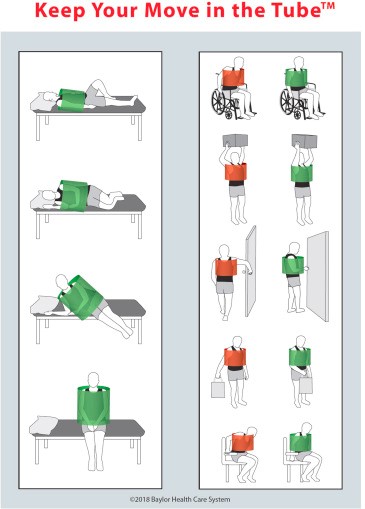
Typical Sternal Precautions (for 6-8 weeks):
- No lifting: Do not lift anything heavier than 5-10 lbs (approx. 2-4.5 kg).
- No pushing or pulling: Avoid pushing heavy doors, vacuuming, or pulling up in bed with your arms.
- No asymmetrical reaching: Avoid reaching overhead or out to the side with one arm. Keep movements symmetrical.
- Use your legs: When moving from sitting to standing, use leg strength instead of pushing up with the arms.
- Protected cough/sneeze: Hug a pillow or towel against the chest to splint the incision.
These precautions directly impact how you assist a patient with mobilization. For example, instead of having them pull on your arm to sit up, you would guide them through a "log roll" technique and use your assistance at their trunk to help them rise.
Conclusion
Today we explored the crucial role of physiotherapy in the ICU and post-cardiothoracic surgery setting. We moved beyond the general principles of rehabilitation to focus on the specific, hands-on techniques used to manage critically ill patients safely and effectively.
Key Takeaways:
- Rationale: Early mobilization in the ICU is an evidence-based strategy to combat the severe negative effects of bed rest, such as ICU-acquired weakness and pulmonary complications.
- Safety is Paramount: Mobilization must be preceded by a thorough safety screen, including checking vital signs, ventilatory support parameters (FiO2, PEEP), and the patient's level of consciousness.
- Positioning is a Treatment: Using upright and side-lying positions actively improves lung mechanics, but special rules apply (e.g., for pneumonectomy).
- Mobilization is Progressive: It follows a step-by-step sequence from simple in-bed exercises to sitting, standing, and finally walking, guided by the patient's tolerance.
- Sternal Precautions are Non-Negotiable: After cardiac surgery, protecting the healing sternum with the "Move in the Tube" principles is essential to prevent complications and ensure proper recovery.
This lesson concludes our module on Cardiopulmonary Physiotherapy. You have now covered the full spectrum, from basic physiology to managing complex conditions and critically ill patients. Our next lesson will mark a shift as we begin the final module, "Specialty Topics and Exam Strategy," starting with the fundamentals of pediatric physiotherapy: normal motor development milestones and the integration of primitive reflexes.