Introduction
In our previous lesson, we detailed the physiotherapy management for obstructive and restrictive lung diseases, focusing on how pathophysiology dictates our interventions. We will now move from the pulmonary system to the heart, exploring another cornerstone of cardiopulmonary physiotherapy: cardiac rehabilitation. This is a vital topic for your PGET preparation, as it integrates exercise physiology, patient education, and risk management into a structured, multiphase process.
This lesson directly addresses the learning outcome: Describe the phases of cardiac rehabilitation and principles of exercise prescription for cardiac patients. We will first outline the standard phases of recovery and rehabilitation following a cardiac event. Then, we will dive into the core principles of prescribing exercise safely and effectively for this population, focusing on parameters like intensity, duration, and progression.
The Four Phases of Cardiac Rehabilitation
Cardiac Rehabilitation (CR) is a comprehensive, multidisciplinary program designed to help patients recover from cardiac events like a myocardial infarction (MI), heart surgery, or angioplasty. It's a structured journey that guides the patient from the hospital bed back to an active and healthy life. This process is typically divided into four distinct phases.
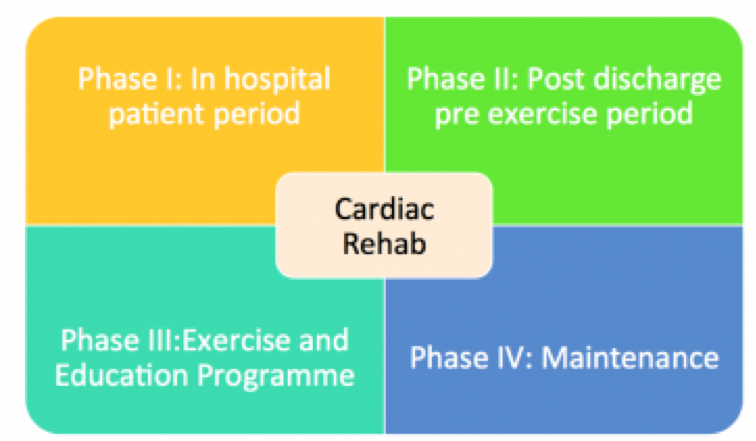
The World Health Organization (WHO) provides a detailed guideline that breaks down this structure. As you read, focus on the primary goal and setting of each phase.
[PDF] Rehabilitation Guideline after Myocardial Infarction - Extranet Systems
This WHO guideline offers an authoritative and detailed description of the four-phase model of cardiac rehabilitation. Understanding this structure is fundamental.
Read the following sections to understand the purpose and key activities of each phase: First, locate the heading "C.1. Organisation of Rehabilitation Services". Read the bulleted list under point 1, which outlines the four phases. Phase 1: Read the description under "C.2.1.Hospital Care Post Myocardial infarction – Phase 1". Focus on the key elements and the main purpose of exercise in this phase. Phase 2: Read the description under "C.2.2. Immediate Post Discharge – Phase 2". Note its role as a transitional period focusing on education and gradual activity resumption. (Note: The text refers to Phase 2 starting on page 12, but the excerpt is provided here). Phase 3: Read the first paragraph under "C.2.3. Intermediate Outpatients – Phase 3". This describes the structured, supervised exercise component. Phase 4: Read the description under "C.2.4. Long-term Maintenance – Phase 4". Understand its goal of sustaining long-term benefits.
To summarize the progression:
- Phase I (Inpatient): Begins in the hospital once the patient is medically stable. The focus is on early, low-level mobilization to counteract bed rest effects, patient education on their condition, and discharge planning. All activities are closely monitored.
- Phase II (Immediate Post-Discharge): A transitional phase at home, typically lasting 4-6 weeks. It bridges the gap between hospital discharge and formal outpatient rehab. Support is often provided via phone calls or home visits. Patients gradually increase their daily activities (e.g., walking).
- Phase III (Structured Outpatient Program): This is the core, supervised exercise and education program, usually run in a hospital or clinic setting. Patients attend sessions 2-3 times a week, where their exercise prescription is progressively advanced.
- Phase IV (Long-term Maintenance): The final phase, focused on independent, lifelong maintenance of exercise, diet, and other lifestyle changes. This often takes place in community settings like gyms or local support groups.
This short video provides a great visual summary of the phases and the role of therapy within each.
Cardiac Rehab: Phases and OT Interventions | NBCOT Exam Prep | OT Dude Academy
This video from OT Dude, while from an occupational therapy perspective, provides a clear and concise overview of the progression through the phases of cardiac rehab.
Watch from the beginning to the end. Pay attention to how the patient's location, the intensity of monitoring, and the MET levels of activity change as they progress from Phase 1 through Phase 3.
Principles of Exercise Prescription
Prescribing exercise for cardiac patients requires a systematic approach to ensure safety and efficacy. It's not just about choosing exercises, but about personalizing the intensity, duration, and progression based on a thorough assessment.

1. Assessment and Risk Stratification
Before any exercise program begins, every patient must be assessed to determine their risk of an adverse event during exercise. This is a critical safety step that will dictate the level of supervision and monitoring required.
The Physiopedia article on Cardiac Rehabilitation provides an excellent, concise summary of the key elements of assessment, including inclusion/exclusion criteria and the risk stratification process.
Cardiac Rehabilitation - Physiopedia
This resource clearly outlines the crucial first steps of exercise prescription: assessing the patient and stratifying their risk.
Please read the following sections: Under "Individual Risk Assessment", review the table of modifiable and non-modifiable risk factors. Scroll down to the table under "Cardiac Rehabilitation Participation". Review the Inclusion and Exclusion criteria for Phase III exercise. This is essential for understanding who is and is not a candidate for supervised exercise. Under "Health and Safety", read the list of conditions where a patient should not exercise. These are your absolute contraindications. Finally, under "Exercise Testing and Risk Stratification", review the table that defines Low, Moderate, and High Risk patients based on their clinical characteristics and exercise test results.
A key takeaway is that patients are stratified into low, moderate, or high-risk categories. A high-risk patient (e.g., one with complex arrhythmias or severely depressed left ventricular function) will require much more intensive monitoring and a slower progression than a low-risk patient.
2. The FITT-VP Principle
Once the patient is assessed and risk-stratified, their exercise program is designed using the FITT-VP principle:
- Frequency (how often)
- Intensity (how hard)
- Time (duration)
- Type (mode of exercise)
- Volume (total amount)
- Progression (how to advance)
Intensity is the most critical parameter to control. It is prescribed and monitored using:
- Heart Rate (HR): A target heart rate (THR) zone is calculated, often using the Karvonen formula (Heart Rate Reserve method) if a maximal exercise test was done. For Phase I, a simpler formula like
Resting HR + 20-30 bpmis used. - Rate of Perceived Exertion (RPE): The Borg Scale (6-20) is used to gauge the patient's subjective feeling of effort. This is vital because HR can be affected by medications like beta-blockers. The target is typically 11-14 ("fairly light" to "somewhat hard").
- Metabolic Equivalents (METs): METs quantify the energy cost of an activity. 1 MET is the energy used at rest. Exercise is prescribed by targeting activities within a specific MET range.
The following table, derived from the WHO guidelines, summarizes the FITT principle as applied to different phases.
| Phase | Frequency | Intensity (RPE 6-20) | Intensity (HR) | Time | Type |
|---|---|---|---|---|---|
| Phase I | 3-4 times/day (early) -> 2 times/day (later) | < 13 | Resting HR + 20 bpm (post-MI) | 3-5 min bouts, up to 20 min total | ROM, walking, ADLs |
| Phase III | 3-5 times/week | 11-14 | 60-85% of max HR | 20-60 minutes | Aerobic circuit, light resistance training |
| Phase IV | Lifelong, 5+ times/week | 11-14 | Self-monitored | 30+ minutes | Recreational activities, gym, walking |
3. Understanding MET Levels
Being able to connect specific activities to their MET level is a crucial skill for your exam. It allows you to judge whether an activity is appropriate for a patient at a certain stage of recovery.
This video from OT Miri provides an excellent and memorable guide to MET levels, grouping activities in a way that is easy to recall.
Cardiac Rehab & MET Levels | OT MIRI
This video offers a fantastic breakdown of activities by their MET levels, using helpful visuals and narratives to aid memorization. This is highly relevant for exam questions.
Watch the detailed breakdown from this section. Pay close attention to the examples given for each MET range: 1.5 - 2 METs: Seated activities, transfers. 2 - 3 METs: Seated warm shower, dressing, light instrument playing. 3 - 4 METs: Standing warm shower, making the bed, sweeping. 4 - 5 METs: Hot standing shower, golf, table tennis, dancing. 5 - 6 METs: Sexual activity, shoveling, digging. 6+ METs: Brisk walking, jogging, running, competitive sports.
Notice the logical progression: from seated, personal care activities at low MET levels, to household chores, then light recreation, and finally more vigorous exercise. Understanding these progressions is more effective than trying to memorize every single activity.
Conclusion
Today's lesson provided a structured overview of cardiac rehabilitation, a critical area of physiotherapy practice. We established the journey a patient takes through four distinct phases and then delved into the principles that guide the creation of a safe and effective exercise program.
Key Takeaways:
- Cardiac rehabilitation is a multiphase process: Phase I (inpatient), Phase II (post-discharge transition), Phase III (supervised outpatient exercise), and Phase IV (long-term maintenance).
- Exercise prescription must begin with a thorough assessment and risk stratification to ensure patient safety. Patients are categorized as low, moderate, or high risk.
- The FITT-VP principle (Frequency, Intensity, Time, Type, Volume, Progression) provides the framework for designing exercise programs.
- Intensity is the most critical variable, monitored using Target Heart Rate (THR), Rate of Perceived Exertion (RPE), and Metabolic Equivalents (METs).
- Activities are progressed logically, from low-MET tasks like self-care to higher-MET recreational and vocational activities, always guided by the patient's response.
In our next lesson, we will build upon the principles of Phase I rehabilitation by focusing specifically on physiotherapy techniques for positioning and early mobilization in the ICU and post-cardiothoracic surgery, looking at the unique challenges and strategies for managing the most critically ill patients.