Hello! Welcome to the next lesson in your journey to becoming a Sales Development Representative.
In our last few lessons, you've built a solid foundation for prospecting. You know how to research companies, use LinkedIn to identify the right people to contact (your prospects), and how to find their email addresses and phone numbers. You've covered the who and the how.
Today, we're tackling the final, crucial piece of the puzzle before you start reaching out: the why now? Your learning goal is to identify trigger events (e.g., new funding, key hires) that signal a buying opportunity.
Understanding trigger events is what separates generic, ineffective outreach from timely, relevant communication that gets a response. It’s the secret to warming up a cold lead. This skill will not only be critical on the job but will also be a powerful topic to discuss in your interviews, showing hiring managers that you understand modern sales strategy.
1. What is a Sales Trigger Event?
A sales trigger is an event that creates a window of opportunity, signaling that a prospect or their company might have a new need or be more receptive to your solution. It's your reason for reaching out at this specific moment. Acting on these triggers allows you to connect with prospects when they are most likely to be looking for solutions, rather than trying to create interest out of thin air.
Sales Triggers: A No-Nonsense Guide for Busy Sales Teams
To get a clear and concise definition, let's start with the article 'Sales Triggers: A No-Nonsense Guide for Busy Sales Teams' from Persana.ai. It gets straight to the point, which I know you'll appreciate.
Please read the first section, 'What is a sales trigger?'. Pay attention to how it emphasizes the importance of timing in B2B sales.
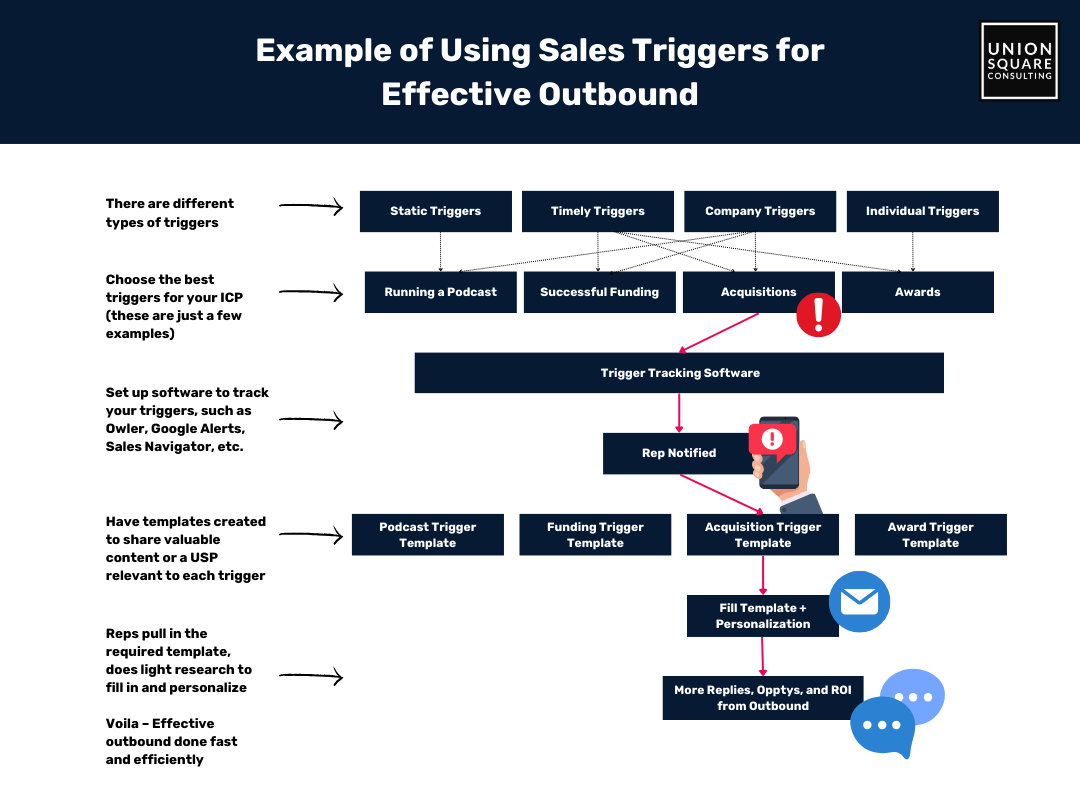
The key benefits of using trigger events, as outlined in the resource "The 23 Most Important Sales Trigger Events," are that they allow you to:
- Personalize your outreach: You can reference the specific event, showing you've done your research.
- Perfect your timing: You're reaching out when they are actively considering new solutions.
- Act faster than competitors: By monitoring these signals, you can be the first to offer help.
This entire process can be visualized as a clear workflow:
2. High-Impact Trigger Events to Monitor
While there are dozens of potential triggers, a handful are particularly powerful and common. As an SDR, focusing on these will give you the best return on your research time.
Sales Triggers: A No-Nonsense Guide for Busy Sales Teams
The 'No-Nonsense Guide' provides an excellent summary of the most common and effective triggers. Let's review them.
Read the section titled '6 proven sales trigger events to watch.' As you read, think about why each of these events might create a new need or budget for a company.
To summarize the key triggers from the article:
- New Executive Appointments: A new leader (like a VP or C-level exec) will often re-evaluate all existing tools and strategies within their first 90 days. They want to make their mark, which makes them open to new ideas.
- Company Funding Rounds: This is one of the strongest signals. A company that just raised money is planning to grow and has cash to spend on new tools, services, and staff.
- Mergers & Acquisitions (M&A): When two companies combine, they often need to consolidate systems, leading them to look for new, unified solutions.
- New Product or Service Launches: A new launch might require new supporting software or services to ensure its success (e.g., new marketing tools, customer support platforms).
- Major Industry Developments: A big technological shift or a change in the market can force companies to adapt, creating a need for new solutions to stay competitive.
- Legal or Regulatory Changes: New laws (like GDPR for data privacy) can create an urgent need for compliance tools and services.
This is a great starting list. For a more exhaustive look, the article "The 23 Most Important Sales Trigger Events" (Resource ID LINK) provides a much longer list, including events like new hires (not just execs), company expansion, and even layoff announcements, which might signal a need for efficiency and cost-saving tools.
3. How to Track Trigger Events
Knowing what to look for is the first step. The next is setting up a system to find these events. This is where your research skills come into play. You don't need expensive tools to get started; several free methods are highly effective.
Sales Triggers: A No-Nonsense Guide for Busy Sales Teams
Let's turn back to our primary guide to learn the practical methods for tracking these events. It covers both free tools you can use today and the professional platforms you'll encounter on the job.
Read the section 'How to track and detect sales triggers effectively.' Focus on the practical steps for using Google Alerts and LinkedIn, as these are tools you can start using immediately for your job search preparation.
Here is a summary of the most practical tracking methods for an aspiring SDR:
- Google Alerts: This is a simple but powerful tool. You can set up alerts for your target companies' names, so you get an email whenever they're mentioned in the news. You can also set alerts for keywords like "Series B funding," "acquisition," or "new VP of Sales."
- LinkedIn:
- Follow Companies: Follow your target accounts. Their major announcements (funding, new products, etc.) will often appear in your feed.
- Use 'Save as Lead' in Sales Navigator (if you have it): This notifies you of job changes and when your prospects share content or are mentioned in the news. Even on the free version of LinkedIn, you can see job changes by regularly checking your connections' profiles.
- Industry News & Press Releases: Keep an eye on industry-specific news sites. For funding announcements specifically, sites like Crunchbase are invaluable (they have a free search feature).
Test your understanding!
You are an SDR selling a project management software. Your ideal customer is a fast-growing tech company. You've set up a Google Alert for "Series A funding tech company."
You get an alert that a 50-person company on your target list, "InnovateSphere," just closed a $15 million Series A funding round. The press release mentions they plan to "double their engineering team and accelerate product development."
How does this trigger event give you a specific reason to reach out? What might you say in your opening line to make it relevant?
Show answer
The opportunity: The funding round signals rapid growth and a significant increase in headcount, especially in engineering. This will create complexity and challenges in managing projects, coordinating tasks, and onboarding new team members—problems your project management software can solve.
Potential opening line: "Hi [Prospect Name], saw the exciting news about InnovateSphere's $15M Series A funding - congratulations! As you prepare to double the engineering team, I imagine keeping new projects and new hires organized will be a top priority."
This opening is timely, personalized, and immediately connects their situation to the problem your product solves.
Conclusion
You now have the final piece of the prospecting puzzle. You've moved from finding a list of names to understanding the critical moments when those individuals are most likely to need help. By identifying and acting on trigger events, you transform your outreach from a simple interruption into a timely, valuable conversation.
Key Takeaways:
- Triggers answer "Why now?": They provide a compelling reason to initiate contact, making your outreach relevant and welcome.
- Focus on high-impact events: Pay close attention to new executives, funding rounds, M&A activity, and new product launches as they are strong indicators of need and budget.
- You can start tracking today: Use free tools like Google Alerts and LinkedIn to monitor your target companies and keywords.
- The goal is personalization: The information from a trigger event is the fuel for a personalized message that stands out from generic templates.
In our next lesson, we will finally put all these pieces together. You will learn how to write a concise, personalized cold email with a clear value proposition and call-to-action, using the triggers you've identified to make a powerful first impression.