Hello! Welcome to the next lesson in your SDR training.
In our last lesson, you learned how to identify trigger events—the crucial "why now?" that turns a cold outreach into a timely and relevant conversation. You now know how to spot the signals that a company might be ready to buy.
Today, we'll put that research into action. Your learning goal is to write a concise, personalized cold email with a clear value proposition and a compelling call-to-action. This is one of the most fundamental skills of an SDR. Mastering it will not only be essential for your future job but will also be something you'll likely be asked to demonstrate or discuss in your interviews. Given your preference for practical, no-fluff advice, we'll focus on simple, repeatable frameworks that get results.
1. Why Most Cold Emails Fail
Before we build a great email, let's look at what to avoid. Prospects' inboxes are flooded with terrible emails that are either long, generic essays or filled with fake, cringey personalization. Acknowledging these common failure modes is the first step toward standing out.
10 Years of Expert Cold Email Advice in 36 Minutes (B2B Sales)
To start, let's hear from an expert on the two common traps that SDRs fall into. This video from 'Tech Sales With Higher Levels' does an excellent job of breaking down why typical corporate training and the advice from 'LinkedIn gurus' often lead to emails that get deleted.
Watch the segment from 01:53 to 06:08. Pay attention to the distinction between the 'too long' sales enablement style and the 'fake personalized' guru style. This will help you understand the middle ground we're aiming for: professional, direct, and valuable.
The key takeaway is that you need an approach that is both scalable and effective. You can't spend an hour writing a single "perfect" email, nor can you blast out a generic template to hundreds of people and expect a reply. The sweet spot is a structured, repeatable framework that you can quickly personalize with your research.
2. The Anatomy of an Effective Cold Email
A high-converting cold email has a clear, logical structure. While there are several popular frameworks, they all share the same core DNA: they grab attention, provide value, and make the next step easy.
The best emails are typically very short. A great rule of thumb comes from the guide "How to Write Cold Email?", which suggests an optimal length of 50-125 words.
Let's break down the essential components.
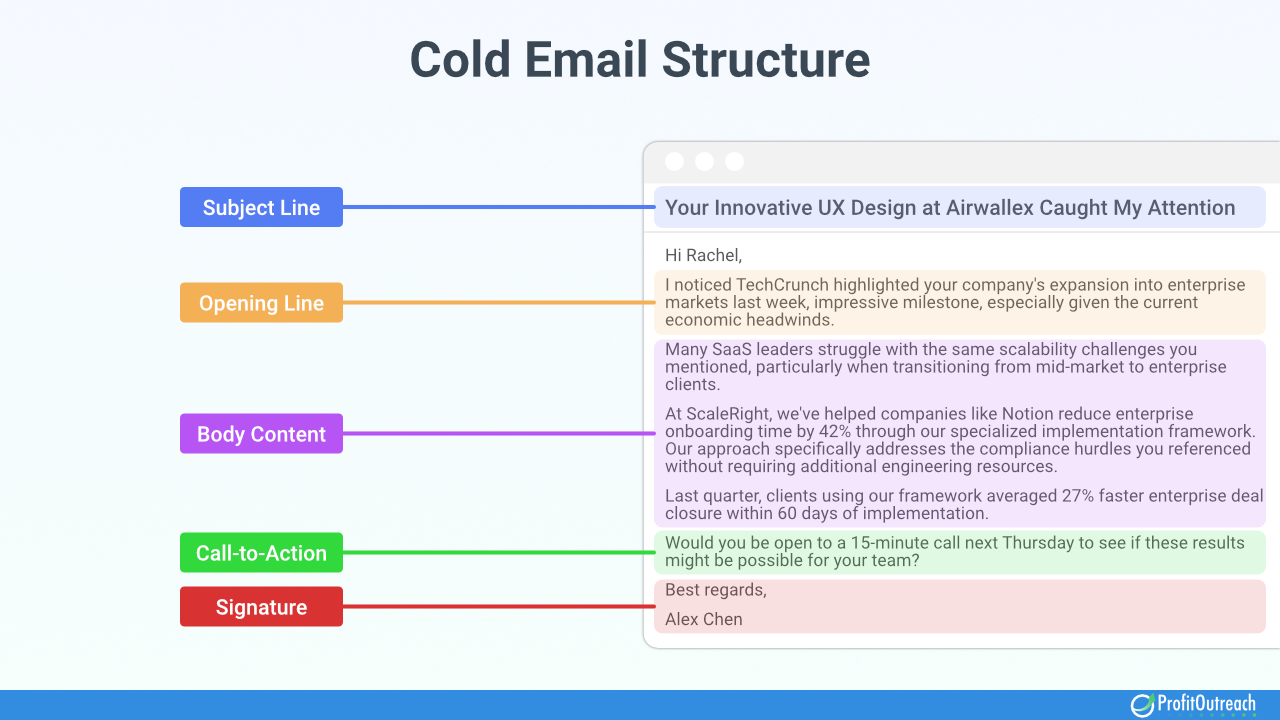
A. The Subject Line & Opening Line: Your First Impression
This is where you use the trigger events from our last lesson. The goal is to immediately signal that this is not a generic mass email.
Cold Email Best Practices for 2025
The article 'Cold Email Best Practices for 2025' from SalesUp.club provides excellent, straightforward advice on crafting these critical first two elements.
Please read the first two sections under 'The Anatomy of a High-Converting Cold Email': '1. The Subject Line' and '2. The Opening Line'. Note the 'Do's and 'Don'ts' and the examples provided.
Key Principles:
- Subject Line: Keep it short (under 50 characters), relevant, and curiosity-driven.
- Good:
Quick question re: [Company Name] - Good:
[Trigger Event] -> [Your Company](e.g.,Series B -> Your Company) - Bad:
Can I save you 25%???
- Good:
- Opening Line: This must be personalized. It’s your proof that you've done your homework.
- Example: "Saw the news about [Company Name]'s recent funding round—congrats on the momentum!"
- Example: "Noticed your team is hiring several new Account Executives for the quarter."
B. The Body: Your Value Proposition
This is the core of your email. In 1-3 sentences, you must answer the prospect's unspoken question: "What's in it for me?" Don't list features; focus on the outcome or problem you solve.
A great framework for this, mentioned in the "Cold Email Best Practices" article, is:
"We help [type of company] achieve [specific outcome] by [unique approach]."
- Example: "We help fast-growing SaaS companies like yours scale their sales teams by providing a pipeline of qualified candidates, saving your managers from spending hours on sourcing."
C. The Call-to-Action (CTA): The Next Step
Your CTA should be a low-friction, easy question to answer. The goal is to start a conversation, not to pressure them into a 60-minute demo.
- Good (Low-Friction): "Would you be open to a brief 15-minute call next week to explore this?"
- Bad (Vague): "Let me know your thoughts."
- Bad (Too Pushy): "Click here to book a demo on my calendar now."
3. Putting It All Together: Frameworks and Examples
Now let's see how these components come together into a finished product. We'll look at two highly effective, no-fluff templates.
First, let's watch the direct, three-paragraph framework that's all about being a clear, professional resource.
10 Years of Expert Cold Email Advice in 36 Minutes (B2B Sales)
Let's return to the 'Tech Sales With Higher Levels' video to see this direct structure in action. Connor Murray provides two fantastic examples that follow a simple 'Who I am, Why I'm relevant, What I want' model.
Watch from 21:50 to 26:19. Notice the assumptive, confident language. He's not asking for permission; he's positioning himself as part of their 'account team' and assuming a meeting is the logical next step.
Next, let's look at a written example that masterfully integrates a trigger event.
For a concise, written template, the guide from Reachoutly offers a perfect example. It's under 90 words and directly ties a trigger event to a clear value proposition.
Read the short section 'How to Write a Cold Email for Sales?' and analyze the example email. See if you can identify the personalization, value proposition, and CTA.
This example is a masterclass in efficiency:
- Subject: Poses a question tied to a goal (
Quick win for Q4 targets?). - Personalization: Immediately references a trigger (
Saw your LinkedIn post about scaling...). - Value Prop: States a problem (
struggle with keeping the pipeline full) and provides social proof with a quantifiable result (We helped [Similar Company] boost qualified leads by 40%...). - CTA: A clear, low-commitment ask (
Open to a quick 10-min call...).
Test your understanding!
Let's use the scenario from our last lesson. You are an SDR selling project management software. Your prospect is the VP of Engineering at "InnovateSphere," a tech company that just raised a $15 million Series A to "double their engineering team."
Using the components and frameworks we've discussed, draft a cold email to this VP of Engineering.
Show answer
Here is one possible example following the structure we've learned:
Subject: InnovateSphere's growth
Hi [VP's First Name],
Saw the exciting news about InnovateSphere's $15M Series A — congratulations on the momentum.
As you prepare to double the engineering team, leaders I speak with are often focused on keeping new projects and new hires organized without slowing down development. We help engineering teams at scaling companies like [Similar Company] streamline their project workflows, cutting down onboarding time for new developers by 30%.
Would you be open to a quick 15-minute call next week to see if this could support your expansion plans?
Best,
[Your Name]
4. A Quick Word on Follow-Ups
Writing a single great email is only the first step. In reality, 70-80% of meetings are booked on the follow-up emails. While building full multi-step sequences is a topic for another day, it's critical to know that your initial email is the start of a brief, focused campaign.
10 Years of Expert Cold Email Advice in 36 Minutes (B2B Sales)
A single email is rarely enough. Let's quickly watch one more segment from Connor Murray that explains a highly effective and efficient follow-up strategy.
Watch from 12:44 to 19:13. Focus on the core principles: most replies come from follow-ups, keep the follow-ups short, send them quickly (every 24-48 hours), and use them to direct the prospect back to your original email's value proposition.
The key is to send 3-4 short follow-ups over the course of a week. Each one simply "bumps" the original email back to the top of their inbox and asks for a response.
Conclusion
You now have the tools and frameworks to write a powerful cold email that respects the prospect's time and delivers value. This skill is your key to starting conversations and booking the meetings that will ultimately lead to sales.
Key Takeaways:
- Structure is your friend: A simple framework (like
Personalization -> Value Prop -> CTA) ensures your message is clear and effective. - Concise is respectful: Keep your emails under 125 words. Busy people don't read essays.
- Personalization is your hook: Use trigger events and research to prove you've done your homework.
- The Value Prop is the core: Always focus on the outcome you provide for them, not the features you sell.
- The CTA must be clear and low-friction: Make it easy for them to say "yes."
In our next lesson, we'll tackle the other primary channel for SDRs. You will learn how to structure an effective cold call opening to build rapport and capture attention in the first 30 seconds. Just like with email, the first few moments are critical, and having a solid framework is the key to success.