Hello! Welcome to the third lesson in our "Nailing the SDR Interview" module.
In our last session, we crafted a compelling answer to the crucial "Why do you want to work in sales?" question. We established that a strong answer connects your personal motivations—like a competitive drive or a passion for problem-solving—to the core demands of the SDR role.
Today, we'll put that work to use by tackling what is often the very first thing you'll hear in an interview: "So, tell me about yourself." This lesson is designed to help you structure a concise, confident, and memorable 60- to 90-second pitch. Mastering this response is critical because it sets the tone for the entire interview and gives you the first opportunity to control the narrative.
By the end of this lesson, you'll have a clear framework to build a personal pitch that highlights your transferable skills from customer service, showcases your motivation for sales, and makes a powerful first impression on any hiring manager.
The Real Question: "Show Me What You've Got"
First, it's essential to understand that "Tell me about yourself" is not an invitation to share your life story. It's a test. Hiring managers use this open-ended question to gauge your professionalism, preparedness, and communication skills right from the start.
This first video explains the interviewer's mindset and provides a high-level framework for your answer.
Top 15 SDR Interview Questions (Full Breakdown + Real Answers)
In this clip from 'Top 15 SDR Interview Questions,' Connor Murray breaks down the real intent behind 'Tell me about yourself.' He explains that interviewers are looking for a good first impression and to see if you came prepared.
Watch from 00:27 to 02:13. Focus on the 'hidden question' he describes and the three-part answer framework he proposes: background, why sales, and why this company.
As Connor points out, this is your chance to show you're ready to "play ball." A great way to frame this mentally comes from a sales leader on LinkedIn.
How to Ace an SDR Interview | Maddison Crooke posted ...
This post from Maddison Crooke offers a fantastic mental model for approaching this question.
Read tip #3 in Maddison Crooke's main post. The idea of treating 'Tell me about yourself' as your 'first cold call' is a powerful way to shift your perspective.
Thinking of it as your "first cold call" keeps you focused on the goal: be concise, be confident, and immediately establish your value for the role.
How to Structure Your Pitch: The Present-Past-Future Formula
The most effective and widely used framework for structuring your answer is the Present-Past-Future formula. It's simple, logical, and helps you tell a compelling story without rambling.
"Tell Me About Yourself" 20+ Sample Answers + How-to
The article '"Tell Me About Yourself" 20+ Sample Answers + How-to' from BigInterview provides a detailed breakdown of this formula.
Read the section 'How to Answer “Tell Me About Yourself”' and focus on the descriptions of the Present, Past, and Future components. This will be the backbone of your pitch.
Let's break down how this applies directly to you:
- Present: Start with where you are now. This is a concise, one-sentence summary.
- Example: "I'm currently leveraging my background in customer service to transition into a tech sales career, and I'm actively seeking an SDR position where I can apply my communication and problem-solving skills."
- Past: Connect your previous experience to the SDR role. This is where you make your customer service background a strength. Don't just state what you did; highlight the skills you built.
- Example: "In my recent role at a telecom retail store, I quickly learned a complex product line and became adept at explaining technical features in simple terms to customers. I discovered I was most energized when I could identify a customer's underlying need and guide them to a better solution, not just fix a surface-level problem."
- Future: Explain why you want this role at this company. This is where you'll integrate the answer you crafted in the last lesson ("Why Sales?") and combine it with company-specific research.
- Example: "That experience is what drove me towards a sales career, where I can be more proactive in creating those 'aha' moments. I'm especially drawn to the SDR role because I thrive in competitive, performance-driven environments. I'm particularly excited about [Company Name] because of your reputation for [mention something specific, e.g., 'thorough training for new SDRs' or 'your innovative approach to solving X problem for customers']."
This structure transforms your lack of direct sales experience from a weakness into a compelling origin story for your sales career.
Putting It All Together: A Model Answer
Let's watch a full example. The presenter in this video models a complete answer that seamlessly blends his background, motivations, and interest in the specific company.
Top 15 SDR Interview Questions (Full Breakdown + Real Answers)
Let's return to Connor Murray's video to see a complete example answer in action. Notice how he weaves together his personal background, his desire for a performance-based career, and his specific interest in the hypothetical company.
Watch the example answer from 02:13 to 04:37. Pay attention to how he naturally transitions from one part of his story to the next and keeps the entire pitch under 90 seconds.
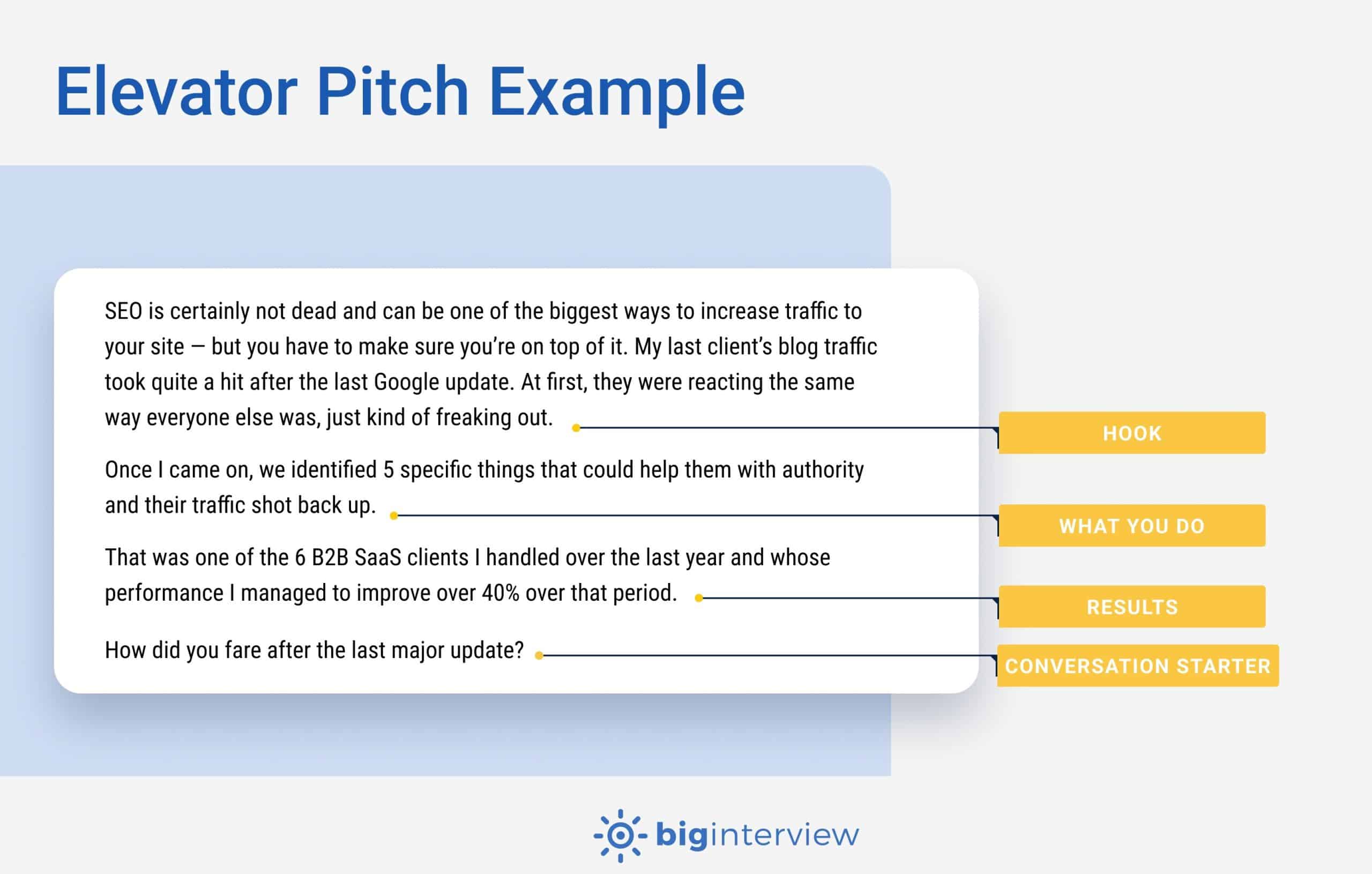
Notice the structure. It’s essentially a well-crafted elevator pitch.
Final Polish: Common Mistakes and Advanced Tips
Before you start drafting, it's crucial to know what to avoid. Many candidates weaken their strong start by making easily avoidable mistakes.
"Tell Me About Yourself" 20+ Sample Answers + How-to
The BigInterview article also contains an excellent section on what not to do. Reviewing these common pitfalls will help you refine your pitch.
Read the section 'How Not to Answer “Tell Me About Yourself”'. Pay close attention to the mistakes of 'repeating your resume,' 'getting too personal,' and 'underselling yourself.'
Finally, here's a short video with a key tip on making your pitch conversational and strategic.
Tech Sales Interview Questions and Answers [2025] | Part 1
This clip from 'Tech Sales Interview Questions and Answers' emphasizes the importance of keeping your answer concise and using it to guide the rest of the interview.
Watch from 01:36 to 04:59. The key takeaway is the idea of leaving 'hooks' in your story—points of interest that you want the interviewer to ask you about next. This is how you take control of the conversation.
By mentioning your customer service experience or your competitive drive, you are inviting the interviewer to ask follow-up questions like, "Tell me about a time you dealt with a difficult customer," or "What's the most competitive thing you've done?" This allows you to steer the conversation toward your strengths.
Test your understanding!
Now it's time to build your own pitch. Using the Present-Past-Future framework, draft a 60-90 second response to "Tell me about yourself."
- Present: Write one sentence about where you are right now in your career journey.
- Past: Write two sentences connecting your customer service role to the skills needed in sales (e.g., communication, problem-solving, resilience, product knowledge).
- Future: Write two sentences that combine your "Why Sales?" motivation with a specific reason you're interested in the company you're interviewing with. (For now, you can use a placeholder like "[Company Name]" and "[Specific Reason]").
Practice saying it out loud to ensure it flows naturally and fits within the time limit.
Show a sample draft
Here is a full sample pitch you can use as a model.
(Present)
"I'm currently making a focused transition from a customer-facing role into a career in tech sales, and I’m looking for an SDR position where I can have a direct impact on business growth."
(Past)
"In my previous role in telecom customer service, I was responsible for handling a high volume of client interactions and solving complex issues. I found that I excelled at quickly learning the product details and translating them into clear solutions for customers, which naturally led to my interest in a more proactive role."
(Future)
"That experience is why I’m pursuing sales. I'm driven by competition and the idea of a performance-based career where hard work directly translates to results. I'm especially excited about the SDR opportunity at [Company Name] because of your reputation for developing talent from the ground up and the impressive growth you've shown in the [Company's Industry] space."
Conclusion
You now have a powerful, repeatable structure for answering the most common interview opening. By framing your pitch with the Present-Past-Future model, you can tell a compelling story that turns your background into an asset and demonstrates your motivation and preparedness.
Key Takeaways:
- Understand the Goal: "Tell me about yourself" is a test of your communication and preparation. Treat it like your first cold call.
- Use the Framework: Structure your pitch using the Present-Past-Future model to create a concise and logical narrative.
- Bridge Your Experience: Explicitly connect the skills from your customer service role (problem-solving, communication) to the needs of an SDR.
- Be Strategic: Keep your pitch under 90 seconds and include "hooks" that invite the interviewer to ask about your strengths.
- Practice, Don't Memorize: Rehearse your pitch so it sounds natural and confident, not robotic.
In our next lesson, we will prepare for the next layer of questions. Once you've made your introduction, hiring managers will want to dig into specific examples from your past. We will cover the STAR method, a crucial technique for structuring clear and impactful answers to behavioral questions like, "Tell me about a time you faced a challenge."