Hello! Welcome to your next lesson in the "Nailing the SDR Interview" module.
In the last lesson, we established a solid foundation by breaking down the SDR role: its core purpose, daily responsibilities, and the key metrics used to measure success. You now understand what an SDR does. Today, we're tackling the crucial follow-up question: Why do you want to do it?
This lesson is designed to help you articulate a persuasive answer to 'Why do you want to work in sales?'. This isn't just a hypothetical exercise; it's one of the most common and critical questions you'll face in every SDR interview. A weak answer can end your chances, while a strong one can set you apart from a crowd of applicants.
By the end of this lesson, you'll have a clear framework for crafting a personal, authentic, and compelling story that shows hiring managers you have the right motivations to succeed in this challenging and rewarding role.
Why This Question Matters So Much
Before crafting your answer, it's essential to understand why hiring managers ask this question. The SDR role is known for its high-pressure environment and the constant rejection you face. Turnover can be high, and hiring managers want to ensure they're bringing on someone who is genuinely motivated and understands the realities of the job.
26 Sales Interview Questions (Beginner & Experienced)
The article '26 Sales Interview Questions' from Sales Talent Inc. explains the interviewer's perspective when asking 'Why sales?'. It highlights their need to gauge your motivations and commitment.
Read the section titled '2. Why are you interested in a sales position, or why did you get into sales?'. Focus on the 'Interviewer Perspective' and 'Candidate Perspective' paragraphs. Notice the examples of strong motivators they like to hear.
As the article points out, the interviewer is looking to understand your personality, your commitment to a sales career, and whether your motivations align with the job's demands. They are trying to de-risk their hiring decision by weeding out candidates who might quit after a few tough weeks. Your goal is to give them an answer that builds confidence in your long-term potential.
Answers to Avoid: The Common Red Flags
Many candidates fall into the trap of giving generic, weak answers. Hiring managers have heard them all before, and they are instant red flags. Let's start by looking at what not to say.
This video from Connor Murray does an excellent job of highlighting two of the most common—and problematic—answers.
The ULTIMATE Guide to Dominate EVERY Sales Job Interview | SDR/BDR Interview Tips
Let's watch a clip from 'The ULTIMATE Guide to Dominate EVERY Sales Job Interview'. Connor Murray breaks down why answering with 'I'm a people person' or solely focusing on 'money' are significant mistakes.
Watch from 05:40 to 07:06. Pay close attention to his reasoning for why these answers signal a misunderstanding of the sales role.
Let's break down these red flags:
1. "I'm a people person" / "I like helping people."
This is the most common cliché. While it sounds positive, it shows a fundamental misunderstanding of an SDR's job.
- The Reality: The best salespeople are not necessarily extroverts. Success comes from preparation, discipline, and the ability to challenge a prospect's thinking, which can sometimes be uncomfortable.
- The Signal It Sends: It suggests you think the job is about making friends, not about driving results and handling rejection.
This LinkedIn post from sales leader Collin Cadmus puts it bluntly.
THE CLASSIC INTERVIEW QUESTION: | Collin Cadmus
This post from Collin Cadmus on LinkedIn provides a sharp, no-fluff contrast between weak and strong reasons for getting into sales. It's a great gut check for your own motivations.
Read the main post and Collin's first comment. Note the contrast between 'people pleaser' traits and the more challenging, persuasive traits required for sales.
2. "I want to make a lot of money."
As Connor Murray explained, this isn't necessarily a bad motivator—it's an expected one. The problem is when it's your only answer.
- The Reality: Everyone in a sales role is motivated by money to some degree. It's the primary incentive structure.
- The Signal It Sends: Answering with just "money" is a low-effort response. It doesn't differentiate you or show any deeper connection to the role's challenges and rewards. It's better to frame this as being driven by a performance-based career, where your income is a direct result of your hard work and success.
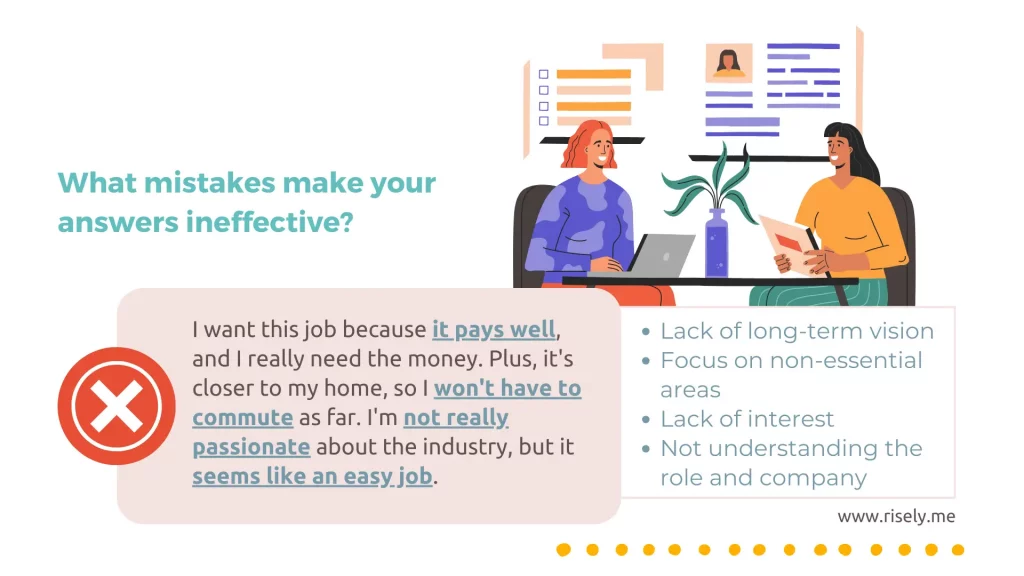
3. Other Low-Effort Answers
Avoid any answer that focuses on what the job can do for you in terms of convenience, rather than how you can contribute to the company.
Building a Persuasive Answer: The Key Ingredients
A strong answer is authentic, personal, and aligned with the traits of a successful SDR. It should have three core components:
- A Personal Connection: A brief story or experience that sparked your interest in sales.
- Strong Motivators: Connecting your personality to traits valued in sales (e.g., competition, problem-solving).
- An Understanding of the Role: Acknowledging the challenges and showing you're ready for them.
Let's look at some examples of strong motivators and how they can be woven into a compelling narrative.
Strong Motivator 1: Competition & Performance
This is one of the most powerful themes. Sales is a competitive field, both internally (with other reps) and externally (against competitors).
- How to frame it: Talk about your desire to win, to be measured by your performance, and to be in a role where your hard work directly translates into tangible results. You can draw on experiences from sports, academic competitions, or even personal goals.
Strong Motivator 2: Problem-Solving & Challenge
As Collin Cadmus's post mentioned, great salespeople are "problem solvers, challengers, and strategic thinkers."
- How to frame it: Express your enjoyment of a good challenge, of persuading people, or of dissecting a problem and finding a solution. This shows you have the intellectual curiosity and resilience for the role.
Strong Motivator 3: Direct Impact on the Business
SDRs are the engine of the sales team. Your work directly fuels the company's growth.
- How to frame it: Show that you understand this and are excited by the prospect of being a "direct impact player."
This video from Tech Bag Trey gives a great personal example that combines the themes of competition and impact.
Tech Sales Interview Prep 2024 • Best Interview Tips for SDR BDR Entry Level Roles • Tech Bag Trey
In this clip from 'Tech Sales Interview Prep 2024,' the host shares his personal answer to 'Why sales?'. Notice how he effectively combines his background in sports with the desire to make a direct impact.
Watch from 17:12 to 18:44. Listen for the key themes he hits: sales as the 'lifeblood' of the company, being a competitor, and being a team player.
Crafting Your Personal Answer: A Workshop
Now it's your turn. Let's combine these elements into a structure you can use to build your own answer. Your story will be unique to you, but it should follow this general framework.
Framework:
- The Hook (Your Origin Story): "My interest in sales started when..."
- Example based on your background: "In my customer service role at the telecom store, I found I was most energized when I could help a customer not just fix a problem, but understand how a different product or plan could genuinely improve their situation..."
- The Core Motivators (Why Sales?): "...and that led me to explore a career where I could do that proactively. I'm drawn to sales for two main reasons. First, I'm highly competitive and I thrive in a performance-based environment where my results are a direct reflection of my effort. Second, I enjoy the challenge of..."
- The Connection to the SDR Role (Why Here?): "...I understand that the SDR role is about discipline and resilience, and that it involves a high volume of outreach and rejection. But the opportunity to be on the front lines, creating new business for the company and directly contributing to its growth, is a challenge that really excites me."
Test your understanding!
Take 10 minutes to draft your own answer using the framework above. Don't aim for perfection, just a solid first draft.
- The Hook: Think about your customer service role. Was there a time you went beyond just answering a question and actually helped a customer see a better solution? Or maybe an experience outside of work (a hobby, a project) that sparked your competitive drive?
- The Core Motivators: Choose two motivators that feel most authentic to you from our list: Competition, Performance-Based Results, Problem-Solving, Challenge, Impact.
- The Connection: Combine these pieces into a concise story (aim for 60-90 seconds when spoken).
Show a sample answer
Here is a strong sample answer you could adapt:
"In my previous role in customer service, I really enjoyed solving complex customer issues. But I often found myself thinking I could have prevented the issue in the first place if I had been able to speak with them earlier. That's what led me to sales.
I'm drawn to it because I'm competitive by nature and I love the idea of a career where my success is directly tied to my performance and hard work. I also enjoy the strategic challenge of understanding a person's problem and persuading them that there's a better way to solve it.
I know the SDR role is demanding and requires a lot of persistence to break through the noise. But the challenge of being that first point of contact, creating opportunities, and having a direct impact on the company's bottom line is exactly what I'm looking for."
Conclusion
You now have the tools to move beyond generic clichés and articulate a powerful, personal reason for wanting a career in sales. Hiring managers aren't looking for one "correct" answer; they're looking for an authentic one that proves you have the right mindset for the job.
Key Takeaways:
- Avoid Red Flags: Steer clear of "I'm a people person" and making money your sole motivation.
- Embrace Strong Motivators: Anchor your answer in themes like competition, performance, challenge, and impact.
- Tell Your Story: Connect your motivations to a personal experience to make your answer memorable and authentic.
- Show You Understand the Role: Acknowledge the challenges (rejection, persistence) to show you've done your homework.
In our next lesson, we'll zoom out and tackle the most common interview opener: "Tell me about yourself." You'll find that the "Why sales?" answer you just crafted will become a powerful component of this broader personal pitch.