Hello! Welcome to your next lesson in the "Practical Application and System Design" module.
In our previous lessons, you calculated your personalized macronutrient targets and developed a strategy for managing the initial adaptation phase. You now have the quantitative "what" (grams of protein, fat, carbs) and the procedural "how" for getting started.
Today, we move from initiation to optimization. The goal of this lesson is to formulate principles for food selection based on macronutrient content and nutrient density. Simply hitting your macros isn't enough to achieve your goals of enhanced mental sharpness and long-term health. The quality of the foods you choose is paramount. We will build a logical framework to help you select foods that not only maintain ketosis but also maximize nutritional value, creating a truly health-promoting lifestyle.
1. Beyond the Macros: The "Clean" vs. "Dirty" Keto Framework
Ketosis is a metabolic state, not a specific diet plan. You could technically achieve ketosis by eating highly processed, low-carb foods. However, this approach, often called "dirty" or "lazy" keto, would not align with your goals for healthspan and cognitive performance. It prioritizes macronutrient ratios above all else, often at the expense of food quality and micronutrient content.
For your objectives, a "clean" keto approach is the logical choice. This framework emphasizes whole, unprocessed, nutrient-dense foods that naturally fit the ketogenic macro structure. The primary benefit is not just a change in fuel source, but a reduction in systemic inflammation and an improvement in overall cellular health—key factors for longevity.
CLEAN KETO vs DIRTY KETO: THE REAL TRUTH ABOUT KETOSIS!
To understand the fundamental distinction between these two approaches, let's watch a segment from Dr. Nick's 'CLEAN KETO vs DIRTY KETO' video. He articulates why food quality is the decisive factor for long-term health outcomes.
Please watch these two clips: 01:18 - 03:11: Focus on the reasons why a 'clean' keto approach is superior for health, particularly its effects on inflammation, metabolic diseases, and brain function. 06:06 - 09:10: This section explains the disadvantages of 'dirty' keto, highlighting the pro-inflammatory nature of poor-quality fats and the lack of nutrient density and gut-supporting prebiotics.
The core takeaway is this: you are building a system for optimal health, not just a system to produce ketones. Therefore, our first principle of food selection is to prioritize foods that are both low-carb and high-quality. This involves actively choosing anti-inflammatory foods and, just as importantly, eliminating pro-inflammatory ones.
2. The First Filter: Foods to Eliminate
Before we build up our list of ideal foods, we must first define what to exclude. This is a critical step that simplifies all future food choices. The primary categories to eliminate are those that are inflammatory, disrupt insulin signaling, and are devoid of meaningful nutrition.
Nutritional Strategies for Mental Performance and Long- ...
The article 'Nutritional Strategies for Mental Performance and Long-Term Brain Health' provides an excellent, detailed list of foods to limit or avoid. This serves as a strong foundation for our elimination filter.
Please read the section 'Foods to Limit or Avoid', which starts after the section on Turmeric. Pay close attention to the sub-sections on: 'Free Sugars' 'Processed and Refined Carbs' (especially the detailed lists under 'So what carbs should your patients focus on then?') 'Trans Fat' These sections provide a clear rationale for why these foods are detrimental to brain health and metabolic function.
Based on this, our foundational principles for elimination are:
- Avoid Sugars and Simple Carbohydrates: This is the obvious cornerstone of a ketogenic diet. This includes not just table sugar and candy but also high-glycemic foods like bread, pasta, rice, and potatoes, as well as hidden sugars in sauces and dressings.
- Avoid Industrial Seed Oils and Trans Fats: Eliminate oils like soybean, corn, canola, and sunflower oil, which are high in omega-6 fatty acids and promote inflammation. This also means avoiding most processed foods, fast food, and margarine, which are common sources of these fats.
- Limit High-Sugar Fruits and Grains: While some low-glycemic fruits (like berries) are acceptable in moderation, most fruits and all grains (including "healthy" whole grains) are too high in carbohydrates to sustain ketosis.
Applying this filter drastically narrows your food choices to whole, unprocessed options, making the next step—selecting for nutrient density—much simpler.
3. The Second Filter: Maximizing Nutrient Density
With the inflammatory and high-carb foods removed, we can now focus on selecting the most nutrient-dense foods. Nutrient density refers to the concentration of micronutrients (vitamins, minerals, antioxidants) per calorie. For your goals of cognitive performance and longevity, a diet rich in these compounds is essential.
Visualizing Nutrient Density
The concept of nutrient density can be abstract. Visual aids can provide a more intuitive understanding.
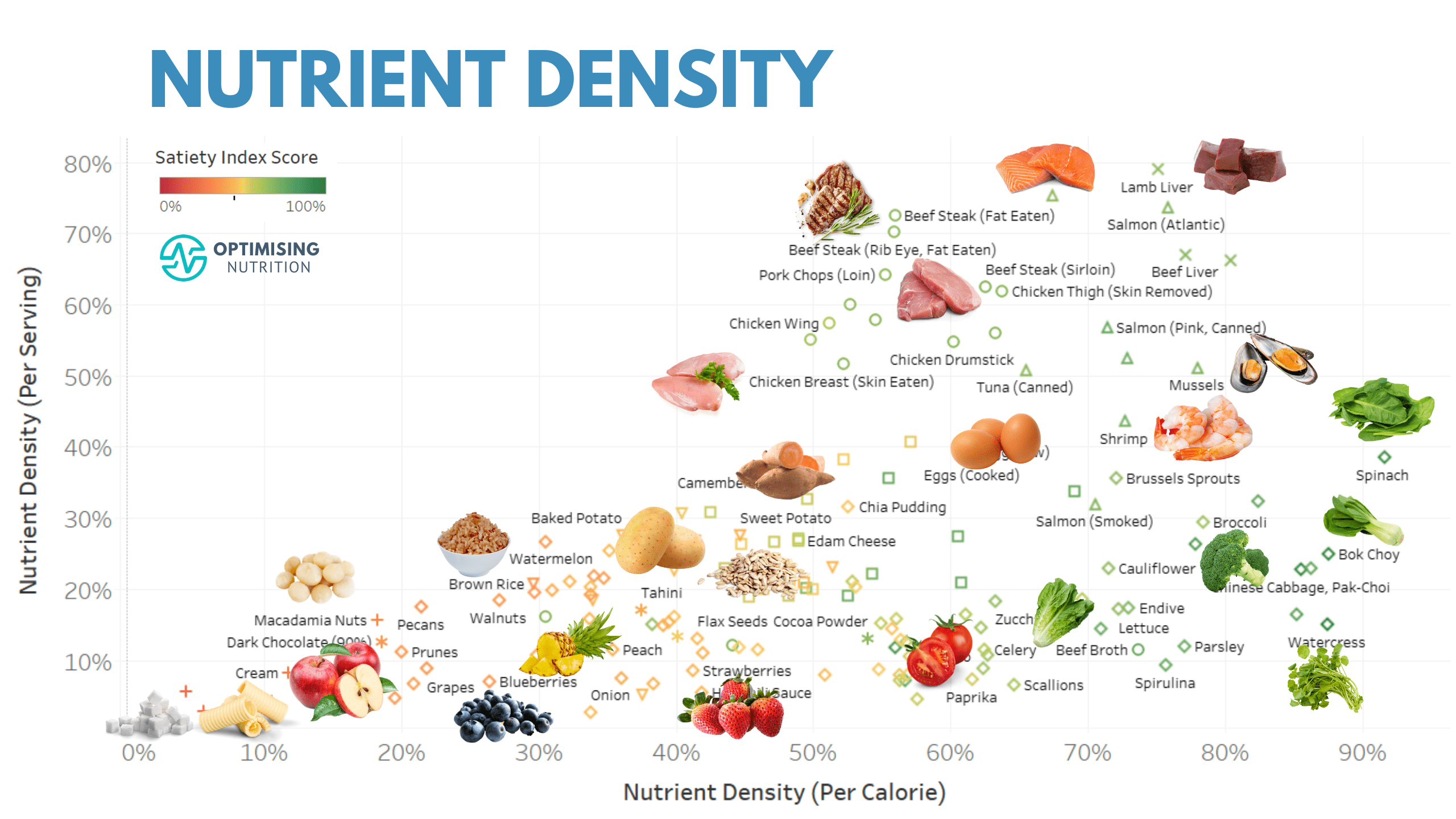
Another practical tool is a curated list of high-performers within a ketogenic context.

Building Your "Clean Keto" Pantry
Using this nutrient-density framework, we can identify specific foods that are ideal for a high-performance ketogenic diet. A "Mediterranean Keto" style is an excellent practical model, as it prioritizes anti-inflammatory fats and whole foods.
When Diets Collide: Mediterranean Keto - A Practical Guide
In his video 'When Diets Collide: Mediterranean Keto', Dr. Nick Norwitz outlines his top food choices. This list is a superb, practical guide to selecting foods that are both ketogenic and highly nutritious.
Watch the segment from 06:42 to 14:14. Dr. Norwitz details nine food categories. For each one, note not just what it is, but why it's a good choice (e.g., the specific type of fat, a key mineral, or other beneficial compound).
Synthesizing these resources, we can establish our principles for positive food selection:
- Non-Starchy Vegetables: These should form the base of your diet. They are low in calories and carbs but high in fiber, vitamins, and minerals.
- Examples: Spinach, kale, arugula, broccoli, cauliflower, bell peppers, asparagus.
- High-Quality Protein: Protein is crucial for maintaining muscle mass. Focus on sources that also provide beneficial fats and micronutrients.
- Examples: Wild-caught fatty fish (salmon, sardines, mackerel), grass-fed beef and lamb, pasture-raised eggs, shellfish.
- Healthy Fats: Fats are your primary energy source. Choose unprocessed, anti-inflammatory options.
- Examples: Extra virgin olive oil, avocado oil, avocados, macadamia nuts, grass-fed butter or ghee.
- Gut-Supporting Foods: A healthy gut microbiome is linked to better brain function.
- Examples: Fermented foods like kimchi, sauerkraut, and low-sugar kefir. Fiber from leafy greens and seeds like chia and flax.
- Nutrient-Dense "Extras":
- Examples: High-cacao dark chocolate (85%+), herbs and spices (like turmeric), and specific cheeses like Manchego or Roquefort in moderation.
Test your understanding!
You are at the grocery store and need to choose a cooking fat. Your two options are a bottle of extra virgin olive oil and a bottle of corn oil. Both fit your fat macro for the day. Using the principles we've discussed, which one do you choose and why?
Show answer
You should choose the extra virgin olive oil. While both are pure fats, corn oil fails the first filter: it is an industrial seed oil high in inflammatory omega-6 fatty acids. Extra virgin olive oil passes this filter and is a core component of a "clean," anti-inflammatory ketogenic diet, rich in beneficial monounsaturated fats and polyphenols.
Conclusion
You now have a robust, principle-based framework for food selection that goes far beyond simply counting macros. By focusing on food quality, you create a system that directly supports your primary goals of mental sharpness and long-term health.
Key Takeaways:
- Adopt a "Clean Keto" Framework: Prioritize whole, unprocessed foods over processed "keto" products to minimize inflammation and maximize nutrient intake.
- Use a Two-Filter System: First, apply an elimination filter to remove sugars, refined carbs, and inflammatory industrial oils. Second, use a nutrient-density filter to select the most vitamin- and mineral-rich foods within the remaining options.
- Prioritize Key Food Groups: Build your meals around a foundation of non-starchy vegetables, high-quality proteins, and healthy, unprocessed fats.
- Focus on Food Quality: Always opt for grass-fed, pasture-raised, and wild-caught when possible, as these choices offer superior nutrient profiles.
Preview of the next lesson:
With these selection principles established, the next logical step is to put them into practice. In our next lesson, we will construct a sample one-day meal plan that integrates your ketogenic macros with your chosen intermittent fasting window. This will transform the principles from theory into a concrete, actionable daily template.