Hello! Welcome back to our module on Longevity and Metabolic Health.
In our last lesson, we navigated the complex and often controversial topic of how a ketogenic diet impacts cardiovascular markers. We saw that while it consistently improves triglycerides and HDL, the response of LDL cholesterol is highly individual, leading us to the "Lean Mass Hyper-Responder" phenotype—a profile that is particularly relevant for lean, fit individuals.
Today, we address another critical question for someone who is already fit: what happens to body composition? A common concern is that by cutting out carbohydrates, you risk losing hard-earned muscle along with any fat. Our goal for this lesson is to explain the effects of a ketogenic diet on body composition and muscle mass, particularly in already-lean individuals. We will build a framework based on the underlying physiology and the current scientific evidence to address this concern directly.
1. Deconstructing Body Composition: Muscle, Fat, and Water
Before we dive into the effects of the diet, it's essential to be precise with our terminology. Your body weight is composed of two main things: fat mass and lean body mass.
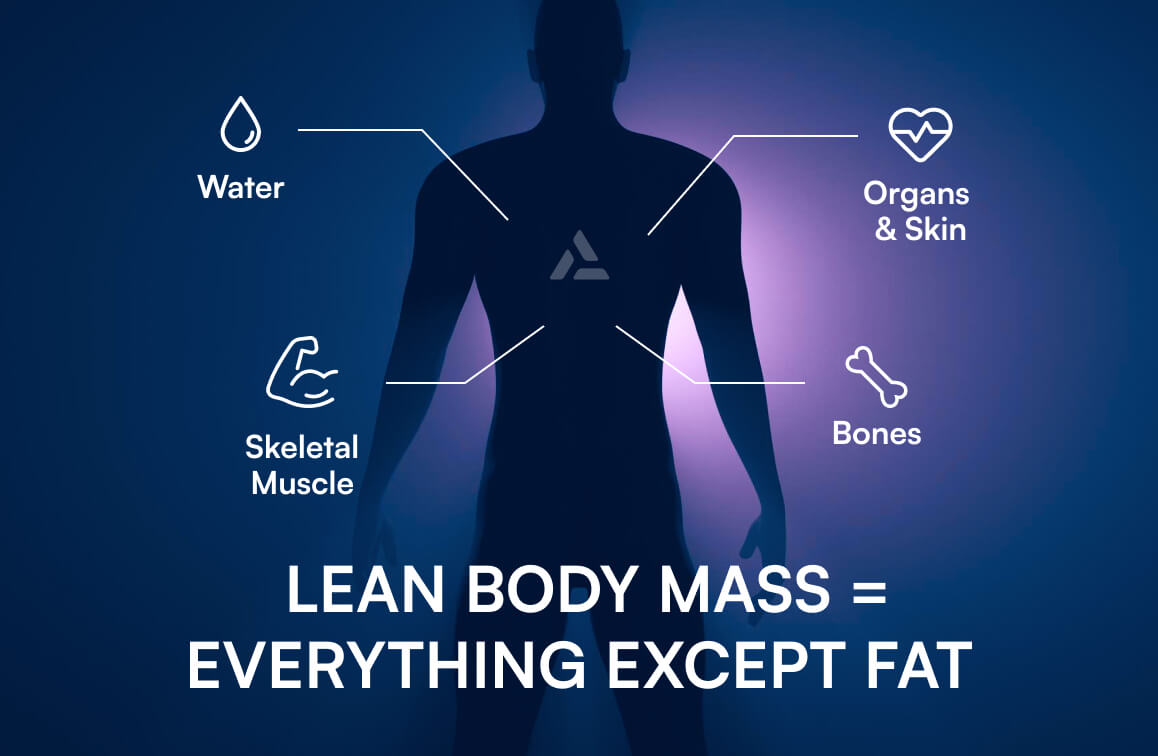
In scientific literature, you'll often see the term Fat-Free Mass (FFM) used. While it's frequently used interchangeably with LBM, the way it's measured can be influenced by changes in body water. This is a critical point for ketogenic diets because the initial, rapid weight loss is primarily due to the shedding of water that was stored alongside glycogen (your body's stored form of glucose) in your muscles and liver.
Therefore, a study might report a decrease in FFM, which sounds like muscle loss, but may in fact only reflect a loss of water and glycogen. Our investigation will need to distinguish between these two possibilities.
2. The "Muscle Wasting" Concern: A Mechanistic Deep Dive
The conventional wisdom that "carbs are necessary for muscle" stems from the known role of insulin in muscle metabolism. Since a ketogenic diet keeps insulin low, the logical, skeptical question is: won't this cause muscle breakdown? Let's dissect the mechanisms.
Insulin's Role Re-examined
The idea that high insulin is required to build muscle is an oversimplification. Insulin's primary role in muscle is not to directly trigger growth, but to prevent breakdown. It is more accurately described as anti-catabolic rather than anabolic.
To understand this crucial distinction, let's turn to Dr. Ben Bikman, a research scientist who specializes in metabolic function.
116: Can You Build Muscle on a Low-Carb Ketogenic Diet? What the Science Says with Dr. Ben Bikman
In this segment from his lecture, Dr. Bikman clarifies the precise role of insulin in muscle tissue. This is the foundation for understanding why low insulin on a ketogenic diet does not automatically lead to muscle loss.
Watch the section from 03:24 to 08:02. Pay close attention to the analogy of the construction site, where he describes muscle protein synthesis as building a wall and proteolysis (breakdown) as demolition. Insulin acts as the security guard preventing demolition.
Compensatory Mechanisms: Amino Acids and Ketones
If insulin is just one piece of the puzzle, what other factors are at play, especially in a low-insulin state? The body has powerful redundant systems.
1. The Primacy of Amino Acids
The true architects of muscle growth are amino acids, the building blocks of protein. Specific amino acids, like leucine, are potent direct activators of muscle protein synthesis.
116: Can You Build Muscle on a Low-Carb Ketogenic Diet? What the Science Says with Dr. Ben Bikman
Dr. Bikman continues by explaining how amino acids, particularly from dietary protein, step up to both stimulate muscle growth and prevent breakdown, compensating for lower insulin levels.
Watch from 08:02 to 11:24. Note the mention of the mTOR pathway, which is the master regulator of cell growth, and how it is directly activated by leucine.
2. The Unique Role of Ketones
Here is where the ketogenic diet has a unique advantage. The primary ketone body, beta-hydroxybutyrate (BHB), is not just a passive fuel source; it's an active signaling molecule that helps preserve muscle in two ways.
116: Can You Build Muscle on a Low-Carb Ketogenic Diet? What the Science Says with Dr. Ben Bikman
This final segment from Dr. Bikman's lecture is perhaps the most important. He explains how ketones themselves are 'muscle-sparing' both indirectly and directly.
Watch from 11:24 to 18:47. Focus on these two key mechanisms: Indirect Sparing: By providing the brain with its preferred fuel, ketones reduce the brain's demand for glucose. This spares the body from needing to break down muscle protein to create glucose (a process called gluconeogenesis). Direct Protection: BHB has direct effects on muscle cells, enhancing mitochondrial function and making them more resilient to damage.
This framework shows that while one anti-catabolic signal (insulin) is lower, other signals—both anabolic (from amino acids) and anti-catabolic (from ketones)—are upregulated, creating a robust system for muscle preservation.
3. Sizing Up the Evidence
The mechanisms suggest muscle should be preserved, but what do human studies show?
Reviewing the Research
First, let's look at a recent systematic review that provides a balanced perspective on the literature, summarizing both the proposed negative and positive mechanisms affecting muscle mass.
Impact of the ketogenic diet on body fat, muscle mass, and ...
This 2023 review article titled 'Impact of the ketogenic diet on body fat, muscle mass, and ...' provides an excellent overview. We will focus on the section discussing muscle mass.
Please read the section titled 'EFFECTS OF THE KETOGENIC DIET ON MUSCLE MASS'. Notice how it lists the potential negative mechanisms (e.g., reduced glycogen) before listing the positive, muscle-preserving mechanisms we've just discussed. Pay special attention to the conclusion drawn from the Wilson et al. study on resistance-trained men.
As the review concludes, the evidence points towards the ketogenic diet being "a strategy for selectively removing fat without muscle loss," which is highly relevant to your goal.
The View from 30,000 Feet: A Meta-Analysis
To get the most reliable answer, we can look at a meta-analysis, which pools the data from many individual studies.
Effects of ketogenic diet on muscle mass, strength, aerobic ...
This 2025 meta-analysis published in the 'Journal of the International Society of Exercise and Nutrition' represents one of the highest levels of evidence. Let's look at its core findings.
First, read the 'Abstract' for a complete overview. Then, read the 'Muscle mass' subsection within the 'Evidence synthesis' section. Note the distinct findings for 'muscle mass' versus 'fat-free mass (FFM)'.
The key finding is a perfect illustration of the point we made earlier:
- Muscle Mass: No significant difference between ketogenic and control diets.
- Fat-Free Mass (FFM): A significant decrease in the ketogenic group.
This apparent contradiction is resolved when we remember that FFM includes body water. The ketogenic diet leads to a depletion of stored glycogen, which releases a significant amount of water. Therefore, the drop in FFM is largely attributable to this water loss, not a loss of actual contractile muscle tissue. The analysis also found no negative impact on strength, which further supports the conclusion that functional muscle is preserved.
Test your understanding!
A friend starts a ketogenic diet and is alarmed that after a week, their smart scale reports a 2 kg loss in "Lean Mass". Based on what you've just learned, how would you explain this result and what would be a better indicator of whether they are actually losing muscle?
Show answer
You could explain that the reported loss in "Lean Mass" is very likely due to the loss of water and stored glycogen, not actual muscle tissue. This happens quickly when carbohydrate intake is drastically reduced. A much better indicator of whether they are preserving functional muscle would be their strength in the gym. If their performance in key lifts (like squats, bench press, deadlifts) is stable or increasing after the initial adaptation phase, it's a very strong sign that they are not losing functional muscle.
4. Visualizing the Results
This chart summarizes the findings from numerous studies, showing the change in fat mass (brown) versus lean body mass (blue) in various populations on a ketogenic diet.

As you can see, especially in studies involving athletic or trained individuals (e.g., Paoli 2012, Wilson 2017), fat mass decreases substantially while lean mass is either maintained or even slightly increased. This visual framework reinforces the concept of the ketogenic diet as a tool for body recomposition.
Conclusion: A Tool for Body Recomposition
For a lean, fit individual, the evidence does not support the concern that a well-formulated ketogenic diet leads to muscle loss. In fact, it appears to be an effective strategy for improving body composition by selectively reducing fat while preserving—and in some cases, even building—muscle mass.
Key Takeaways:
- The fear of muscle loss on keto is largely unfounded and based on a simplified understanding of insulin's role.
- Muscle preservation is supported by multiple mechanisms: amino acids driving protein synthesis and ketones providing direct and indirect protective effects.
- High-level evidence from meta-analyses confirms that a ketogenic diet does not decrease muscle mass or strength, though it does reduce water-and-glycogen-related "fat-free mass."
- For an individual who is already lean and engages in resistance training, the diet can be a potent tool for body recomposition—simultaneously decreasing fat mass while maintaining or gaining muscle. This requires adequate protein intake and sufficient calories.
Now that we have a solid theoretical understanding of the ketogenic diet's effects on metabolic health, cardiovascular markers, and body composition, we can move on to practical application.
Preview of the next lesson: In our next lesson, we will begin the "Practical Application" module by learning how to calculate personalized macronutrient targets for achieving nutritional ketosis. This will directly build on today's discussion about the importance of adequate protein and energy intake to support your goals.