Welcome to the second lesson in your exploration of DevOps and SRE. In our previous session, we examined the fundamental problem that DevOps solves: the "wall of confusion" that arises from siloed development and operations teams. We saw how this friction impedes an organization's ability to deliver value quickly and reliably.
Today, we will build on that foundation by introducing a structured framework for understanding the core principles of the DevOps solution. This framework is known as CALMS, and it provides a robust vocabulary for analyzing and guiding a DevOps transformation. For your work in organizational design, mastering these five pillars will enable you to assess a team's maturity and identify key areas for cultural and process improvement.
The lesson will cover:
- Culture: Shifting from blame to shared responsibility.
- Automation: Using technology to create flow and consistency.
- Lean: Focusing on value and eliminating waste.
- Measurement: Making data-driven decisions to improve performance.
- Sharing: Fostering collaboration and collective knowledge.
The CALMS Framework: Five Pillars of DevOps
The CALMS model is a conceptual framework that organizes DevOps into five essential, interdependent pillars. It was first proposed by Jez Humble and later expanded upon by others in the DevOps community. While some models use the acronym CAMS, we will use CALMS as it explicitly includes the "Lean" dimension, which is critical for understanding the focus on flow and value that underpins modern DevOps.
To begin, let's watch a video that provides a concise overview of four of these pillars. We will then add the 'Lean' principle to complete the picture.
DevOps Principles - The C.A.M.S. Model
This video from Coding Tech, "DevOps Principles - The C.A.M.S. Model," introduces the core components of the DevOps philosophy. It clearly explains the importance of Culture, Automation, Measurement, and Sharing.
Please watch from the introduction of the CAMS model through the detailed explanations of Culture, Automation, Measurement, and Sharing. As you watch, note how each principle directly counteracts the siloed behaviors we discussed in the last lesson.
Now that you have a general sense of the framework, let's explore each pillar in more detail, connecting them to your work in organizational design and your interest in AI's role.
1. Culture: The Foundation of Change
As the video and the acronym itself suggest, culture is the starting point and the foundation for a successful DevOps transformation. It's about changing how people work together and moving from a culture of blame to one of shared responsibility and psychological safety.
From an organizational design perspective, two practices are particularly powerful indicators of a healthy DevOps culture:
- Shared Responsibility: This principle dismantles the "wall of confusion" by making teams collectively responsible for the product's entire lifecycle. The mantra "You build it, you run it," popularized by Amazon's CTO Werner Vogels, means developers don't just hand off code to operations; they are also involved in its deployment and maintenance. This alignment of incentives is a fundamental structural change.
- Blameless Postmortems: When failures inevitably occur, the focus shifts from "Who caused this?" to "What in our system allowed this to happen, and how can we prevent it from recurring?" This approach encourages open communication and turns incidents into valuable learning opportunities, rather than events to be feared and concealed.
The following reading elaborates on these cultural shifts.
DevOps Fundamentals in 2026: Culture, Practices, and the Tools ...
This article from Nucamp uses a practical kitchen analogy to explain the DevOps culture. It provides excellent detail on shared responsibility and the importance of blameless postmortems.
Please read the section "DevOps Culture: Shared Responsibility and Continuous Improvement." Pay close attention to the table comparing Blame vs. DevOps Culture and the explanation of blameless reviews. These concepts are central to creating the conditions for continuous improvement.
2. Automation: The Engine of Consistency
Automation is perhaps the most visible aspect of DevOps. Its goal is to make processes repeatable, reliable, and fast, reducing the manual effort and human error that plagued traditional software delivery. This is where CI/CD pipelines, which we introduced in the last lesson, come into play.
The core practices of automation include:
- Continuous Integration/Continuous Delivery (CI/CD): Automating the process of building, testing, and deploying code.
- Infrastructure as Code (IaC): Managing and provisioning infrastructure (servers, networks, databases) through machine-readable definition files, rather than manual configuration.
The Nucamp article provides some examples of what this looks like in practice. While you don't need to write this code, reviewing it helps demystify what's happening "under the hood."
DevOps Fundamentals in 2026: Culture, Practices, and the Tools ...
This section of the Nucamp article details the core technical practices that enable automation.
Please read the section "Core Practices: Heat, Timing, and Flow." In the part on CI/CD, the YAML code shows a simple GitHub Actions workflow that automatically runs tests whenever code is pushed. In the part on Infrastructure as Code, the table explains tools like Terraform that define infrastructure in code. This is the "visual-technical" insight you're interested in.
The Role of AI in Automation (AIOps)
Your interest in AI is highly relevant here. The evolution of automation is leading to AIOps, where AI and machine learning are applied to automate and enhance IT operations. AI doesn't just execute predefined scripts; it can analyze data to predict failures, identify root causes of problems, and even remediate issues without human intervention. This moves teams from reactive to proactive or even predictive operations.
This image neatly contrasts the practices of a standard DevOps environment with one augmented by AIOps.
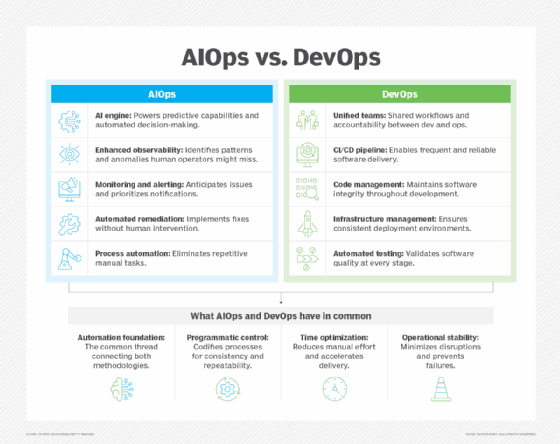
This diagram compares the core components of AIOps (left column) and DevOps (right column), while also highlighting what they have in common at the bottom. Notice how AIOps builds upon DevOps by adding predictive capabilities and automated decision-making.
3. Lean: The Pursuit of Value
The 'L' in CALMS stands for Lean. This principle, originating from the Toyota Production System in manufacturing, is about maximizing customer value while minimizing waste. In software, "waste" can be anything that doesn't add value to the end user, such as:
- Partially done work
- Unnecessary features
- Manual, error-prone processes
- Delays and waiting time
Lean thinking is realized through The Three Ways of DevOps, a concept from the influential book The Phoenix Project.
DevOps CALMS Framework: 5 key principles [+3 ways explained]
This article from ManageEngine provides an excellent explanation of the full CALMS model, with a particularly strong section on the Lean principle and its connection to The Three Ways.
First, read the section "The Three Ways of DevOps" to understand the foundational concepts of Flow, Feedback, and Continuous Learning. Then, read the section "Lean: Focus on Value, Eliminate Waste and Optimize Flow", which connects these ideas directly to the Lean pillar of CALMS.
For an organizational designer, the Lean principle is crucial. It provides the rationale for streamlining workflows, organizing teams for optimal flow (a concept we'll revisit when discussing team topologies), and ensuring that all effort is directed toward business objectives.
4. Measurement: The Compass for Improvement
You can't improve what you don't measure. The Measurement pillar is about using data to guide decision-making and track progress. This replaces gut feelings and anecdotes with objective evidence.
The most widely recognized metrics for measuring the performance of software delivery teams are the DORA metrics, named after the DevOps Research and Assessment (DORA) team. These four metrics provide a balanced view of both team velocity and system stability.
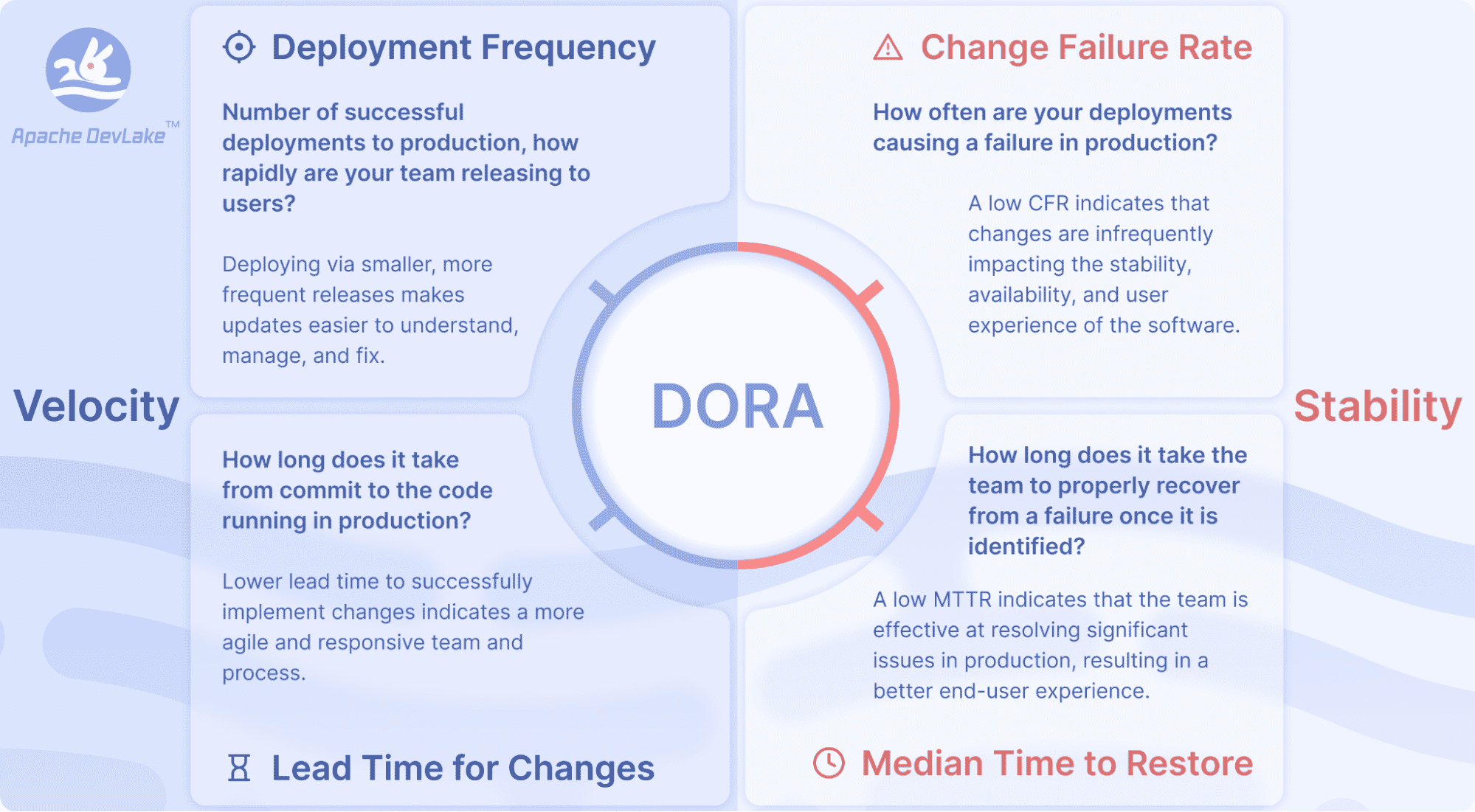
This diagram shows the four key DORA metrics. The two on the left, Deployment Frequency and Lead Time for Changes, measure team velocity. The two on the right, Change Failure Rate and Median Time to Restore, measure operational stability.
Here's what they mean:
- Deployment Frequency: How often an organization successfully releases to production. (Measures speed)
- Lead Time for Changes: The amount of time it takes a commit to get into production. (Measures speed)
- Change Failure Rate: The percentage of deployments causing a failure in production. (Measures quality/stability)
- Time to Restore Service (MTTR): How long it takes an organization to recover from a failure in production. (Measures stability/resilience)
As someone evaluating team productivity, these four metrics are your starting point. They provide a high-level, data-driven assessment of a team's DevOps maturity. High-performing teams are able to improve both speed and stability simultaneously, busting the myth that you have to trade one for the other.
5. Sharing: The Multiplier of Knowledge
The final pillar, Sharing, is about creating channels for communication and collaboration to ensure that knowledge, ideas, and feedback flow freely across the organization. This is the antidote to the knowledge hoarding that happens within silos.
Sharing manifests in many ways:
- Transparent tools: Using shared platforms like Jira for planning or Grafana for dashboards so everyone has the same view of work and system health.
- Documentation: Creating and maintaining accessible documentation.
- Cross-team collaboration: Fostering regular interaction between Dev, Ops, Security, and Business teams.
From an organizational design standpoint, an important aspect of sharing is managing cognitive load. It's unrealistic to expect one team to know everything. A key insight in modern DevOps is to structure teams to facilitate sharing while preventing burnout. This has led to the rise of platform teams, which provide shared services and tools (the "paved road") that product teams can use, reducing their cognitive load and allowing them to focus on delivering features.
DevOps CALMS Framework: 5 key principles [+3 ways explained]
This final section from the ManageEngine article discusses the Sharing principle, including the important concept of managing cognitive load through organizational constructs like platform teams.
Please read the section titled "Sharing: Distributing Cognitive Load...". This idea of distinguishing between product and platform teams is a core concept in modern organizational design for technology companies.
Conclusion
In this lesson, we have unpacked the CALMS framework, giving you a structured way to understand the principles behind DevOps. This is more than just a list of buzzwords; it is a holistic system where each pillar reinforces the others. You can't have a culture of continuous learning without measurement, you can't automate effectively without lean processes, and none of it works without a culture of sharing and shared responsibility.
Here are your key takeaways:
- The CALMS framework (Culture, Automation, Lean, Measurement, Sharing) provides a comprehensive model for implementing and assessing DevOps.
- Culture is the foundation, emphasizing shared responsibility and blamelessness to foster psychological safety and learning.
- Automation (including CI/CD and IaC) is the engine that drives consistency and speed, with AIOps representing the next frontier of intelligent automation.
- Lean principles focus on optimizing for value and flow by eliminating waste, guided by The Three Ways (Flow, Feedback, Continuous Learning).
- Measurement, particularly through the four DORA metrics, provides objective data to guide improvement and assess performance.
- Sharing knowledge and tools prevents silos and manages cognitive load, leading to more resilient and efficient organizational structures like platform teams.
In our next lesson, we will look at how these CALMS principles are applied in practice across the key stages of the DevOps lifecycle, from planning and coding to deployment and monitoring. This will connect the "why" and "what" of DevOps to the "how."