Welcome to your first lesson in our course on DevOps and Site Reliability Engineering. Your goal is to gain a strategic understanding of these domains to inform your work in organizational design and change management, particularly in the context of AI-driven transformation.
This lesson lays the groundwork by exploring the fundamental problem that DevOps was created to solve. We will describe the challenges of traditional, siloed software delivery models and then introduce DevOps as the solution that bridges the critical gap between development and operations teams. Understanding this "why" is the essential first step before we delve into the principles and practices in subsequent lessons.
1. The World Before DevOps: The "Wall of Confusion"
In traditional software development organizations, teams were often structured into functional "silos." Much like agricultural silos that keep different grains separate, these departments—Development, Operations, Quality Assurance (QA), Security—worked in isolation. Each team had its own goals, its own metrics, and often, its own culture.
The most prominent and problematic of these divides was between the Development (Dev) and Operations (Ops) teams.
- Developers are incentivized to create and ship new features. Their primary driver is change.
- Operations staff are responsible for keeping the production systems running smoothly. Their primary driver is stability.
This fundamental conflict of interest created what became known as the "wall of confusion." To get a vivid sense of the friction this caused, the following video provides some historical context.
DevOps Explained and the History of DevOps
Watch this segment from the video "DevOps Explained and the History of DevOps" by Moss. It details the challenges of the pre-cloud era, where limited access, rigid processes, and poor communication between Dev and Ops teams created long feedback loops and constant conflict.
Please watch the section from "back in time". As you watch, consider how these communication and process barriers would impact a business's ability to respond to market changes—a key concern in your field of organizational design.
This separation led to a number of predictable and damaging consequences for any organization trying to deliver software effectively.
Breaking Down Silos in Software Development with DevOps
The article "Breaking Down Silos in Software Development with DevOps" from Codestringers clearly defines organizational silos and their business impact.
Please read the introduction and the sections titled "Understanding Organizational Silos in Software Development" and "Consequences of Silos in Software Development." Focus on the list under the consequences of silos. These points—slow deployment, poor quality, and inter-team conflicts—are the very problems that drive the need for organizational change.
This image provides a powerful visual metaphor for the problem. On the left side, you see the rigid, siloed structure where work is handed off sequentially, creating friction and slowing everything down.

This diagram contrasts the traditional "Rigid Silos" model of software development with the modern, AI-assisted model of "Dissolving Boundaries." The left side illustrates the friction and separation between functional teams like Design, Product, and Code.
2. The DevOps Solution: Integration and Continuity
DevOps emerged not as a tool or a specific job title, but as a cultural philosophy and a set of practices designed to dismantle this "wall of confusion." It proposes a new model where development and operations are no longer separate functions but integrated parts of a single, continuous process.
The most common symbol for DevOps is the infinity loop, which represents the continuous, cyclical nature of software delivery. It connects planning, coding, building, testing, releasing, deploying, operating, and monitoring into a seamless, automated feedback loop.
This clip from ForrestKnight's "A Complete Overview of DevOps" introduces the iconic infinity loop and explains how it represents a continuous cycle.
Watch the segment from defining the process that walks through the stages of the loop. Notice how feedback from the "operate" and "monitor" stages flows directly back into the "plan" stage, creating a mechanism for continuous improvement.
So, how does this new philosophy actually break down the silos we discussed? The change was driven by two parallel forces: advancements in technology and shifts in work culture.
DevOps Explained and the History of DevOps
Let's return to the "DevOps Explained" video, which now explains the solutions that emerged to solve the silo problem.
Please watch the segment from "what changed". Pay attention to how the presenter outlines both technological changes (like cloud computing and automation) and cultural changes (like Agile methodology and cross-functional teams). This dual-pronged approach is a classic change management scenario.
To summarize, DevOps addresses the silo challenge through several key mechanisms, which we will explore in depth throughout this course:
- Automation and CI/CD: Automating the build, test, and deployment process removes manual handoffs and bottlenecks. The "CI/CD Pipelines" diagram below gives a high-level view of this automated flow, which replaces the error-prone, sequential steps of the past.
- Shared Ownership: Practices like "You Build It, You Run It" make development teams responsible for their code in production, aligning their incentives with the Ops team's goal of stability.
- Infrastructure as Code (IaC): Managing infrastructure through code ensures that development, testing, and production environments are consistent, eliminating a major source of "it worked on my machine" errors.
- Shared Monitoring and Observability: Giving developers access to performance data from production allows them to see the impact of their code and proactively address issues.
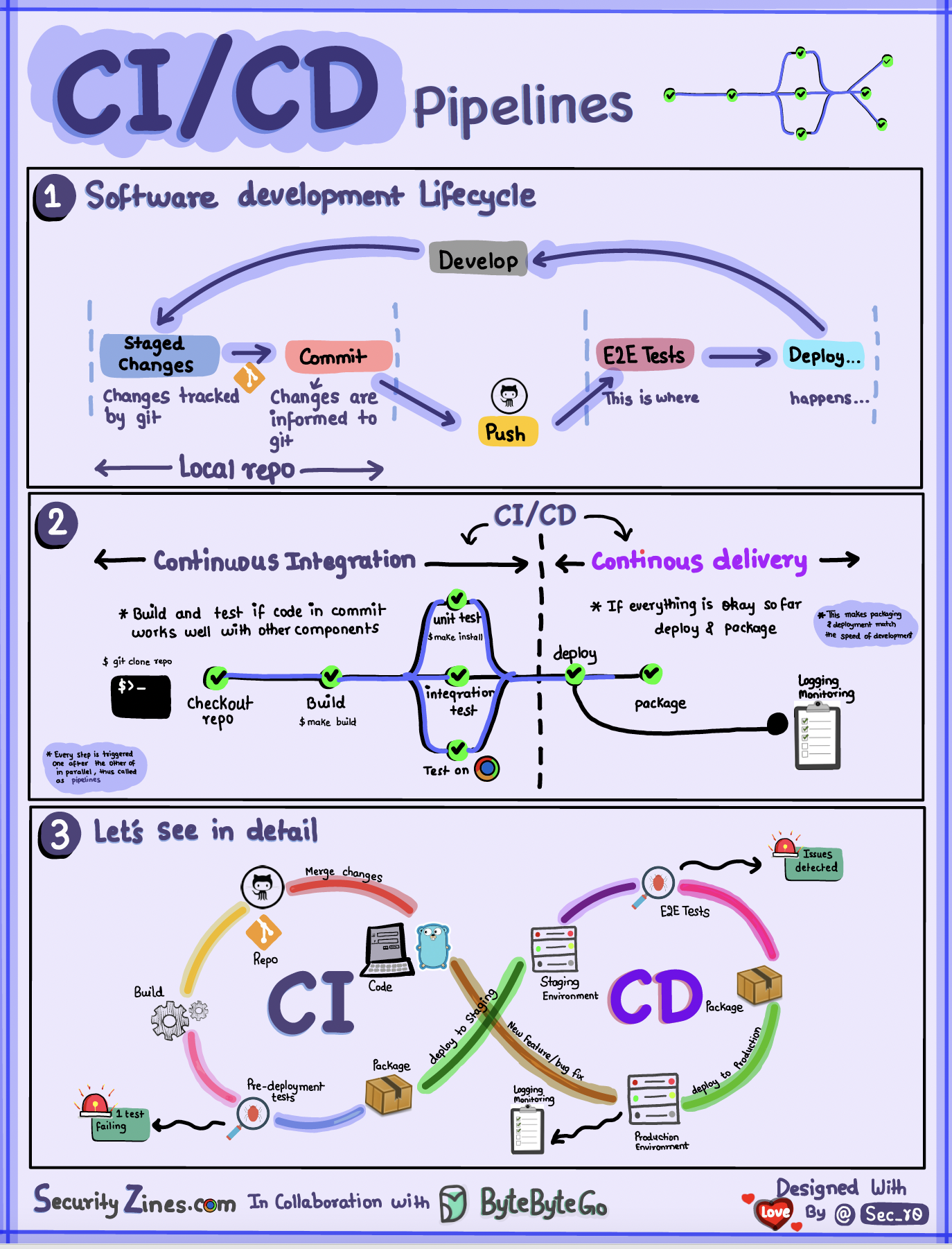
This diagram illustrates the stages of a modern software development lifecycle, emphasizing the automated flow of Continuous Integration (CI) and Continuous Delivery (CD) that is central to the DevOps approach.
3. The Next Frontier: AI as a Silo-Breaker
Your interest in how AI tools integrate into this landscape is timely. AI is not just another tool in the DevOps toolchain; it is acting as a powerful catalyst for breaking down silos even further. It does this by making specialized knowledge more accessible across different roles.
Given your familiarity with AI assistants, the following article will be particularly insightful. It explores how these tools are creating more versatile engineers and changing the very nature of team collaboration.
Breaking Down Engineering Silos with AI Coding Tools: DevOps
This article by Paul Bonneville directly addresses how AI coding assistants are accelerating the breakdown of traditional engineering silos, a topic central to your goal of understanding AI's role in organizational restructuring.
Please read the article from the introduction through to the end of the "The Bigger Picture" section. As you read, focus on how AI enables "infrastructure literacy" for non-specialists. Think about the concept of the "Bridge Mind" from the first image—an individual who can translate between domains. This is the new type of role that AI is helping to create, with significant implications for organizational design.
Revisiting the first image, the right side now comes into focus. AI doesn't just speed up the old process; it enables a new one where boundaries dissolve, and a "Bridge Mind" can synthesize information across domains. For an organizational designer, this shift from rigid specialist roles to AI-assisted functional access is the key takeaway.
Conclusion
In this lesson, we have established the foundational context for DevOps. You've seen that the friction and inefficiency of traditional, siloed software delivery created a compelling need for a new way of working.
Here are the key takeaways:
- Traditional software organizations were often structured in functional silos (Dev, Ops, QA), creating boundaries that hindered collaboration and speed.
- The primary conflict between Development (driving change) and Operations (ensuring stability) created a "wall of confusion," leading to slow deployments, poor quality, and inter-team friction.
- DevOps is the cultural and technical response, promoting integration, shared responsibility, and automation to create a continuous software delivery lifecycle, often visualized as an infinity loop.
- This is achieved through practices like CI/CD, Infrastructure as Code, and shared monitoring, which we will cover in detail later.
- Modern AI tools are accelerating this trend by democratizing technical knowledge, enabling engineers to work across traditional boundaries and fostering a more collaborative and efficient environment.
In our next lesson, we will put a more formal structure on these ideas by exploring the CALMS framework—a model that breaks DevOps down into five core pillars: Culture, Automation, Lean, Measurement, and Sharing. This will give you a robust vocabulary for discussing and evaluating DevOps transformations within an organization.