Introduction
In our last lesson, we established the universal rule for a firm seeking to maximize its profit: produce at the quantity where marginal revenue equals marginal cost (). This principle is the cornerstone of a firm's output decision. Now, we begin our exploration of different market environments by applying this rule to the most foundational market structure: perfect competition.
This lesson will define the specific conditions that create a perfectly competitive market. We will then explore the crucial implication of these conditions: firms in this market are "price takers," meaning they have no control over the market price. The core of our work today will be to formally derive why, for such a firm, its marginal revenue is exactly equal to the market price (). This derivation, which we will approach both numerically and with calculus, simplifies the general profit-maximization rule to a more specific condition for this market type.
The Characteristics of Perfect Competition
A market structure describes the key characteristics of a market, including the number of firms, the similarity of their products, and the ease of entry and exit. Perfect competition represents a theoretical benchmark or an ideal model at one end of the spectrum.
To understand its defining features, please watch the first part of the following video.
Chapter 14: Perfect Competition - Part 1
This video by Dr. Azevedo Econ clearly outlines the three fundamental characteristics of a perfectly competitive market.
Please watch from the beginning until the end of the section describing the three key traits.
As the video explains, a market is considered perfectly competitive if it satisfies three conditions:
- Many Buyers and Sellers: The market is composed of a large number of buyers and sellers, each of whom is small relative to the total market size. No single participant can influence the market price.
- Identical Goods: The products offered by all sellers are homogeneous or perfect substitutes for one another. From a consumer's perspective, there is no difference between the product of one firm and another.
- Free Entry and Exit: There are no significant barriers preventing new firms from entering the market or existing firms from leaving it. This condition is crucial for how the market behaves in the long run, a topic we will explore soon.
The first two conditions have a powerful immediate consequence: they make every firm a price taker.
The Price-Taking Firm
What does it mean to be a price taker? It means the firm must accept the prevailing market price and cannot charge a higher price without losing all its customers, nor does it have any incentive to charge a lower price since it can sell all it wants at the market price.
The following video segment explains this concept and visualizes the consequence for the firm's demand curve.
Chapter 14: Perfect Competition - Part 1
This segment explains why a perfectly competitive firm is a price taker and how this results in a perfectly elastic demand curve.
Please watch from this section. Pay close attention to the two-panel graph that distinguishes the downward-sloping market demand curve from the horizontal demand curve that the individual firm faces.
Let's visualize this crucial distinction with the classic two-panel diagram.
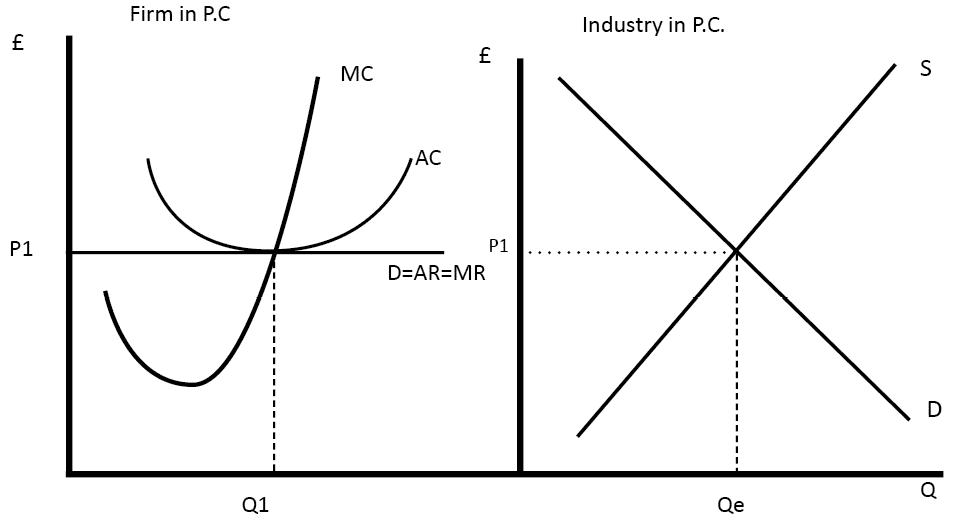
Because the firm can sell as much as it wants at the market price P1, its demand curve is a horizontal line. This is the graphical signature of a price-taking firm.
Deriving the P = MR Relationship
We can now proceed to the central derivation of this lesson. We will prove that for a perfectly competitive firm, price is equal to marginal revenue (). We'll do this first with a numerical example and then with a formal calculus derivation, which should resonate with your quantitative background.
A Numerical Demonstration
The same video you just watched provides an excellent numerical table that builds the logic from the ground up. It shows that when price is constant, the additional revenue from selling one more unit (marginal revenue) is always equal to that constant price.
Chapter 14: Perfect Competition - Part 1
This final segment of the video uses a table to calculate total, average, and marginal revenue, demonstrating that for a price-taking firm, P = MR.
Please watch from the beginning of this section. Follow the calculations in the table, especially the column for marginal revenue.
As the table shows, if a firm sells milk for a constant price of $6 per gallon, its total revenue increases by exactly $6 for each additional gallon it sells. Thus, its marginal revenue is a constant $6, which is equal to the price.
A Formal Calculus Proof
Now, let's prove this result more formally using calculus. This approach is more general and provides a rigorous foundation for our analysis.
A firm's total revenue () is defined as price () multiplied by quantity ():
In a perfectly competitive market, the firm is a price taker, which means is a constant determined by the market. The firm's only choice is the quantity to produce.
Marginal revenue () is the first derivative of the total revenue function with respect to quantity:
Substituting our expression for , we get:
Since is a constant, the rules of differentiation tell us that the derivative of a constant times a variable () is just the constant. Therefore:
This completes the formal proof. For any price-taking firm, marginal revenue is always equal to the price. The following resource provides a concise summary of this logic and a formal mathematical proof.
Revision Notes - MC = MR rule for maximizing profit
This article from Sparkl summarises the key concepts and provides a clear mathematical proof.
First, quickly review the sections on The MC = MR Rule Explained and Perfect Competition and the MC = MR Rule. These connect what you've just learned. Then, focus on the section Mathematical Proof, which formalises the profit maximization condition using calculus.
It is essential to remember this result, as it is a defining feature of perfect competition. In the market structures we study later, such as monopoly, this will not be the case.
The Profit-Maximizing Rule for a Competitive Firm
We can now synthesize everything we have covered.
- From our last lesson, we know the universal condition for profit maximization is .
- In this lesson, we have proven that for a perfectly competitive firm, .
By substituting the second equation into the first, we arrive at the profit-maximization rule specific to perfect competition:
This means a perfectly competitive firm maximizes its profit by choosing a quantity of output where the marginal cost of the last unit produced is equal to the market price. The firm adjusts its production level until its rises to meet the price set by the market.
This logic is summarized elegantly in the following document.
[PDF] Profit Maximization by a Competitive Firm Having derived the total ...
This PDF from Ohio State University's economics department provides a concise, formal treatment of the topic.
Please read the first three paragraphs, from the beginning down to equation (1) and its interpretation. Notice how it starts with the general MR = MC rule and quickly specializes it to P = MC for a competitive firm.
The document also mentions a "second-order condition": the marginal cost curve must be upward-sloping at the point of intersection. This ensures we have found a profit maximum, not a minimum. We will see the importance of this graphically in our next lesson.
Conclusion
In this lesson, we have formally defined the market structure of perfect competition and derived its key implications for a firm's behavior. We established that the combination of many small firms, identical products, and free entry and exit forces each firm to be a price taker, facing a perfectly elastic demand curve at the market price.
Our main analytical task was to prove, both numerically and through calculus, that for such a firm, marginal revenue is equal to price (). This allowed us to simplify the universal profit-maximization rule () into a specific condition for perfect competition: a firm maximizes its profit by producing at the quantity where price equals marginal cost ().
Key Takeaways:
- Conditions for Perfect Competition: 1) Many buyers and sellers, 2) Homogeneous products, 3) Free entry and exit.
- Price Taker: A firm in perfect competition cannot influence the market price and faces a horizontal demand curve.
- Revenue Identity: For a competitive firm, Price = Average Revenue = Marginal Revenue ().
- Profit Maximization Rule: The firm chooses the output quantity where .
In our next lesson, we will put this rule into practice. We will combine the condition with a firm's cost curves to graphically and numerically determine its short-run profit-maximizing output and calculate its total profit or loss.