Introduction
In our previous lessons, we meticulously constructed the two pillars of a firm's decision-making framework: costs and revenues. We used calculus to define marginal cost as the derivative of the total cost function, , and marginal revenue as the derivative of the total revenue function, . Now, we will bring these two concepts together to address the central question for any firm: what quantity of output will maximize its profit?
This lesson will establish the fundamental rule of profit maximization. You will learn to determine a firm's profit-maximizing output level by applying the condition that marginal cost must equal marginal revenue. Given your background in statistics and quantitative reasoning, you will appreciate that this is an application of a standard optimization principle, which we will derive formally before applying it to numerical problems.
The Mathematics of Profit Maximization
A firm's profit, denoted by , is the difference between its total revenue (TR) and its total cost (TC), both of which are functions of the quantity produced, .
The firm's goal is to choose the quantity that maximizes this profit function. From calculus, we know that to find the maximum (or minimum) of a function, we must find the point where its first derivative with respect to the variable of interest is equal to zero. In this case, we differentiate the profit function with respect to :
To find the maximum profit, we set this derivative to zero:
Recalling our definitions from previous lessons, we know that is the marginal revenue (MR) and is the marginal cost (MC). Substituting these into the equation gives us the cornerstone of microeconomic analysis:
This elegant result provides a universal rule: a firm maximizes its profit by producing at the level of output where marginal revenue equals marginal cost.
The logic is intuitive:
- If MR > MC, producing and selling one more unit adds more to revenue than it adds to cost, so profit increases. The firm should expand production.
- If MR < MC, the last unit produced added more to cost than it added to revenue, so profit fell. The firm should reduce production.
- If MR = MC, the firm has exhausted all opportunities to increase profit by changing its output level. Profit is at its maximum.
For a more detailed mathematical and graphical explanation of this rule, the following resource provides an excellent supplement.
PROFIT-MAXIMIZATION - Technical Supplement
This document provides a rigorous derivation of the profit-maximization rule.
Please read the section titled The Marginal Rule. This section formally derives the MR = MC condition from the profit function and shows how it can be used to calculate the profit-maximizing quantity directly.
Applying the Rule: A Worked Example
Let's now see this rule in action. We'll watch a video that works through two scenarios, reinforcing the theory and demonstrating the calculation process. The second example, in particular, combines concepts from our previous lessons on cost and revenue functions.
Marginal Revenue, Average Cost, Profit, Price & Demand Function - Calculus
This video by The Organic Chemistry Tutor demonstrates how to find the profit-maximizing output level.
First, watch the introductory segment from this clip, which recaps the profit function and the derivation of the MR = MC condition. Next, focus on the more complex example presented from this segment. Here, the price is not constant. The presenter calculates MR and MC from their respective functions, sets them equal to find the profit-maximizing quantity, and then confirms the result by directly maximizing the profit function. This dual approach will solidify your understanding of the underlying mathematics.
As the video demonstrates, the procedure is methodical:
- Derive the Marginal Revenue (MR) function from the firm's demand (or total revenue) function.
- Derive the Marginal Cost (MC) function from the firm's total cost function.
- Set and solve for the quantity, . This is the profit-maximizing level of output.
The Graphical Representation
Visually, the profit-maximizing quantity is found where the marginal cost and marginal revenue curves intersect.
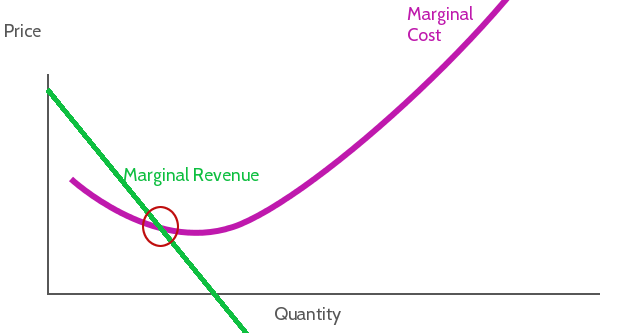
An important point to remember is that this graph only gives you the optimal quantity. To find the price the firm will charge, you must take this quantity and find the corresponding price on the demand curve (which is also the Average Revenue curve), not the MR curve.
A Step-by-Step Problem
Let's now apply this method to a typical problem you might encounter. The following resource presents a clear, step-by-step solution.
1 A Profit-Maximization Problem Step-by- ...
This document provides an excellent, analytically rigorous example of solving a profit-maximization problem.
Please read the section titled ANSWER Q2. Follow the three main steps: Finding the profit-maximizing quantity q* by setting mr = mc. Finding the profit-maximizing price p* by substituting q* back into the inverse demand function. Calculating the firm's maximum profits π* by subtracting total costs from total revenues at q*.
Let's summarize the key steps from that example:
- Demand:
- Inverse Demand:
- Marginal Revenue: (using the double-the-slope rule)
- Marginal Cost: (given as constant)
1. Find Q:*
Set :
2. Find P:*
Substitute into the inverse demand function:
3. Find Profit π:*
Total Revenue:
Total Cost: (since fixed costs are zero)
Profit:
A Final Note on Fixed Costs
You might wonder how fixed costs (FC) fit into this picture. Fixed costs are crucial for determining the total profit, but they do not affect the profit-maximizing quantity.
Remember that marginal cost is the derivative of total cost: . Since , where VC is variable cost, the derivative is:
Because fixed cost (FC) is a constant, its derivative is zero. Therefore, . Marginal cost is solely determined by the change in variable costs. Since the decision rule only involves marginal values, fixed costs do not enter the calculation for the optimal quantity.
PROFIT-MAXIMIZATION - Technical Supplement
This section explains why fixed costs don't alter the profit-maximization decision.
Read the section titled FIXED COSTS. It demonstrates both graphically and mathematically why the MR = MC condition is independent of the level of fixed costs.
Conclusion
In this lesson, we unified our analyses of cost and revenue to derive and apply the fundamental condition for profit maximization: . This powerful rule provides a clear-cut method for determining a firm's optimal output level. The process involves deriving the MR and MC functions, equating them to solve for the optimal quantity , and then using the demand curve to find the corresponding price .
Key Takeaways:
- The profit function is .
- Profit is maximized when its derivative with respect to quantity is zero, which leads to the condition .
- Fixed costs affect the level of profit but not the profit-maximizing quantity, as they do not influence marginal cost.
- The process for finding the profit-maximizing outcome is:
- Find and .
- Solve for in the equation .
- Find by substituting into the inverse demand function .
We have now completed our toolkit for analyzing the firm. In the upcoming module, we will apply this framework to understand how firms behave in different market structures, starting with the two polar opposites: perfect competition and monopoly.