Introduction
In our last lesson, we examined the long-run equilibrium in a perfectly competitive market. We saw how the freedom of entry and exit is a powerful force that erodes any short-run economic profits, ultimately compelling firms to produce at their most efficient scale where price equals the minimum average total cost. This results in zero economic profit for all firms in the long run.
Today, we pivot to the opposite extreme of market structure: monopoly. We will explore a market landscape where the assumptions of perfect competition are completely relaxed. Instead of many firms, there is only one. Instead of being a price-taker, this firm is a price-maker. This lesson will define the core characteristics of a monopoly and, crucially, investigate the sources of its power. You will learn to identify the "barriers to entry" that shield a monopolist from competition, and we will introduce quantitative measures to assess the extent of a firm's market power, linking it directly to the price elasticity of demand.
Defining Monopoly and Market Power
A monopoly is a market structure characterized by three key conditions:
- A single seller: One firm produces the entire output of the market.
- No close substitutes: Consumers have no viable alternative products to turn to.
- Significant barriers to entry: Other firms are prevented from entering the market to compete.
The first two videos provide a concise introduction to these defining features and highlight the fundamental shift from the price-taking behavior of competitive firms to the price-making ability of a monopolist.
Intermediate Microeconomics: Market Power and Monopoly
This video by Dr. Azevedo Econ introduces the essential characteristics of a monopoly, contrasting it directly with the perfectly competitive model.
Watch the initial segment from the beginning. Focus on the three core characteristics outlined: a single firm, no close substitutes, and strict barriers to entry.
This excerpt from an MIT OpenCourseWare lecture emphasizes the critical distinction between price-takers and price-makers, which is the defining consequence of monopoly power.
Watch the segment from Monopoly vs. Perfect Competition. The key takeaway here is the concept that a monopolist faces the entire market demand curve and therefore has the power to set the price.
Quantifying Market Power
The ability to set the price is formally known as market power. For our analytical purposes, we define market power as the ability of a firm to profitably charge a price above its marginal cost (). This stands in sharp contrast to the perfectly competitive firm, which maximizes profit where .
Let's look at a typical graphical representation of a monopoly. We will delve into the full calculation of a monopolist's decisions in the next lesson, but for now, this graph helps visualize the concept of market power.
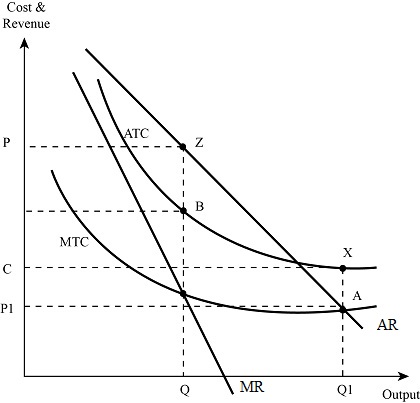
The primary measure of this market power is the Lerner Index, which expresses the markup of price over marginal cost as a fraction of the price. As a statistician, you'll appreciate that it's a normalized measure, ranging from 0 (for perfect competition) to a theoretical maximum of 1.
The Lerner Index is defined as:
Remarkably, this index is directly related to the price elasticity of demand (), a concept you've encountered previously. The relationship is given by:
This elegant formula reveals that a monopolist's market power is fundamentally constrained by consumer responsiveness. If demand is highly elastic (a large negative ), the markup is small. If demand is inelastic (an close to -1), the markup can be very large.
The following text provides a rigorous derivation of this relationship and offers numerical examples that demonstrate how to calculate market power using elasticity data—a common task when cost data is unavailable.
Measures of market power and \epsilon_D
This article offers a comprehensive quantitative look at market power, connecting it directly to elasticity. It's an excellent resource for understanding how market power is measured in practice.
Please read the entire article. Start with the section on price markups to solidify the P > MC concept. Then, carefully study the derivation of the price markup formula and the subsequent numerical examples, which show how different elasticities lead to vastly different markups. Finally, review the section on the Lerner index and the summary table.
Sources of Market Power: Barriers to Entry
We've defined what market power is and how to measure it. But why does it exist in the first place? The answer lies in barriers to entry—obstacles that prevent new firms from entering a market and competing away the monopolist's profits. This is the crucial feature that differentiates monopoly from perfect competition, where entry is free.
The following video provides an excellent and structured overview of the primary sources of these barriers.
Intermediate Microeconomics: Market Power and Monopoly
Continuing with Dr. Azevedo's lecture, this section systematically breaks down the most common and important barriers to entry that sustain monopolies.
Watch the segment from Sources of Barriers to Entry. As you watch, pay close attention to the following distinct categories:
Let's review these barriers in detail:
-
Natural Monopoly: This occurs when economies of scale are so pervasive that a single firm can supply the entire market at a lower average cost than two or more firms. The average total cost (ATC) curve is downward-sloping over the entire relevant range of output. As the video explains with the cost function , the average cost continuously falls as quantity increases. Public utilities like water and electricity distribution are classic examples.
-
Control of a Key Resource: If a single firm has exclusive ownership of a crucial input for production, it can prevent others from competing. Historical examples include De Beers' control over diamond mines and Alcoa's control over bauxite reserves for aluminum production.
-
Government-Created Barriers: Governments can grant exclusive rights to a firm, creating a legal monopoly.
- Patents and Copyrights: These grant an innovator the exclusive right to produce and sell a new product or creative work for a set period. This is intended to encourage innovation by allowing firms to recoup their research and development costs. The video below gives a memorable example.
- Licensing and Public Franchise: Governments may grant exclusive licenses for certain services, such as operating a specific bus route or being the sole provider of cable television in a region.
-
Network Externalities: A product exhibits network externalities if its value to a consumer increases as more people use it. Social media platforms, operating systems (like Windows), and online dating sites are prime examples. A new entrant faces a significant challenge because its product has little value with no existing user base.
-
Switching Costs: These are costs consumers incur when they switch from one supplier to another. Airlines create switching costs through frequent flyer programs, and banks may do so with account closure fees or the inconvenience of moving automated payments.
The following video provides a practical example of a government-created barrier—copyright—and explains how the elasticity of demand still acts as a check on the monopolist's pricing power.
This MIT lecture segment explains the concept of market power in the context of copyright protection, using the prices of books by Mark Twain and F. Scott Fitzgerald as a compelling case study.
Watch from Market Power and Elasticity. Note how the expiration of copyright for Huckleberry Finn leads to a competitive market price close to marginal cost, while the existing copyright for The Great Gatsby allows for a monopoly markup. The key insight is that even this monopoly price is limited by consumers' ability to substitute to other books (i.e., by the elasticity of demand).
Conclusion
In this lesson, we have formally defined monopoly and contrasted its core features with those of perfect competition. We moved beyond a purely conceptual definition to a quantitative one, establishing market power as the ability to set price above marginal cost ().
Key Takeaways:
- A monopoly consists of a single seller of a unique product, protected by significant barriers to entry.
- The defining characteristic of a monopolist is market power: the ability to be a price-maker rather than a price-taker.
- Market power is quantitatively measured by the Lerner Index () or the price markup (). Both are inversely related to the price elasticity of demand.
- Monopolies are sustained by barriers to entry, which can include natural monopolies (economies of scale), control of key resources, government-created barriers (patents, licenses), network externalities, and high switching costs.
Now that you understand what a monopoly is and where its power originates, we are prepared for the next step. In our upcoming lesson, you will apply your quantitative skills to solve the monopolist's profit-maximization problem. We will use cost and demand functions to calculate the optimal price and quantity, and determine the resulting profit.