Introduction
In our previous lesson, we used the Production Possibility Frontier (PPF) to visualize an economy's production capacity and the trade-offs inherent in scarcity. The PPF elegantly frames the question of what can be produced, but it doesn't tell us how an economy decides which combination of goods and services to actually create.
This lesson directly addresses that question. We will analyze the different overarching systems that societies use to solve the fundamental problem of resource allocation: what to produce, how to produce it, and for whom. You will learn to distinguish between market, command, and mixed economies by examining their core decision-making and ownership structures. This provides the essential framework for understanding why some economies rely on prices and competition, while others use central directives.
Defining Economic Systems
At the highest level, we can classify modern economic systems based on two key dimensions: the dominant mode of decision-making (decentralized markets vs. centralized planning) and the dominant pattern of ownership of productive resources (private vs. social/state).
To establish a clear set of definitions for these systems, let's turn to a foundational text on the topic.
[PDF] Comparative Economic Systems: - Boston University
This document from Boston University provides a clear and structured overview of the major types of economic systems and ownership patterns.
Please read the following two subsections from the chapter: First, read the subsection "The Three Major Types of Economic Systems". This will introduce you to the core concepts of planned, market, and mixed economies. Next, read the subsection "Patterns of Ownership" up to the point where the sawmill example begins. This part clarifies the crucial distinction between private, social, and state ownership.
As you've just read, these categories are not rigid boxes but rather points on a spectrum. No real-world economy is a "pure" market or "pure" planned system. Instead, they are all mixed economies, but they lean heavily in one direction or another. The United States leans toward the market end, while North Korea leans toward the planned end. The key is to understand the primary mechanism each system uses to allocate its scarce resources.
The Market Economy and the Price Mechanism
In a market economy, the billions of daily decisions about resource allocation are not made by a central authority. Instead, they are coordinated through the price mechanism. Prices act as the nervous system of the economy, carrying information and creating incentives that guide the actions of independent households and firms.
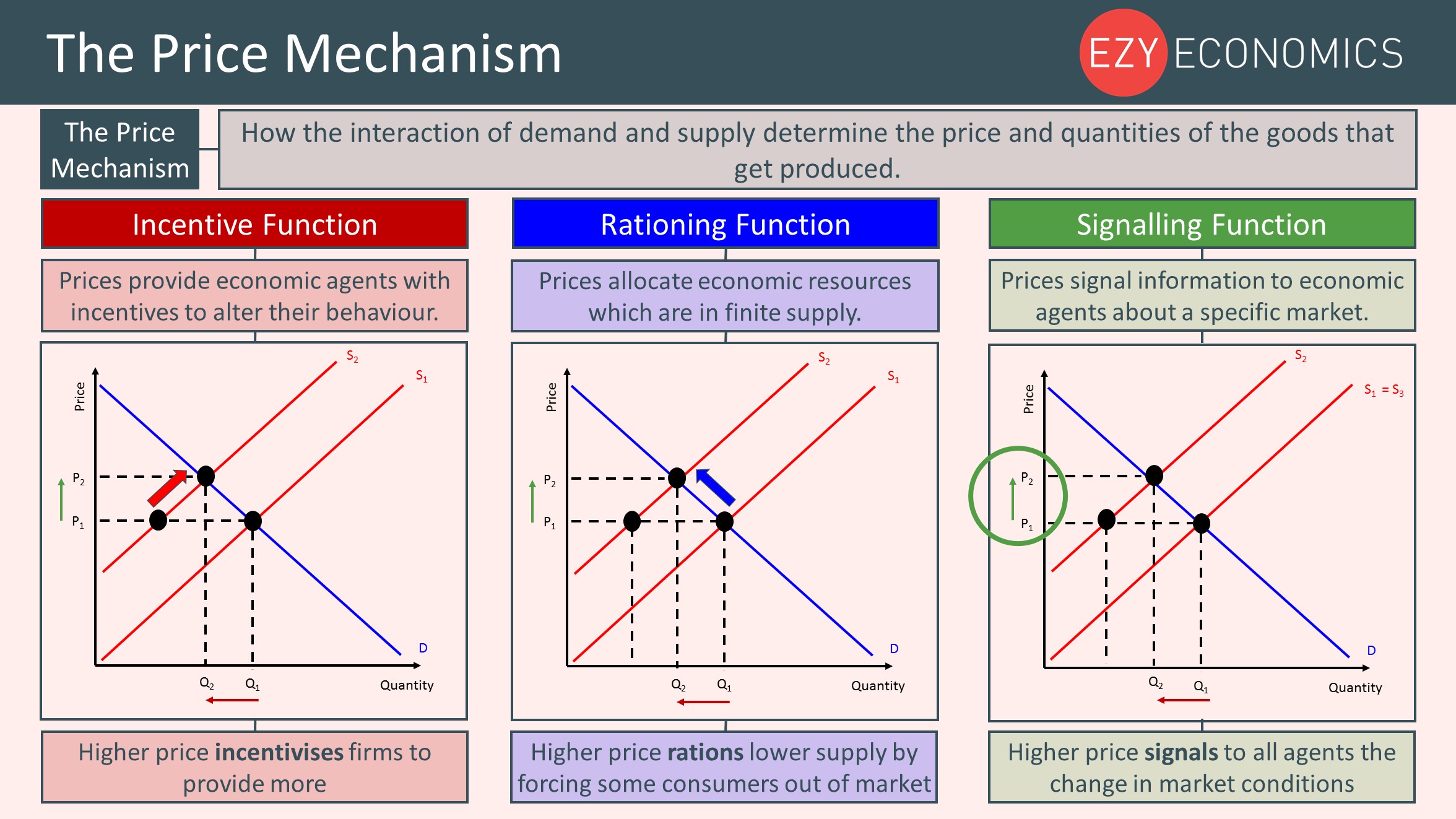
The price mechanism performs three critical functions simultaneously:
- Signalling Function: Prices provide information to economic agents. A rising price for a product signals to producers that demand is high, suggesting an opportunity for profit. A falling price signals the opposite.
- Incentive Function: Prices create incentives that alter behavior. For producers, the prospect of higher prices and profits incentivizes them to increase supply. For consumers, lower prices incentivize them to buy more.
- Rationing Function: When a good is scarce relative to demand, the price increases. This rations the limited supply to only those who are willing and able to pay that higher price, effectively forcing some consumers out of the market.
This diagram provides a powerful visual summary of how these functions operate within the familiar supply and demand framework.
So, how does this mechanism answer the three fundamental economic questions?
- What to produce? The collective "votes" of consumers, expressed through their spending, create price signals. Goods with high prices relative to their production cost are profitable, so firms produce them.
- How to produce? Firms are incentivized to find the most efficient (least costly) production methods to maximize their profits. The prices of labor, capital, and raw materials guide these decisions.
- For whom to produce? Goods and services are distributed to those who have the ability and willingness to pay the market price.
The following reading elaborates on the institutional bedrock of a market economy, typically referred to as capitalism.
[PDF] Comparative Economic Systems: - Boston University
This section delves into the defining characteristics of capitalism, the system that most fully embodies the principles of a market economy.
Please read the subsection "Defining Characteristics of Capitalism". Focus on how features like private ownership, capital accumulation, and decentralized decision-making work together to drive resource allocation.
The Command Economy and Central Planning
In a command (or planned) economy, the state owns most of the means of production and a central planning authority makes the key decisions about resource allocation. Instead of relying on the emergent signals of the market, this authority directly answers the three economic questions by issuing directives.
Let's explore the mechanics of this system.
[PDF] UNDERSTANDING PRICE MECHANISM IN A SOCIALIST ECONOMY
This research paper provides an analytical look at how a central planning authority functions.
Please read the section starting from "How a Planned Economy Allocates Resources". This passage explains how the authority decides what to produce based on social preferences, how to produce using cost and output rules, and for whom to produce via rationing and fixed prices.
As you've read, the central authority sets production targets, determines which factories will produce what, and fixes the prices of goods and wages for labor.
The Economic Calculation Problem
This centralized approach faces a profound analytical challenge, famously articulated by economist Ludwig von Mises. He argued that rational economic calculation is impossible in a socialist state. Your background in quantitative analysis will help you appreciate the depth of this problem.
The core issue is the absence of market-determined prices for capital goods (machines, factories, raw materials). In a market system, the price of a tractor or a blast furnace reflects its relative scarcity and its value in competing uses. A firm can use these prices to determine if their production plan is economically viable—that is, if the value of the output is likely to exceed the value of the inputs.
Without these price signals, a central planner is "groping in the dark." They may have technical data on how to produce steel, but they lack the economic information to decide whether the resources used to produce that steel would have been more valuable producing something else.
[PDF] UNDERSTANDING PRICE MECHANISM IN A SOCIALIST ECONOMY
This section explains Mises's argument about the impossibility of rational economic calculation without market prices for the means of production.
Please read the section titled "The Economic Calculation Problem". Focus on why the absence of money prices for production goods makes it impossible for planners to allocate resources efficiently.
This "calculation debate" highlights a fundamental difference between the systems. A market economy processes vast amounts of dispersed information through the price system, an emergent and parallel computation. A command economy attempts to gather and process this information through a centralized, serial bureaucracy, a task that has proven to be insurmountably complex.
Conclusion
In this lesson, we have contrasted the primary mechanisms that different economic systems use to solve the problem of resource allocation. You've seen that the choice is fundamentally between a decentralized system coordinated by prices and a centralized system coordinated by a planning authority.
Key Takeaways:
- Market economies use the price mechanism to allocate resources. Prices act as signals, create incentives, and ration scarce goods. Decisions are decentralized.
- Command economies use a central planning authority to issue direct commands on what to produce, how, and for whom. Decisions are centralized.
- A key analytical challenge for command economies is the economic calculation problem: without market-determined prices for capital goods, rational resource allocation is computationally infeasible.
- All real-world economies are mixed, combining elements of both systems, though they typically have a dominant mechanism.
We've established that prices are the cornerstone of the market-based approach to resource allocation. Logically, our next step is to understand precisely how these prices are determined. In the next lesson, we will begin building the foundational model of supply and demand.