Introduction
Welcome to the first lesson of our module on macroeconomics. In our previous module, we focused on microeconomics, analyzing the behavior of individual firms and consumers and exploring how government intervention can address market failures like pollution. We concluded by seeing how aggregating individual firms' abatement costs is crucial for designing efficient environmental policy. This idea of aggregation is central to macroeconomics, where we shift our focus from individual trees to the entire forest.
Our starting point is the most fundamental measure of an economy's performance: Gross Domestic Product (GDP). GDP represents the total output of an entire nation. In this lesson, you will learn how to calculate this essential metric from given data using three distinct but equivalent methods. Your goal is to master the calculation of GDP using the expenditure, income, and output (value-added) approaches. Your background in statistics will be particularly helpful here, as national income accounting is a large-scale exercise in data aggregation, built on the principle that different measurement methods should converge on the same value.
What is GDP and Why are there Three Ways to Measure It?
Gross Domestic Product (GDP) is formally defined as the market value of all final goods and services produced within a country in a specific period of time. Let's quickly break this down:
- Market value: GDP uses market prices to value production, providing a common unit of measurement (e.g., dollars, pounds).
- Final goods and services: It only includes goods and services sold to the end user. It excludes intermediate goods—those used up in the production of other goods—to avoid double-counting.
- Produced: GDP tracks the value of what's produced, not necessarily what's sold. Unsold goods are counted as inventory investment.
- Within a country: It measures production within a nation's borders, regardless of who owns the factors of production.
- Specific period: GDP is a flow variable, measured over a period like a quarter or a year.
Conceptually, any economic transaction has three facets: someone produces something (output), someone buys it (expenditure), and someone earns money from making it (income). This insight gives us the three complementary ways to calculate GDP:
- The Output (or Value-Added) Approach: Sums the value added at each stage of production.
- The Expenditure Approach: Sums the total spending on final goods and services.
- The Income Approach: Sums the total income generated by production.
Theoretically, these three methods must yield the same result. They are simply different perspectives on the same circular flow of money in an economy.
1. The Output (Value-Added) Approach
The most direct way to avoid the problem of double-counting intermediate goods is to sum the value added by each firm in the economy. Value added is the market value of a firm's output minus the cost of the intermediate goods it purchased to produce that output.
Value Added = Value of Output - Cost of Intermediate Inputs
Imagine the production of a simple pair of jeans.
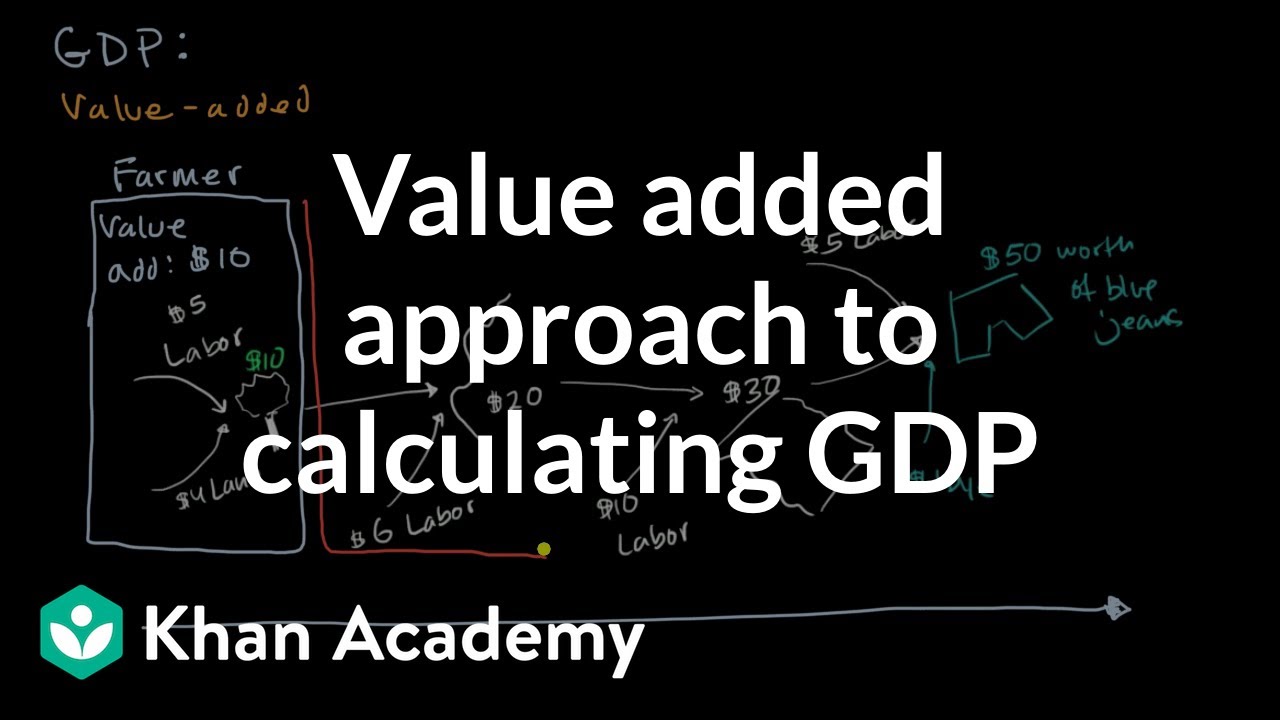
The following video provides an excellent, detailed walkthrough of this method, using the example of producing a cotton shirt. It demonstrates how summing the value added at each stage (farmer, yarn maker, fabric maker, shirt maker) correctly calculates the final value of the shirt, avoiding the error of simply adding up total sales at each stage.
How to Calculate GDP, GNP, NDP, NNP? | Indian Economy - Lecture 3 | UPSC NCERT Free Series
This segment from a lecture by PW OnlyIAS English explains the value-added method with a clear, step-by-step numerical example. This structured approach should align well with your analytical background.
Please watch the section from the beginning of the explanation. Pay close attention to how the value added is calculated for each producer in the chain by subtracting their input costs from their output value. Notice how the sum of the value-added amounts equals the final market price of the shirt.
As the video explains, this method is practically very useful for government statisticians. They don't need to know whether a good is final or intermediate; they just ask each firm for the value of their output and the cost of their inputs, then calculate the value added. Summing this across all firms gives GDP.
2. The Expenditure Approach
This is the most common way GDP is presented and discussed. It categorizes all spending on final goods and services produced in the economy. The formula is a cornerstone of macroeconomics:
Where:
- C: Consumption is spending by households on goods and services.
- I: Gross Private Investment includes spending by firms on new capital (machinery, buildings), changes in inventories, and household purchases of new housing. A key point here is that goods produced but not sold are counted as an increase in inventories, which is part of investment. This ensures that production, not just sales, is measured.
- G: Government Purchases are spending by the government on goods and services (e.g., defense, infrastructure). This excludes transfer payments like pensions or unemployment benefits, as these are not payments for current production.
- (X - M): Net Exports is the value of exports (X) minus the value of imports (M). We add exports because they represent domestic production sold abroad. We subtract imports because, while they are included in C, I, and G, they were not produced domestically.
Let's work through a numerical example. The resource below provides a data table for a fictional economy and asks to calculate GDP using the expenditure approach. This is a typical exam-style problem.
Economics 102 Fall 2017 Answers to Homework #3 Due ...
This document from an Econ 102 course at UW-Madison provides solved problems. We will use Problem 3a to practice the expenditure approach.
Focus on Problem 3a. First, identify which items in the table correspond to C, I, G, and (X-M). Then, follow the calculation to see how they are summed to arrive at GDP. Notice which items (like Transfer Payments) are correctly excluded.
As you can see from the example, the calculation is straightforward once you correctly identify the components:
- Household Consumption (C) = $304
- Government Purchases (G) = $156
- Gross Private Investment (I) = $124
- Net Exports (X - M) = $18
- GDP = 304 + 156 + 124 + 18 = $602
3. The Income Approach
The third approach confirms that every dollar of expenditure is also a dollar of income for someone in the economy. This method sums all the incomes generated in the production process. The main components are the factor payments:
Where:
- Wages: Compensation paid to employees.
- Profits: The income of corporations and unincorporated businesses (proprietors).
- Interest: Net interest paid by businesses to households.
- Rent: Income earned from property.
In formal national accounts, adjustments are made for things like depreciation and taxes, but for our purposes, this factor payment formula is the key. Let's use the same dataset from the previous example to calculate GDP using the income approach.
Economics 102 Fall 2017 Answers to Homework #3 Due ...
We will now look at Problem 3b from the same document, which uses the same data to demonstrate the income approach.
Read through the solution for Problem 3b. Identify the data corresponding to Wages, Interest, Rent, and Profits. Verify that summing these components yields the exact same GDP value as the expenditure approach.
The calculation from the resource confirms the equivalence:
- Wages (W) = $67
- Rental Income (R) = $75
- Interest Income (i) = $186
- Business Profits (PR) = $274
- GDP = 67 + 75 + 186 + 274 = $602
The fact that both methods yield $602 reinforces the fundamental accounting identity of macroeconomics.
A Unified Example: Bringing All Three Approaches Together
To see how all three methods work in concert, let's watch a video that walks through a single example from start to finish. It models the production of a baseball bat and calculates its contribution to GDP using the value-added, expenditure, and income approaches, demonstrating that they all result in the same final number.
How to Calculate GDP (Updated 2025): Expenditure, Income & Value-Added Approaches
This video by Econbusters provides a concise and complete example integrating all three GDP calculation methods.
Watch the video from the beginning until the end of the numerical example. First, follow the Value-Added approach (Value Added) where the value added at each stage (lumberjack, mill, manufacturer, retailer) is calculated and summed. Notice how the final sale price of $80 represents the Expenditure approach (Expenditure). Finally, observe how the value added at each stage is broken down into factor incomes (wages, rent, interest, profit) and summed to demonstrate the Income approach (Income).
This unified example should solidify your understanding of how these three different lenses all capture the same underlying economic value.
Conclusion
In this lesson, we have moved into the realm of macroeconomics by defining and measuring Gross Domestic Product, the primary indicator of a nation's economic output. You have learned that what is produced (output) is equal to what is bought (expenditure), which is equal to what is earned (income).
Key Takeaways:
- GDP is the market value of all final goods and services produced within a country in a given period.
- There are three equivalent methods for calculating GDP:
- Value-Added Approach: Sum the value added (Output Value - Intermediate Input Costs) at every stage of production. This avoids double-counting.
- Expenditure Approach: Sum all spending on final goods and services: .
- Income Approach: Sum all income generated from production: .
- Given a dataset, you can now apply these three methods to calculate GDP and should arrive at the same figure regardless of the method used.
Our calculation of GDP so far has been in terms of current market prices, which is known as nominal GDP. However, to compare output across different years, we need to account for changes in the price level (inflation). In our next lesson, we will learn how to adjust nominal GDP to calculate real GDP and how to compute price indices like the GDP deflator, putting your statistical skills to further use.